CEFR Levels Explained: A2, B1, B2, C1, C2 and What Each Means for You
What do CEFR levels A2, B1, B2, C1, and C2 actually mean? This guide explains each level in plain English with skills, grammar, and next steps.
What Are CEFR Levels?
The Common European Framework of Reference for Languages (CEFR) is the international standard for describing language ability. It divides learners into six levels: A1, A2, B1, B2, C1, and C2, based on what you can actually do with a language, not just what you know about it.
Whether you are taking IELTS, applying for a job, or just trying to understand where you stand, CEFR levels give you a clear, consistent measure that universities, employers, and language schools recognise worldwide.
Quick answer: CEFR levels run from A1 (complete beginner) to C2 (mastery). Most working adults need B2 for professional contexts; B1 is the typical threshold for basic workplace communication. Each level doubles roughly the grammar and vocabulary required.
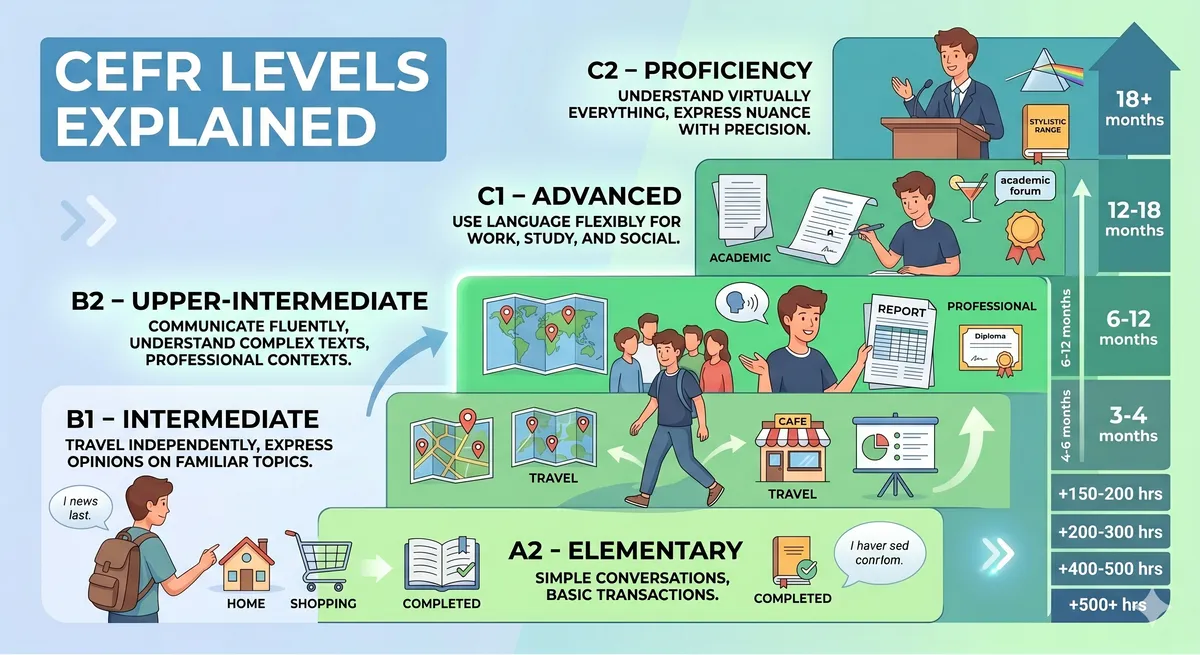
The Six CEFR Levels at a Glance
| Level | Name | What You Can Do |
|---|---|---|
| A1 | Beginner | Introduce yourself; understand very simple phrases |
| A2 | Elementary | Describe your immediate environment; handle basic transactions |
| B1 | Intermediate | Travel independently; express opinions on familiar topics |
| B2 | Upper-Intermediate | Understand complex texts; communicate fluently with native speakers |
| C1 | Advanced | Use language flexibly for work, study, and social purposes |
| C2 | Proficiency | Understand virtually everything; express nuance with precision |
The jump from one level to the next is not equal. Moving from A2 to B1 takes roughly 200–300 hours of guided study; moving from C1 to C2 can take 200+ hours because the gains become increasingly subtle.
A2: Elementary English
What A2 looks like in practice:
- You can understand sentences about everyday topics: shopping, family, local geography, employment
- You can communicate in simple, routine tasks that require direct exchanges
- You can describe your background and immediate environment in simple terms
Grammar at A2:
- Present simple and continuous
- Past simple (regular and common irregular verbs)
- Basic modal verbs: can, can't, must, should
- Articles: a / an / the
- Simple comparatives: bigger, more expensive
Vocabulary: Around 1,000–1,500 words (high-frequency everyday terms)
Common exams at A2: Cambridge A2 Key (KET), IELTS Band 2–3 equivalent
Your next step: Focus on past tenses, present perfect, and expanding everyday vocabulary. Regular practice with short listening and reading tasks builds the foundation for B1. For a fuller picture, including the can-do checklist and the grammar gap that holds learners back from B1, see what A2 (Elementary) English looks like in practice.
B1: Intermediate English
What B1 looks like in practice:
- You can deal with most situations that arise when travelling in an English-speaking country
- You can write simple connected text on familiar or personal topics
- You can describe experiences, events, dreams, and ambitions with basic justification
Grammar at B1:
- Present perfect vs past simple, and knowing when to use each (see our dedicated guide)
- First and second conditionals
- Passive voice (basic)
- Modal verbs for deduction: must be, might, could
- Reported speech (basic)
Vocabulary: Around 2,500–3,000 words
Common exams at B1: Cambridge B1 Preliminary (PET), IELTS Band 4–5 equivalent, TOEIC 550–780
Your next step: The B1→B2 transition is where most learners spend the most time. Focus on perfect tenses, complex conditionals, and reading longer texts; opinion articles and news stories work well. For the full B1 picture, see What Is B1 English Level?.
B2: Upper-Intermediate English
What B2 looks like in practice:
- You can understand the main ideas of complex text on both concrete and abstract topics
- You can interact with a degree of fluency and spontaneity that makes regular interaction with native speakers comfortable
- You can produce clear, detailed text on a wide range of subjects and explain a viewpoint, giving advantages and disadvantages
Grammar at B2:
- Present perfect continuous vs present perfect simple
- Third conditional and mixed conditionals
- Passive voice (advanced, including get-passive)
- Modal perfects: must have been, should have done
- Emphasis with inversion: Rarely have I seen…
- Gerunds and infinitives with subtle meaning differences
Vocabulary: Around 4,000–5,000 words, including academic and professional registers
Common exams at B2: Cambridge B2 First (FCE), IELTS Band 5.5–6.5, TOEIC 785+, TOEFL iBT 72–94
B2 is the most-searched CEFR level, and for good reason. It is the minimum requirement for most international universities and many multinational employers. It signals that you can work or study effectively in English without constant support.
C1: Advanced English
What C1 looks like in practice:
- You can understand a wide range of demanding, longer texts and recognise implicit meaning
- You can use language flexibly and effectively for social, academic, and professional purposes
- You can produce clear, well-structured, detailed text on complex subjects, showing controlled use of organisational patterns and connectors
Grammar at C1:
- All conditional structures, including implied conditionals without if: Were I to leave early, I would miss the meeting.
- Cleft sentences: It was the manager who made the decision.
- Advanced passives and nominalisations
- Subjunctive mood: I suggest that he be informed.
- Sophisticated discourse markers: Notwithstanding, by virtue of, in light of
Vocabulary: 8,000–10,000 words, including idiomatic and academic language
Common exams at C1: Cambridge C1 Advanced (CAE), IELTS Band 7–8, TOEFL iBT 95–120
For the full picture of what C1 (Advanced) English looks like in practice, covering grammar, vocabulary, and exam mapping, see the dedicated guide.
C2: Proficiency
What C2 looks like in practice:
- You can understand everything you hear or read with ease
- You can summarise information from different spoken and written sources, reconstructing arguments and accounts coherently
- You can express yourself spontaneously, very fluently and precisely, differentiating finer shades of meaning in complex situations
Grammar at C2: No new structural patterns; the focus shifts to precision, register control, and stylistic range. A C2 speaker knows when to break a rule for rhetorical effect.
Vocabulary: 12,000–20,000 words (approaching native speaker range)
Common exams at C2: Cambridge C2 Proficiency (CPE), IELTS Band 8.5–9
Important note: Most non-native English speakers never reach C2, and they don't need to. C1 is more than enough for the most demanding professional and academic roles.
How Long Does Each Level Take?
These estimates assume 1–2 hours of focused study per day:
| From | To | Hours of Study | Approximate Time |
|---|---|---|---|
| A1 | A2 | 150–200 hours | 3–4 months |
| A2 | B1 | 200–300 hours | 4–6 months |
| B1 | B2 | 300–400 hours | 6–12 months |
| B2 | C1 | 400–500 hours | 12–18 months |
| C1 | C2 | 500+ hours | 18+ months |
The key variable is quality of practice, not raw hours. Passive exposure (listening to English music or watching TV with subtitles) builds intuition slowly. Active practice (doing grammar exercises, writing with feedback, speaking with correction) is 3–5× more efficient.
Which Level Do You Need?
| Goal | Recommended Level |
|---|---|
| Travel and basic work communication | B1 |
| International business, most universities | B2 |
| Competitive universities (Oxford, Cambridge, Ivy League) | C1 |
| Working as a translator or academic researcher | C1–C2 |
| Teaching English as a second language | C1 minimum |
Common Mistakes About CEFR Levels
Mistake 1: Thinking one skill covers all skills
Your reading level and your speaking level are almost always different. Many learners read at B2 but speak at B1. CEFR describes your integrated ability, so be honest about your weakest skill.
Mistake 2: Assuming an exam score equals a CEFR level in real life
An IELTS 6.0 gives you B2 on paper. That doesn't mean you can read a legal contract or write a business proposal without difficulty. Exam preparation and real-world fluency require different practice habits.
Mistake 3: Plateauing at B1
The B1 plateau is real. Grammar becomes harder to memorise; vocabulary gaps are less obvious. The solution: move from studied input to authentic input: news articles, podcasts, professional email writing.
Practice Exercise
Match each sentence to the CEFR level of the grammar it contains:
- She has been working here since January. → ___
- Had I known earlier, I would have told you. → ___
- I go to school every day. → ___
- The report must have been submitted yesterday. → ___
- She finished work at 6 p.m. last Friday. → ___
Answers: 1. B1 (present perfect + since) | 2. C1 (third conditional inverted) | 3. A2 (present simple) | 4. B2 (modal perfect passive) | 5. A2/B1 (past simple + time phrase)
Practice Grammar at Your Level
Every CEFR level has a matching set of free exercises on EngQuiz Pro, with no sign-up required. Start with the level you identified above, get instant feedback, and see a detailed explanation for every answer.
→ Start a free grammar exercise now →
Find your exact level
A general guide is only half of the picture. The practical step is finding which level you are on right now. Two ways to do that, depending on how much time you have:
- 2-minute self-check: read the free CEFR level test guide: a short grammar placement plus the official can-do checklist across reading, writing, listening and speaking.
- 15-minute calibrated test: take our free 30-question CEFR English level test. No sign-up, instant result, personalised study plan based on the gaps it finds.
Then open the level-specific guide that matches your result:
- What is B2 English level?: the most common target for university and work
- B1 → B2 roadmap: the level transition where most learners plateau
- Which exam matches my level: IELTS vs TOEIC vs Cambridge
The full sourcing for our CEFR coverage (corpora, references, and review process) is on the methodology page.
Frequently Asked Questions
IELTS Band 5.5–6.5 corresponds roughly to CEFR B2. A Band 6.0 is generally accepted as the B2 threshold for university entry.
B2 means you can communicate fluently on most everyday and professional topics. However, native speakers may still notice non-native features. True fluency, where your English feels effortless in any context, is C1–C2.
EngQuiz Pro offers a free self-assessment. Start practising at the level that feels challenging but not impossible, and use the results to guide your focus.
Yes. Millions of people reach C1 and C2 without ever living abroad. Consistent, high-quality practice with authentic materials, plus feedback on your output, is what matters, not geography.
Common European Framework of Reference for Languages. It was developed by the Council of Europe and is now used worldwide, not just in Europe.
New Articles
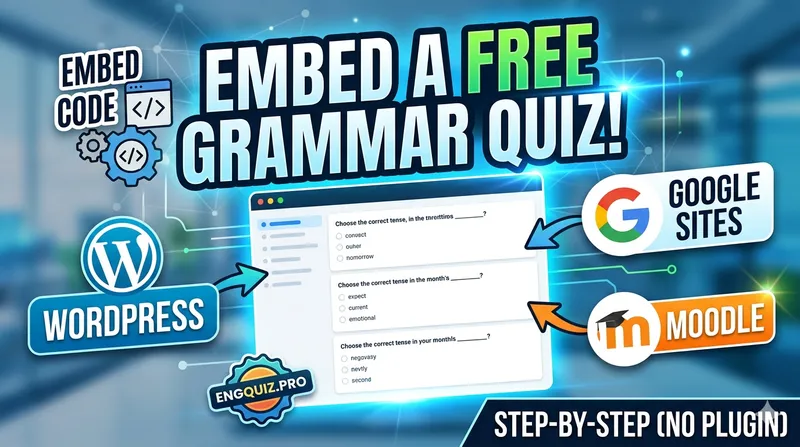
How to Embed a Free English Grammar Quiz on Your Website (WordPress, Google Sites, Moodle)
Step-by-step instructions for adding a free, interactive English grammar quiz to WordPress, Google Sites, Moodle, or any page that accepts HTML. No plugin, no sign-up, no ads.
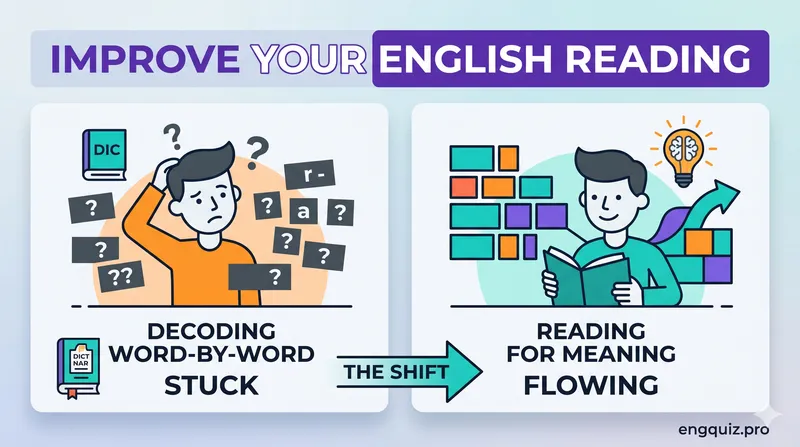
How to Improve English Reading and Actually Understand It
Why the level of the text you choose matters more than the hours you put in, and five exercises that build reading comprehension.
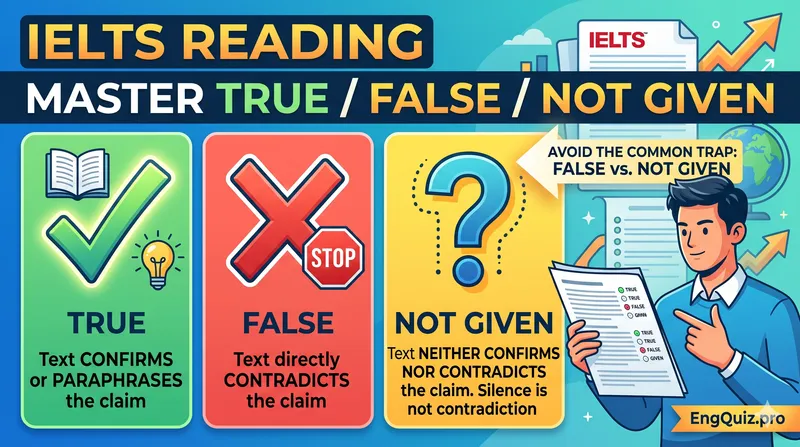
IELTS Reading: How to Master True/False/Not Given
True/False/Not Given is the most-failed IELTS Reading task. Learn the one rule that fixes it, and practise free on real B2/C1 passages with instant feedback.
Related Articles
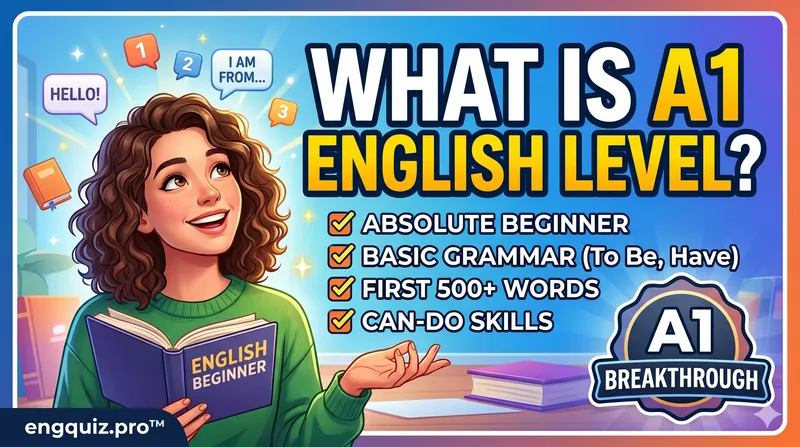
What Is A1 English Level? Skills, Grammar & First Words
A1 is absolute beginner English at the start of the CEFR scale. Learn what A1 means, the first grammar and words, and how long it takes to reach A2.
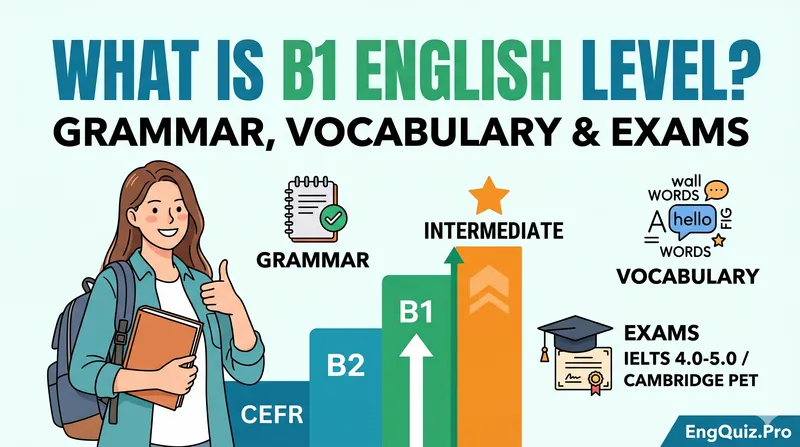
What Is B1 English Level? Grammar, Vocabulary & Exams
B1 is intermediate English: the level where you stop surviving and start communicating. Learn B1 grammar, vocabulary, exam scores, and how to reach it.
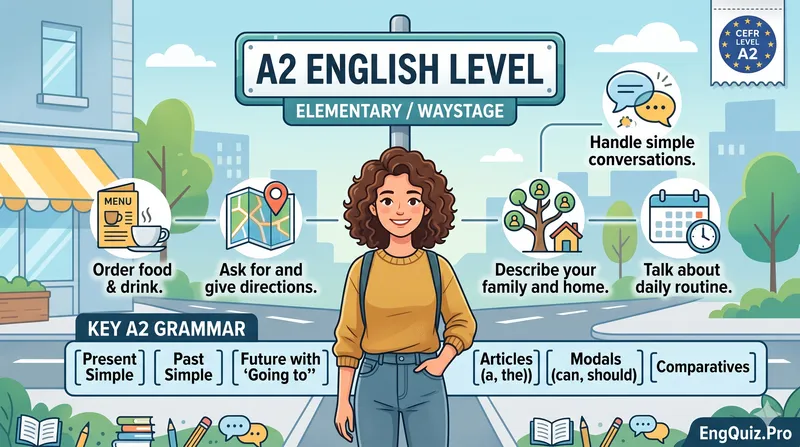
What Is A2 English Level? Grammar, Vocabulary & Exams
A2 is the elementary CEFR level: survival English for everyday situations. Learn A2 grammar, vocabulary, exam scores, and how long it takes to reach it.