Much vs Many: Rules, Examples and Common Mistakes
Much vs many is one of the most common A2 grammar questions. Learn the rule in 60 seconds, see real examples, and test yourself with a quick exercise.
Introduction
Much or many? Learners ask this question every day, and the answer is simpler than most grammar rules in English.
Once you understand the difference between countable and uncountable nouns, the rule becomes automatic. This guide explains it in plain terms, shows you when the rule has exceptions, and gives you a practice exercise to lock it in.
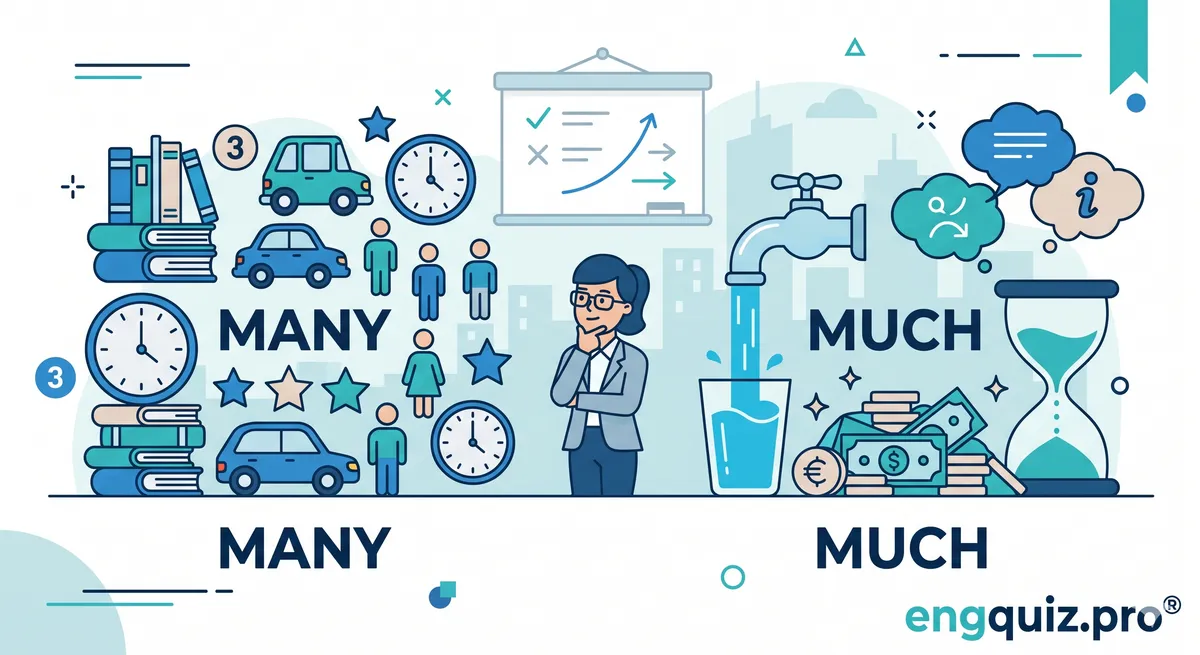
Quick answer: Use many with countable nouns (things you can count: books, people, hours). Use much with uncountable nouns (things you cannot count individually: water, money, time). Both are used mainly in negative sentences and questions; in positive sentences, use a lot of instead.
The Core Rule
| Word | Use with | Example |
|---|---|---|
| many | countable nouns (plural) | How many students are in the class? |
| much | uncountable nouns (singular) | How much water do you drink per day? |
The simplest test: can you put a number in front of the noun?
- three books → you can count books → books is countable → use many
- three waters → this sounds strange → water is uncountable → use much
Countable vs Uncountable Nouns
Understanding much and many starts with understanding noun types.
Countable nouns: use many
Countable nouns have both a singular and plural form:
| Singular | Plural | Use |
|---|---|---|
| a book | books | many books |
| a car | cars | many cars |
| an hour | hours | many hours |
| a problem | problems | many problems |
| a person | people | many people |
Uncountable nouns: use much
Uncountable nouns have only one form (no plural):
| Noun | Category | Use |
|---|---|---|
| water | liquid | much water |
| money | abstract | much money |
| time | abstract | much time |
| information | abstract | much information |
| advice | abstract | much advice |
| furniture | collective | much furniture |
| traffic | collective | much traffic |
| weather | abstract | much weather |
| progress | abstract | much progress |
Important: Some nouns can be both countable and uncountable, with different meanings:
- I had an experience that changed my life. (one specific event, countable)
- I have a lot of experience in marketing. (general expertise, uncountable)
When to Use Much vs Many
Both much and many appear mostly in questions and negative sentences. In positive sentences, they sound formal; a lot of is more natural.
Questions
- How many people came to the event?
- How much time do you have?
- Are there many options?
- Is there much difference?
Negative sentences
- I don't have many friends in this city.
- There isn't much sugar left in the jar.
- We didn't see many changes after the update.
- She hasn't had much luck with the application.
Positive sentences: prefer a lot of
In affirmative sentences, much and many sound formal or emphatic. Use a lot of in everyday speech:
| Formal / emphatic | Everyday |
|---|---|
| Many people attended. | A lot of people came. |
| Much has changed. | A lot has changed. |
| I have much to do. | I have a lot to do. |
Much alone in a positive sentence is rare in everyday speech. Many in a positive sentence sounds formal but is more common than much:
- Many students passed. ✓ (slightly formal, but correct)
- Much water was wasted. ✓ (formal, usually a written style)
Special Cases
Too much / too many
Too intensifies the negative meaning:
- There are too many meetings this week. (more meetings than desired)
- I ate too much cake. (more cake than I should have)
So much / so many
So expresses degree or emphasis:
- She has so many ideas; it's hard to choose.
- We wasted so much time.
As much as / as many as
Used in comparisons:
- I don't have as much money as she does.
- He reads as many books as his brother.
Much + comparative adjective
Much is also used to intensify comparatives, nothing to do with nouns:
- This is much better than I expected.
- She speaks English much more fluently now.
Common Mistakes
Mistake 1: Using "much" with a countable noun
There are much students in the library.
Why it's wrong: "Students" is countable (one student, two students…).
✓ There are many students in the library.
Mistake 2: Using "many" with an uncountable noun
I don't have many information about this.
Why it's wrong: "Information" is uncountable; it has no plural form in English.
✓ I don't have much information about this.
Mistake 3: Using "much" in a casual positive sentence
I have much work to do today.
Why it's wrong: Not grammatically wrong, but it sounds formal/literary in a casual context.
✓ I have a lot of work to do today.
Mistake 4: Treating "money" as countable
How many money did you spend?
Why it's wrong: "Money" is uncountable. You count the units (dollars, pounds, euros), not money itself.
✓ How much money did you spend?
Mistake 5: Confusing "news" with a plural
There are many news today.
Why it's wrong: "News" looks plural but is uncountable (always singular in English).
✓ There is much news today. / ✓ There is a lot of news today.
Quick Reference
| Use | much | many | a lot of |
|---|---|---|---|
| Questions | How much time? | How many people? | Do you have a lot of...? |
| Negatives | Not much money | Not many friends | Not a lot of... |
| Positives | Much progress (formal) | Many students (semi-formal) | A lot of work (everyday) |
| With "too" | Too much noise | Too many cars | – |
| With "so" | So much to learn | So many options | – |
Practice Exercise
Choose much or many:
- How ___ sugar do you take in your coffee?
- There aren't ___ seats left, book quickly.
- She doesn't have ___ experience in sales.
- How ___ times have you been to Japan?
- I don't have ___ luggage, just one bag.
Answers: 1. much | 2. many | 3. much | 4. many | 5. much
Practise Much vs Many Now
EngQuiz Pro has free A2 exercises that drill much/many alongside other quantifiers (some, any, a few, a little). One short exercise beats ten minutes of re-reading the rule.
→ Start a free A2 grammar exercise →
How much and many are tested on exams
Cambridge B1 Preliminary and B2 First both test these quantifiers, usually in the Use of English sentence transformation and open-cloze tasks. TOEIC Part 5 tests them inside business contexts (how much budget, how many candidates). IELTS Writing Task 1 (data description) requires accurate use because describing trends and totals leans heavily on quantifiers.
The two highest-scoring habits for exam candidates: (1) check whether the noun is countable before writing the quantifier, not after; (2) prefer many and much in formal exam writing; a lot of is correct but examiners reward register variety, and a lot of clusters in low-band scripts. Save a lot of for spoken English and informal writing.
If a noun feels ambiguous (e.g. advice: is that one piece or many?), most are uncountable: advice, information, news, knowledge, equipment, furniture, luggage, traffic, weather, money all take much. The Cambridge Dictionary reference on much/many lists the full set worth memorising before any exam.
Frequently Asked Questions
In positive sentences, yes: a lot of works with both countable and uncountable nouns and sounds natural in everyday speech. In negative sentences and questions, much and many are more natural: not many people, how much time.
A few = a small number (countable): a few books, a few minutes. A little = a small amount (uncountable): a little water, a little patience. These are positive quantifiers; they mean "some, but not a lot", not zero.
Yes, in formal written English: Much has been said about this topic. And with comparatives: much better, much faster. But in everyday spoken English, a lot of or lots of is more natural in positive statements.
Few (without a) means "almost none" and has a negative connotation: Few people understand this rule. (almost nobody). A few means "some": A few people came to the meeting. (some, enough).
New Articles

How to Embed a Free English Grammar Quiz on Your Website (WordPress, Google Sites, Moodle)
Step-by-step instructions for adding a free, interactive English grammar quiz to WordPress, Google Sites, Moodle, or any page that accepts HTML. No plugin, no sign-up, no ads.
How to Improve English Reading and Actually Understand It
Why the level of the text you choose matters more than the hours you put in, and five exercises that build reading comprehension.
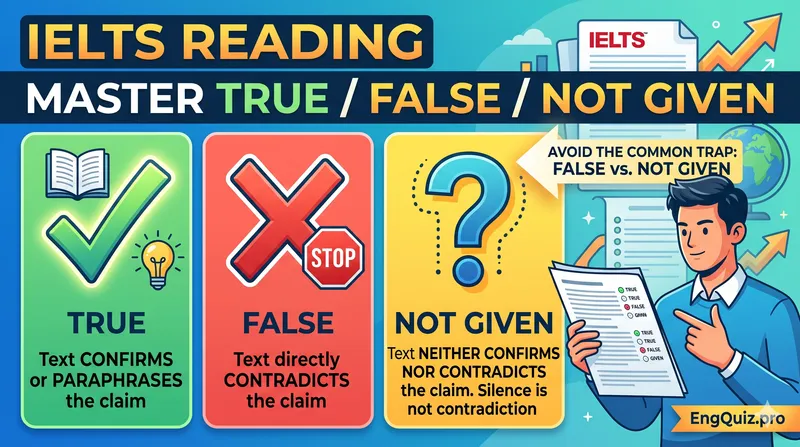
IELTS Reading: How to Master True/False/Not Given
True/False/Not Given is the most-failed IELTS Reading task. Learn the one rule that fixes it, and practise free on real B2/C1 passages with instant feedback.
Related Articles
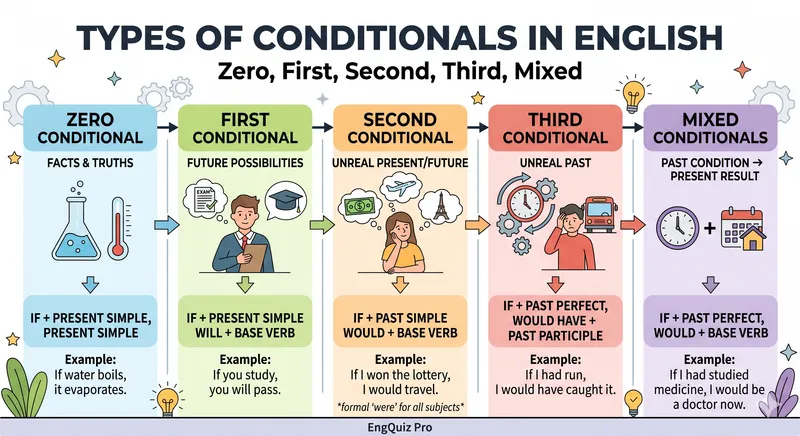
Types of Conditionals in English: Zero, First, Second, Third and Mixed
The 5 types of conditional sentences explained with formulas, examples and common mistakes: zero, first, second, third and mixed conditionals.
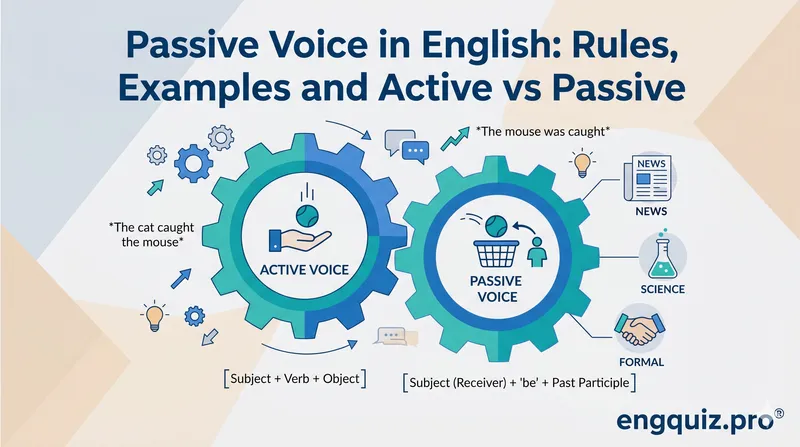
Passive Voice in English: Rules, Examples and Active vs Passive
The passive puts the receiver of an action first: "The letter was written." Learn to form it in every tense, when to use it, and 5 common mistakes.
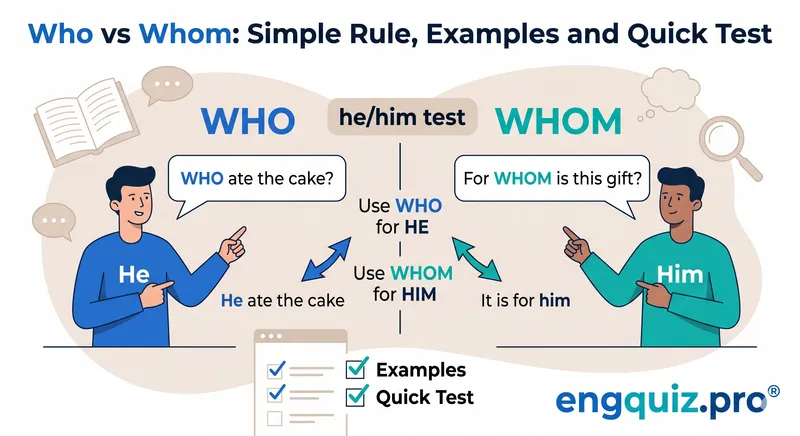
Who vs Whom: Simple Rule, Examples and Quick Test
Confused by who vs whom? Use the he/him test: if he fits, use who; if him fits, use whom. Examples, common mistakes and a 5-question quiz inside.