Present Perfect vs Past Simple: When to Use Each
Confused about when to use present perfect or past simple? This guide explains the difference with clear rules, examples, and a quick-reference table.
Introduction
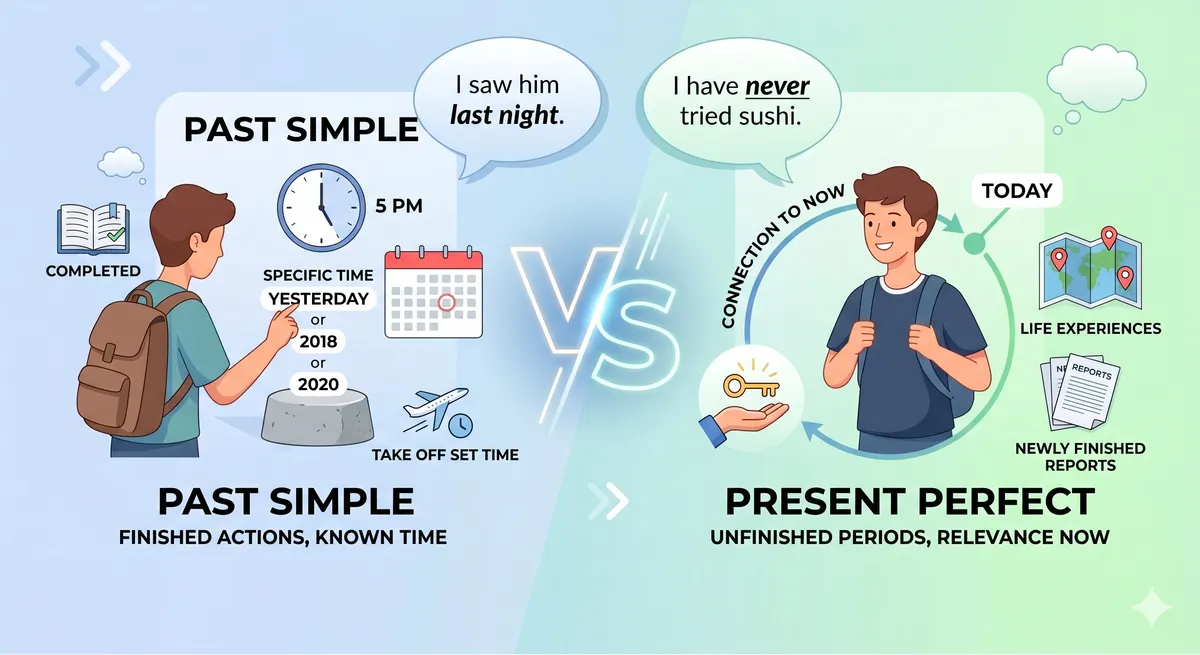
Two of the most commonly confused tenses in English are the present perfect and the past simple. Both talk about things that happened in the past, but they focus on different things, and choosing the wrong one is one of the most common mistakes that B1 learners make.
This guide gives you clear rules, real examples, and a quick-reference table so you can always choose the right tense.
Quick answer: Use past simple when the time is finished and you know when it happened (yesterday, last year, in 2018). Use present perfect when the action connects to the present, where the time is unknown, recent, or still open. The fastest test: if you can name a specific past time, use past simple.
The Core Difference
| Tense | Focus | Example |
|---|---|---|
| Past simple | A finished action at a specific time | I saw that film last night. |
| Present perfect | A past action connected to the present | I have seen that film. (relevance now) |
The key question to ask yourself is: does the time matter?
- If you know when it happened → use past simple
- If the time is unknown or unimportant → use present perfect
When to Use the Past Simple
Use the past simple for actions that are completely finished and happened at a specific time in the past.
Specific time expressions
Use past simple with: yesterday, last week, in 2020, three days ago, when I was young
Examples:
- She left the office at 5 p.m.
- We met in 2018.
- Did you call him yesterday?
Finished time periods
If the time period is clearly over, use past simple:
- I lived in Paris for two years. (I no longer live there.)
- She worked at the bank until 2022.
Narrative sequences
When telling a story about the past, use past simple for the sequence of events:
- He walked in, sat down, and ordered coffee.
When to Use the Present Perfect
Use the present perfect when there is a connection between a past event and the present moment.
Experience (has it ever happened?)
- Have you ever been to Japan?
- I've tried sushi; it's delicious.
- She has never driven a car.
Recent news or events (when the time is not specified)
- The prime minister has resigned.
- Scientists have discovered a new planet.
Unfinished time periods (still going on)
Use present perfect with: today, this week, this year, so far, recently
- I have drunk three cups of coffee today. (today is not over)
- She has written two reports this week.
Connecting the past to a current result
- I've lost my keys. (I can't find them now; the result matters)
- He's broken his leg. (He can't walk now)
Signal Words: Quick Reference
| Present Perfect | Past Simple |
|---|---|
| ever, never | yesterday |
| already, yet | last week / month / year |
| just | in [year] |
| recently | ago |
| so far | when |
| today, this week, this year | at [specific time] |
| since, for (+ unfinished period) | for (+ finished period) |
Common Mistakes to Avoid
Mistake 1: Using present perfect with a specific time
I have seen him yesterday.
Why it's wrong: "Yesterday" is a specific finished time, so use past simple:
✓ I saw him yesterday.
Mistake 2: Using past simple for an unfinished period
I drank two coffees today.
Why it's wrong: "Today" is still in progress, so use present perfect:
✓ I've drunk two coffees today.
Mistake 3: Using past simple for experiences without a time
Did you ever try sushi?
Why it's wrong: This asks about a lifetime experience with no specific time, so use present perfect:
✓ Have you ever tried sushi?
British English vs American English
One important note: American English uses past simple where British English uses present perfect.
| British English | American English |
|---|---|
| I've just eaten. | I just ate. |
| Did you eat already? | Have you eaten already? |
For Cambridge exams (FCE, CAE, IELTS) and most school English, follow British English conventions.
Quick Reference Table
| Use present perfect when... | Use past simple when... |
|---|---|
| The time is not specified | The time is specified |
| The result matters now | The finished action matters |
| The time period is not over | The time period is clearly over |
| Asking about life experience | Asking about a specific occasion |
| Using: ever, never, just, already, yet | Using: yesterday, ago, last, in [year] |
Practice Exercise
Choose the correct tense:
- I ___ (see / have seen) that film last Friday.
- She ___ (finished / has finished) her homework; she looks relieved.
- ___ (Did you ever try / Have you ever tried) authentic Thai food?
- We ___ (lived / have lived) here since 2019.
- The meeting ___ (started / has started) at 9 a.m. this morning.
Answers: 1. saw | 2. has finished | 3. Have you ever tried | 4. have lived | 5. started (if the meeting is over) / has started (if you're talking about a morning still in progress)
Frequently Asked Questions
No. The present perfect connects a past action to now, so it cannot share a sentence with a finished time expression. I have seen him yesterday is a very common ESL error; the correct form is I saw him yesterday. Use the present perfect with unfinished time (today, this week, this year) and with adverbs like ever, never, just, already, yet.
No: have got (as in I have got a sister) is just an alternative to have meaning "possess". It looks like a present perfect but it is a present-tense possession form. The real present perfect uses have/has + past participle of an action verb: I have got (= I have, possess) vs I have caught the train (a true present perfect with the past participle caught).
Mostly, but American English is more flexible with the past simple where British English would prefer the present perfect, especially with already, yet, and just. Did you eat yet? is normal in American English; Have you eaten yet? is preferred in British English. Both are understood worldwide.
Ask whether the action is connected to the present moment. If the result still matters now (I have lost my keys: I cannot find them now), use the present perfect. If you are describing a finished past event with no link to now (I lost my keys yesterday, and I have them again today), use the past simple. The grammar marks the speaker's perspective, not the absolute timing.
The Cambridge B1 Preliminary and B2 First exams test this contrast heavily in the Reading and Use of English open-cloze and key-word transformation sections. IELTS Writing Task 1 (data description) and Task 2 (essay) penalise it when learners use I have lived in 2019 instead of I lived in 2019 or I have lived since 2019. Practice it in mixed-tense exercises rather than in isolation; the real challenge is choosing between competing forms in context.
The other big one is the future: will vs going to follows the same "what does the speaker want to highlight?" logic as present perfect vs past simple. Both pairs are about speaker perspective rather than absolute timing. Once you internalise that frame, the contrasts become much easier to teach yourself. A related register issue at B1–B2 is choosing when to use the passive voice; passives are common in news reports and academic writing, and they often appear with the same present-perfect structures covered above (The decision has been made).
New Articles

How to Embed a Free English Grammar Quiz on Your Website (WordPress, Google Sites, Moodle)
Step-by-step instructions for adding a free, interactive English grammar quiz to WordPress, Google Sites, Moodle, or any page that accepts HTML. No plugin, no sign-up, no ads.
How to Improve English Reading and Actually Understand It
Why the level of the text you choose matters more than the hours you put in, and five exercises that build reading comprehension.
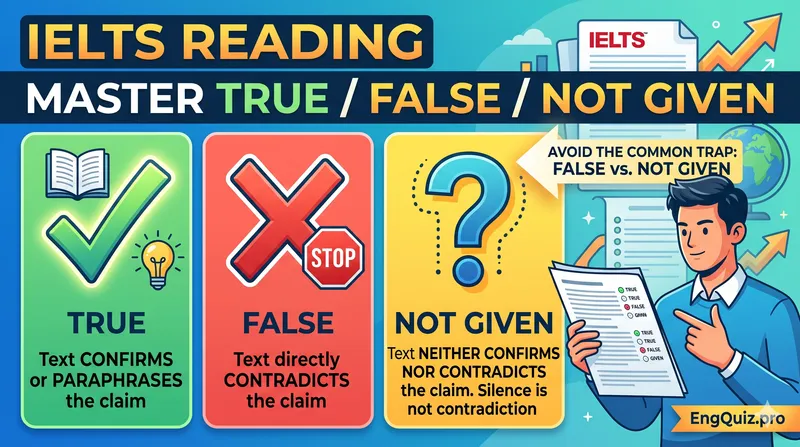
IELTS Reading: How to Master True/False/Not Given
True/False/Not Given is the most-failed IELTS Reading task. Learn the one rule that fixes it, and practise free on real B2/C1 passages with instant feedback.
Related Articles
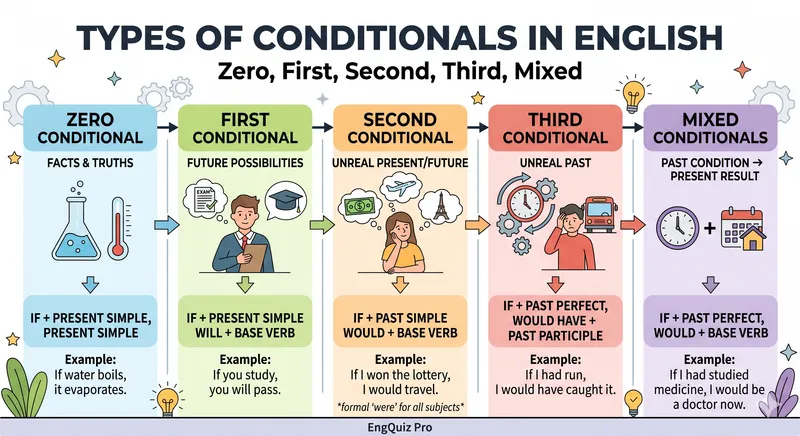
Types of Conditionals in English: Zero, First, Second, Third and Mixed
The 5 types of conditional sentences explained with formulas, examples and common mistakes: zero, first, second, third and mixed conditionals.
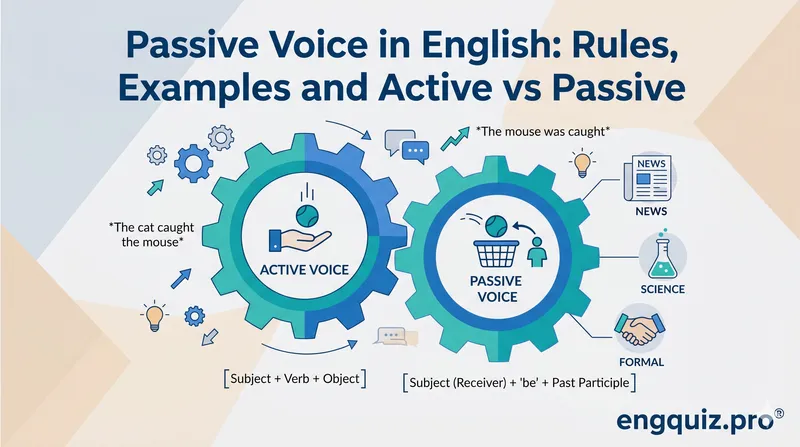
Passive Voice in English: Rules, Examples and Active vs Passive
The passive puts the receiver of an action first: "The letter was written." Learn to form it in every tense, when to use it, and 5 common mistakes.
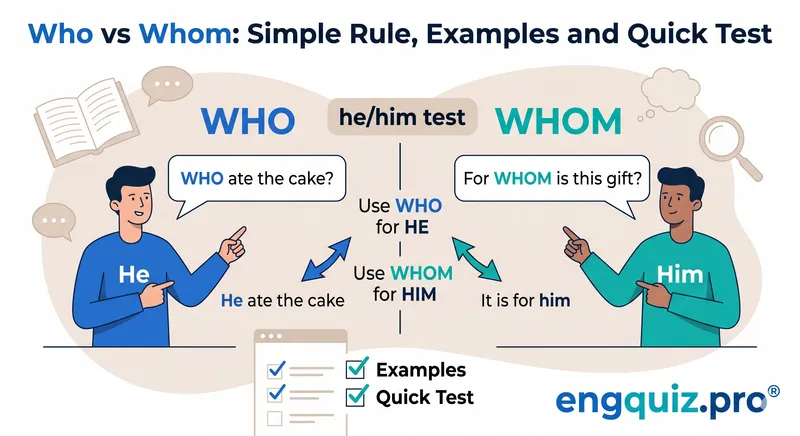
Who vs Whom: Simple Rule, Examples and Quick Test
Confused by who vs whom? Use the he/him test: if he fits, use who; if him fits, use whom. Examples, common mistakes and a 5-question quiz inside.