Since vs For in English: Complete Guide with Examples
When do you use "since" and when do you use "for" in English? Learn the simple rule, see real examples, and test yourself with exercises.
Introduction
"I have lived here for three years." "I have lived here since 2021."
Both sentences are correct, but many English learners mix up since and for every day. The good news: the rule is simple, and once you see it, you will never confuse them again.
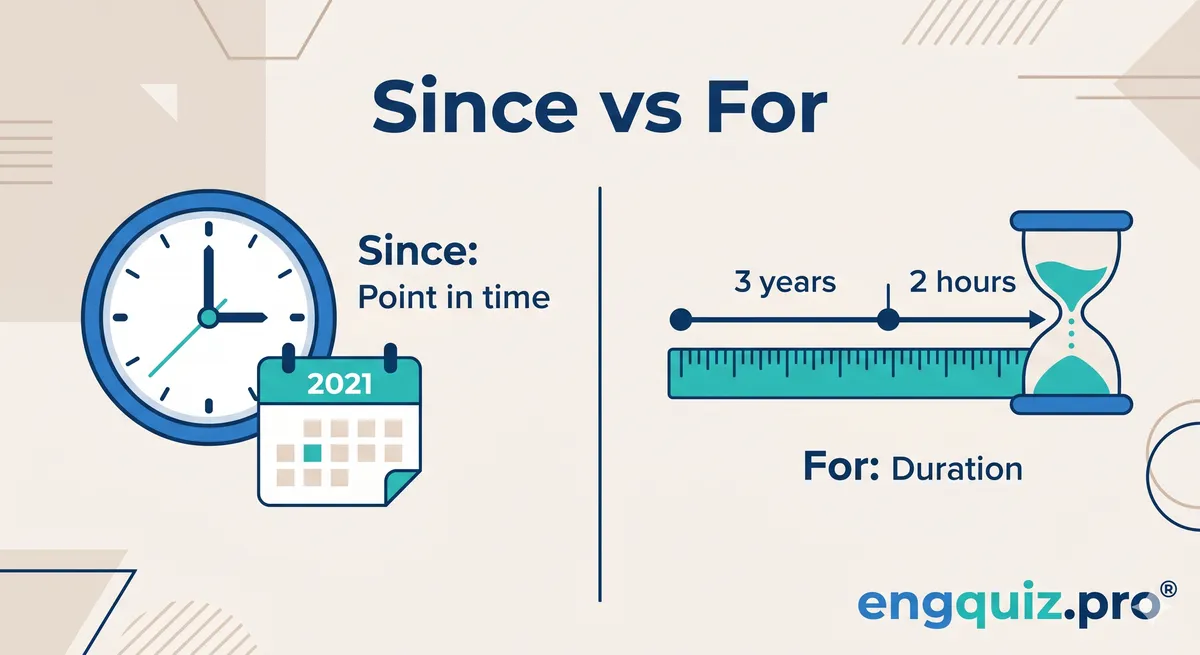
Quick answer: Use for with a duration (a length of time: three years, two hours, a long time). Use since with a starting point (a moment in time: 2021, last Tuesday, I was a child).
The Core Rule
| Word | Follows | Example |
|---|---|---|
| for | a duration: how long something has lasted | for three years, for two weeks, for a long time |
| since | a point in time: when something started | since 2021, since last Tuesday, since she arrived |
The simplest test: can you replace it with "a period of"?
- for three years → a period of three years ✓ → use for
- since 2021 → a period of 2021 ✗ → use since
Since: Starting Points in Time
Since tells us when something started. It always describes a specific moment: a year, a date, an event, or a clause.
With years and dates
- She has worked here since 2019.
- I haven't seen him since last Christmas.
- They have been friends since they met at university.
With a clause (since + subject + verb)
- Since I moved to London, my English has improved a lot.
- She has eaten nothing since she woke up.
- Since the meeting ended, I've answered twenty emails.
Common since time markers
| Time Marker | Example |
|---|---|
| since [year] | since 2018 |
| since [month] | since March |
| since [event] | since the exam, since the lockdown |
| since [clause] | since I started this job |
| since then | We met in 2020. Since then, we've stayed in touch. |
For: Duration of Time
For tells us how long something has lasted. It is always followed by a duration: a number or expression of time.
With specific durations
- I have studied English for five years.
- She waited for an hour.
- We've been colleagues for a long time.
For + all / the whole
- He talked for the whole meeting.
- I've been awake for all night. ✗ → I've been awake all night. ✓ (no for with all night)
Common for time markers
| Duration | Example |
|---|---|
| for [number] years/months/days | for three years |
| for a week / a month | for a week |
| for a long time | for a long time |
| for ages | We haven't spoken for ages. |
| for centuries | Humans have used fire for centuries. |
Since vs For with Different Tenses
Both since and for appear most often with the present perfect tense. But they can also appear in other tenses.
Present perfect (most common)
- I have lived here for ten years.
- I have lived here since 2014.
Past perfect
- By the time she called, I had been waiting for two hours.
- She had not spoken to him since their argument.
The first example uses the past perfect continuous (had been waiting) because for stresses the duration; the second uses the simple past perfect because since points at the starting event.
Present simple (states and facts)
- I know him for a long time. ✗ → use present perfect: I have known him for a long time. ✓
Future
- I will be in London for three days. ✓ (duration, future trip)
- She hasn't been well since Monday. ✓ (past starting point, still true now)
(Choosing will here rather than be going to is a separate B1 decision; see the will vs going to contrast for when each future form fits.)
Common Mistakes
Mistake 1: Using "since" with a duration
I have lived here since three years.
Why it's wrong: "Three years" is a duration, not a starting point.
✓ I have lived here for three years.
Mistake 2: Using "for" with a starting point
I have worked here for 2020.
Why it's wrong: "2020" is a point in time, not a duration.
✓ I have worked here since 2020.
Mistake 3: Using "since" without present perfect
I know her since we were at school.
Why it's wrong: Since used to express an ongoing situation requires a perfect tense.
✓ I have known her since we were at school.
Mistake 4: "Since" with a duration by mistake
Since three hours, I've been waiting.
Why it's wrong: "Three hours" is a duration → use for.
✓ For three hours, I've been waiting.
Special Cases
"It has been [duration] since..."
This structure combines both words correctly:
- It has been three years since we last met.
- It has been a long time since I visited my parents.
"How long have you been...?"
The answer uses for (duration) or since (starting point):
- "How long have you lived here?" → "For five years." / "Since 2019."
"For" in finished actions (past simple, not present perfect)
For can be used with past simple for finished actions:
- She worked there for ten years. (She no longer works there; finished.)
- I waited for an hour. (The waiting is over.)
Since is not used this way; it always implies a connection to the present.
Quick Reference
| for | since | |
|---|---|---|
| Follows | a duration | a point in time |
| Example | for two hours | since 3 p.m. |
| Tense | present perfect, past perfect, past simple, future | present perfect, past perfect |
| Test | can replace with "a period of" | can replace with "starting at" |
Practice Exercise
Fill in the blank with since or for:
- I have known him ___ ten years.
- She has been working here ___ she graduated.
- They haven't called ___ last Monday.
- He lived in Paris ___ two years, then moved to London.
- We have been waiting ___ over an hour.
Answers: 1. for | 2. since | 3. since | 4. for | 5. for
Practise Since vs For Now
The fastest way to stop confusing since and for is deliberate practice immediately after reading this guide. EngQuiz Pro has free B1 present perfect exercises that test exactly this, with instant feedback and rule explanations.
→ Practise Present Perfect with Since & For →
Since vs For on the IELTS, TOEIC and Cambridge Exams
These two prepositions appear in nearly every official English exam, usually in the Use of English / Grammar sections of Cambridge B1 Preliminary, B2 First, and C1 Advanced, in TOEIC Part 5, and in IELTS Writing Task 1 (when describing data over time).
Where examiners catch learners out:
- Past simple with for and since: I worked there for five years is fine when the action is finished. I worked there since 2018 is wrong because since requires a perfect tense to anchor the start point. Examiners watch for this in Cambridge open-cloze and IELTS Writing Task 2.
- Subordinate since clauses: Since I have moved here, I have made many friends is wrong. The since-clause typically takes the past simple to mark the moment: Since I moved here, I have made many friends.
- Numbers with for: for five years, for two days, for a couple of hours. Without for, the phrase often becomes ungrammatical: I lived there five years is acceptable colloquially but penalised in IELTS Writing.
If you are preparing for a Cambridge exam, the British Council reference on how long with for and since is the cleanest single source, and Cambridge B2 First (FCE) past papers test exactly this distinction in the Use of English open-cloze.
Frequently Asked Questions
In most grammar contexts, since used to show an ongoing situation requires a perfect tense. However, in time clauses (since I started this job, my stress has increased), the main clause uses present perfect but the since-clause uses past simple.
Yes. She worked there for five years. (finished action, specific duration) is correct with past simple. The present perfect (She has worked there for five years) implies she still works there.
No. "A long time" is a duration, so use for: for a long time. "Since a long time" is a common learner error.
Since then is a common fixed phrase: We met in 2020. Since then, we've kept in touch. It refers to a point in time already mentioned.
New Articles

How to Embed a Free English Grammar Quiz on Your Website (WordPress, Google Sites, Moodle)
Step-by-step instructions for adding a free, interactive English grammar quiz to WordPress, Google Sites, Moodle, or any page that accepts HTML. No plugin, no sign-up, no ads.
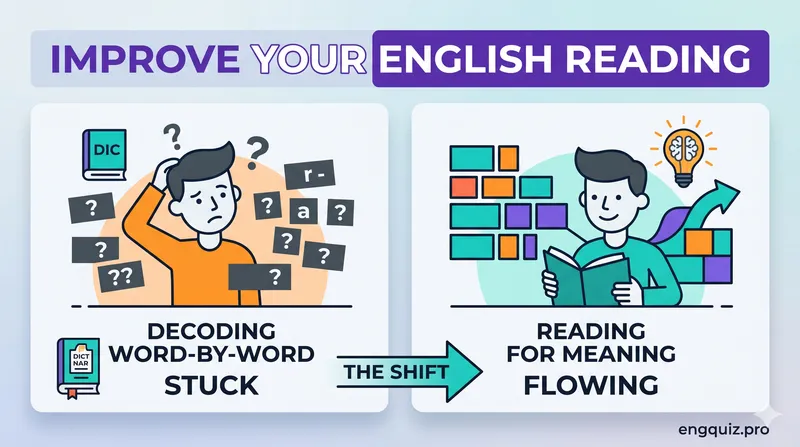
How to Improve English Reading and Actually Understand It
Why the level of the text you choose matters more than the hours you put in, and five exercises that build reading comprehension.
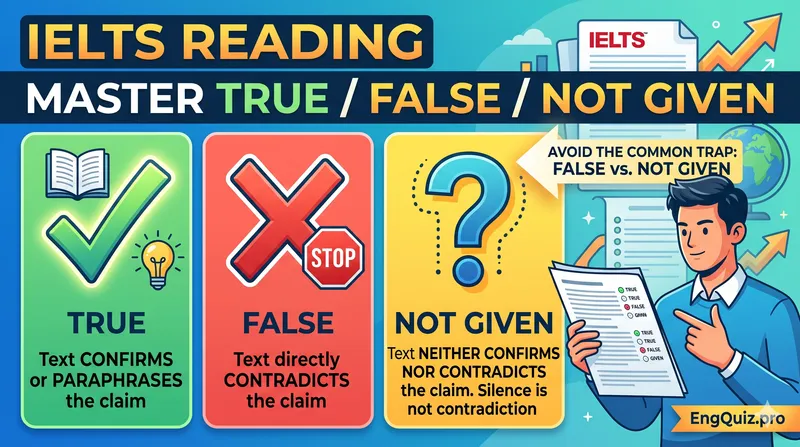
IELTS Reading: How to Master True/False/Not Given
True/False/Not Given is the most-failed IELTS Reading task. Learn the one rule that fixes it, and practise free on real B2/C1 passages with instant feedback.
Related Articles
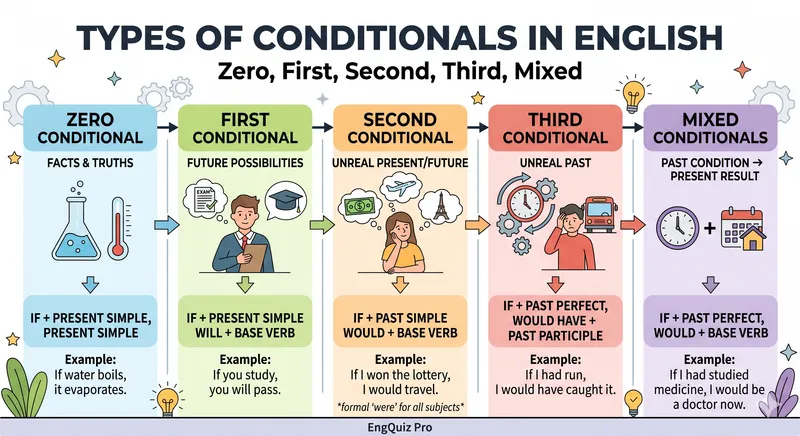
Types of Conditionals in English: Zero, First, Second, Third and Mixed
The 5 types of conditional sentences explained with formulas, examples and common mistakes: zero, first, second, third and mixed conditionals.
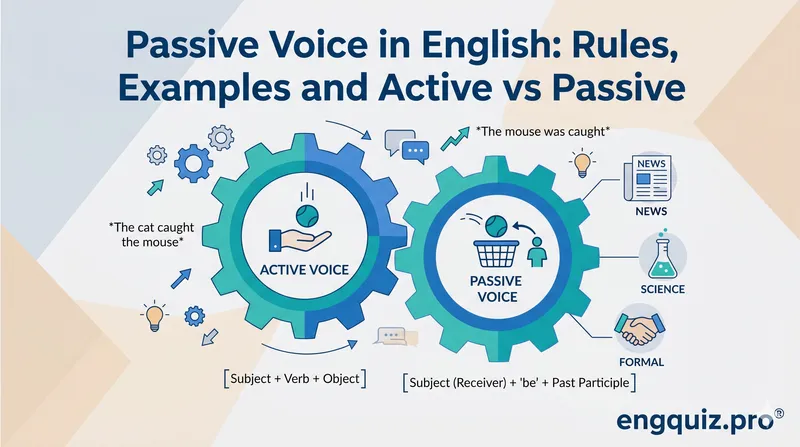
Passive Voice in English: Rules, Examples and Active vs Passive
The passive puts the receiver of an action first: "The letter was written." Learn to form it in every tense, when to use it, and 5 common mistakes.
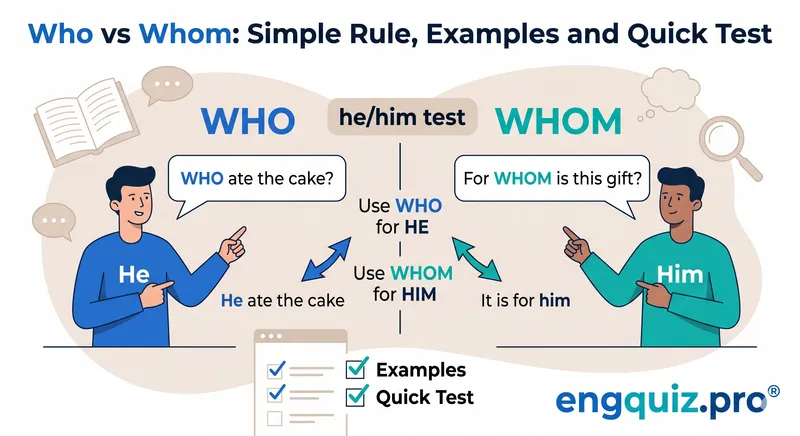
Who vs Whom: Simple Rule, Examples and Quick Test
Confused by who vs whom? Use the he/him test: if he fits, use who; if him fits, use whom. Examples, common mistakes and a 5-question quiz inside.