Gerund vs Infinitive: The Complete Guide (With Rules & Lists)
When do you use a gerund (-ing) and when do you use an infinitive (to + verb)? This complete guide gives you the rules, verb lists, and practice exercises.
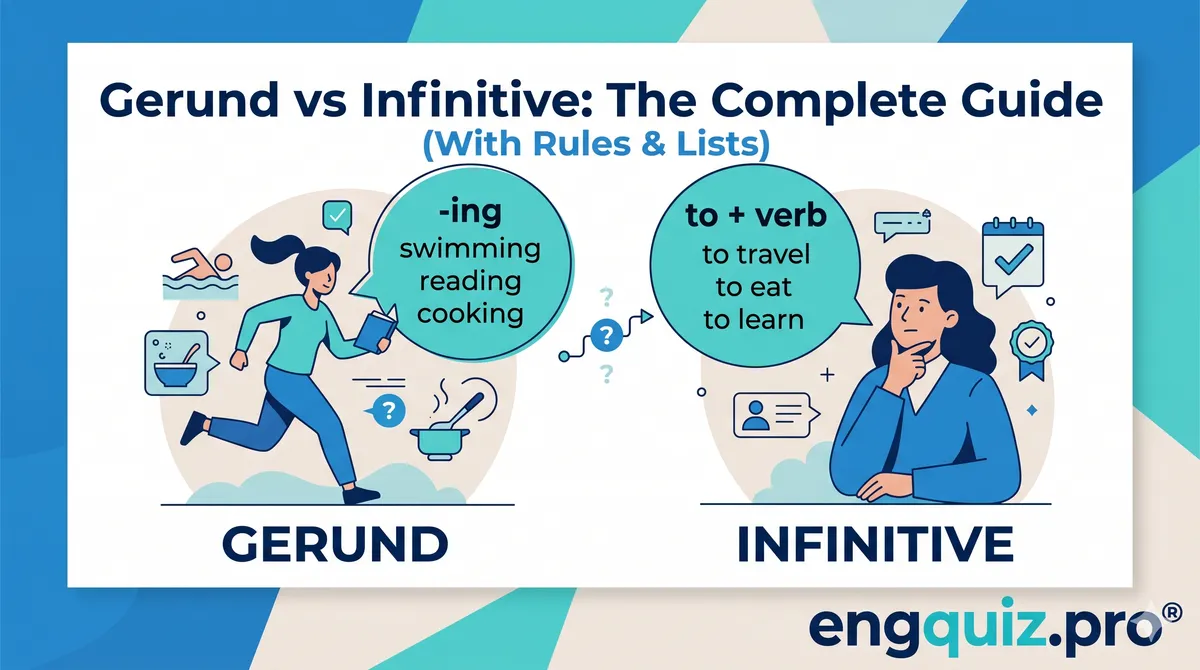
Introduction
"I enjoy to swim." or "I enjoy swimming?"
"I want eating." or "I want to eat?"
Gerunds and infinitives are one of the most confusing aspects of English grammar, not because the rule is complicated, but because there are hundreds of verbs to learn, and some verbs can take both forms with different meanings. This is also one of the 5 most common grammar mistakes that learners make across all levels.
This guide gives you the logic behind the patterns, the most important verb lists, and examples for every case.
Quick answer: A gerund is the -ing form used as a noun (Swimming is fun). An infinitive is to + base verb (I want to swim). Which one follows a verb depends on the verb itself: some verbs take only gerunds (enjoy, avoid, finish), some take only infinitives (want, decide, hope), and some take both, sometimes with different meanings.
Quick reference: which verbs take which form?
The four categories below cover ~95% of the verbs you will meet. Memorise the headline verbs in each row and the rest of the choice usually follows by analogy.
| Pattern | Headline verbs | Example |
|---|---|---|
Gerund only (-ing) |
enjoy, avoid, finish, mind, consider, suggest, recommend, deny, admit, miss, postpone, practise, can't help | I enjoy swimming. |
Infinitive only (to + base) |
want, decide, hope, plan, agree, refuse, manage, expect, learn, offer, promise, choose, fail, pretend, seem | I decided to leave. |
| Both, same meaning | begin, start, continue, like, love, hate, prefer, can't stand | It started raining. / It started to rain. |
| Both, different meaning | remember, forget, stop, try, regret, mean, go on, need | I stopped smoking (quit) vs I stopped to smoke (paused to) |
| Always gerund after preposition | any verb after a preposition: of, on, about, for, in, after, before, without, by | Thanks for helping. |
Detailed lists, examples, and the meaning-change pairs are explained section by section below.
What Is a Gerund?
A gerund is the -ing form of a verb used as a noun. It can be the subject, object, or complement of a sentence.
| Role | Example |
|---|---|
| Subject | Swimming is excellent exercise. |
| Object of a verb | She enjoys reading. |
| Object of a preposition | He is good at cooking. |
| After possessives | I appreciate your helping me. |
Key point: The gerund always functions as a noun. This is different from the present participle (She is swimming), which functions as part of a verb phrase.
What Is an Infinitive?
An infinitive is to + base verb. It can function as a noun, adjective, or adverb.
| Role | Example |
|---|---|
| As a noun (subject) | To travel is my biggest goal. |
| As a noun (object) | He wants to leave. |
| As an adjective | I have work to do. |
| As an adverb (purpose) | She studies hard to improve her grade. |
Bare infinitive (without to): Some verbs take the base form without to: after modal verbs (can, should, will), and after make, let, help:
- She can speak four languages.
- Let him finish his sentence.
Verbs Followed by a Gerund Only
These common verbs must be followed by a gerund, never an infinitive:
| Verb | Example |
|---|---|
| enjoy | I enjoy hiking on weekends. |
| avoid | She avoids making eye contact when nervous. |
| finish | Have you finished writing the report? |
| suggest | He suggested taking a different approach. |
| consider | Are you considering changing jobs? |
| keep | Keep trying; you're almost there. |
| miss | I miss living near the sea. |
| practise | She practises speaking English every day. |
| risk | Don't risk losing your place in the queue. |
| can't stand | He can't stand waiting for other people. |
| can't help | I can't help laughing when he tells that story. |
| imagine | Can you imagine living without the internet? |
| admit | She finally admitted making a mistake. |
| deny | He denied taking the documents. |
| postpone | They postponed signing the contract. |
| involve | The job involves travelling frequently. |
| mind | Would you mind closing the window? |
| regret | I regret spending so much money on it. (past regret) |
| stop | She stopped smoking last year. (permanently quit) |
Memory trick for gerund-only verbs: Many of them describe activities you are already doing, or reactions to something that happened: enjoyment, avoidance, or completion of an action in progress.
Verbs Followed by an Infinitive Only
These verbs must be followed by to + verb:
| Verb | Example |
|---|---|
| want | She wants to move to a bigger flat. |
| decide | We decided to accept the offer. |
| hope | I hope to hear from you soon. |
| plan | They plan to launch in January. |
| promise | He promised to call me back. |
| refuse | She refused to sign the agreement. |
| manage | Did you manage to get the tickets? |
| seem | Something seems to be wrong. |
| need | You need to register before the deadline. |
| expect | We expect to see a significant improvement. |
| agree | Both sides agreed to negotiate. |
| offer | She offered to drive us to the airport. |
| choose | He chose to remain silent. |
| tend | Learners tend to avoid the third conditional. |
| appear | She appears to understand the situation. |
| fail | The system failed to update correctly. |
| learn | He is learning to drive. |
| ask (someone to do) | She asked him to wait. |
Memory trick for infinitive-only verbs: Many express a future-oriented intention, decision, or desire: something you are planning or hoping to do, not already doing.
Verbs Followed by Either, with the Same Meaning
These verbs can take a gerund or an infinitive with no difference in meaning:
| Verb | Gerund | Infinitive |
|---|---|---|
| begin | She began writing the report. | She began to write the report. |
| start | He started learning Spanish. | He started to learn Spanish. |
| continue | We continued working. | We continued to work. |
| like | I like reading before bed. | I like to read before bed. |
| love | She loves cooking Italian food. | She loves to cook Italian food. |
| hate | I hate being late. | I hate to be late. |
| prefer | He prefers walking to driving. | He prefers to walk rather than drive. |
Verbs Followed by Either, with Different Meanings
These are the most important pairs to learn. The meaning changes depending on which form follows:
stop
| Form | Meaning | Example |
|---|---|---|
| stop + gerund | permanently quit an activity | He stopped smoking. (he quit) |
| stop + infinitive | pause in order to do something | He stopped to smoke. (he paused for a cigarette) |
remember
| Form | Meaning | Example |
|---|---|---|
| remember + gerund | recall a past event | I remember meeting her at the conference. |
| remember + infinitive | don't forget a duty | Remember to call the doctor. |
forget
| Form | Meaning | Example |
|---|---|---|
| forget + gerund | fail to recall (rare) | I'll never forget seeing the Northern Lights. |
| forget + infinitive | fail to do something | I forgot to lock the door. |
try
| Form | Meaning | Example |
|---|---|---|
| try + gerund | experiment: do it and see what happens | Try adding more salt; it might help. |
| try + infinitive | attempt something difficult | I tried to lift the box but it was too heavy. |
regret
| Form | Meaning | Example |
|---|---|---|
| regret + gerund | feel sorry about a past action | I regret saying that to her. |
| regret + infinitive | formal way to give bad news | We regret to inform you that your application was unsuccessful. |
mean
| Form | Meaning | Example |
|---|---|---|
| mean + gerund | involve, result in | This change means working longer hours. |
| mean + infinitive | intend | I meant to call you earlier. |
After Prepositions, Always Use a Gerund
After a preposition, always use the gerund, never the infinitive:
- She is interested in learning a new language.
- Thank you for helping me.
- He apologised for being late.
- I am looking forward to seeing you. (note: to here is a preposition, not part of an infinitive)
- After finishing the course, she got a promotion.
- Instead of complaining, let's find a solution.
Common learner error: "I look forward to see you." This is wrong because to in look forward to is a preposition, not part of an infinitive. Always: look forward to seeing.
Common Mistakes
Mistake 1: Infinitive after enjoy/avoid/finish
I enjoy to play chess.✓ I enjoy playing chess.
Mistake 2: Gerund after want/decide/hope
She wants buying a new car.✓ She wants to buy a new car.
Mistake 3: Infinitive after a preposition
He is good at to cook.✓ He is good at cooking.
Mistake 4: Forgetting that "to" in "look forward to" is a preposition
I'm looking forward to see you next week.✓ I'm looking forward to seeing you next week.
Practice Exercise
Choose the correct form, gerund or infinitive:
- She avoided ___ (make) eye contact.
- We decided ___ (take) the train.
- I don't mind ___ (wait) for a few minutes.
- He stopped ___ (drink) coffee after the doctor's advice. (permanently quit)
- Did you remember ___ (send) the email? (a duty)
- Thank you for ___ (help) me move house.
- They managed ___ (finish) the project on time.
- I'm looking forward to ___ (see) you at the conference.
Answers: 1. making | 2. to take | 3. waiting | 4. drinking | 5. to send | 6. helping | 7. to finish | 8. seeing
Practise Gerunds vs Infinitives Now
EngQuiz Pro has free B1 and B2 grammar exercises targeting gerunds and infinitives, including the tricky pairs (stop, remember, try). No sign-up required.
Frequently Asked Questions
Linguists have proposed theories (gerunds often describe completed or habitual actions; infinitives often describe intended or future actions), but the overlap is large enough that the most reliable strategy is to learn the common verbs by category. The logic helps with new verbs you encounter; the list is essential for high-frequency verbs.
Because to in look forward to is a preposition, not the infinitive marker. The same applies to be used to doing, object to doing, resort to doing. Whenever to is a preposition, the following verb must be a gerund.
They look identical (swimming), but they function differently. A gerund acts as a noun; a present participle acts as part of a verb phrase or adjective. Swimming is fun (gerund = subject). She is swimming (present participle = part of verb).
Yes: the bare infinitive appears after modal verbs (must, can, will, should, might) and after make, let, and sometimes help: Let her decide. / They made him apologise. In the passive equivalent, the to reappears: He was made to apologise. (See the passive voice guide for when this pattern occurs and how to choose between active and passive in formal writing.)
New Articles

How to Embed a Free English Grammar Quiz on Your Website (WordPress, Google Sites, Moodle)
Step-by-step instructions for adding a free, interactive English grammar quiz to WordPress, Google Sites, Moodle, or any page that accepts HTML. No plugin, no sign-up, no ads.
How to Improve English Reading and Actually Understand It
Why the level of the text you choose matters more than the hours you put in, and five exercises that build reading comprehension.
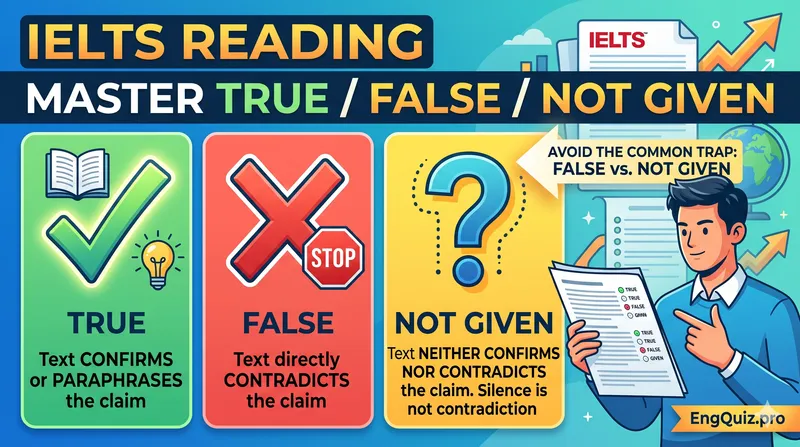
IELTS Reading: How to Master True/False/Not Given
True/False/Not Given is the most-failed IELTS Reading task. Learn the one rule that fixes it, and practise free on real B2/C1 passages with instant feedback.
Related Articles
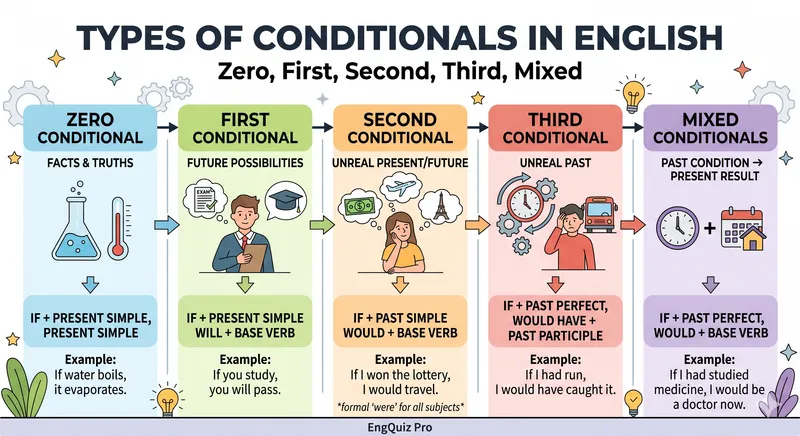
Types of Conditionals in English: Zero, First, Second, Third and Mixed
The 5 types of conditional sentences explained with formulas, examples and common mistakes: zero, first, second, third and mixed conditionals.
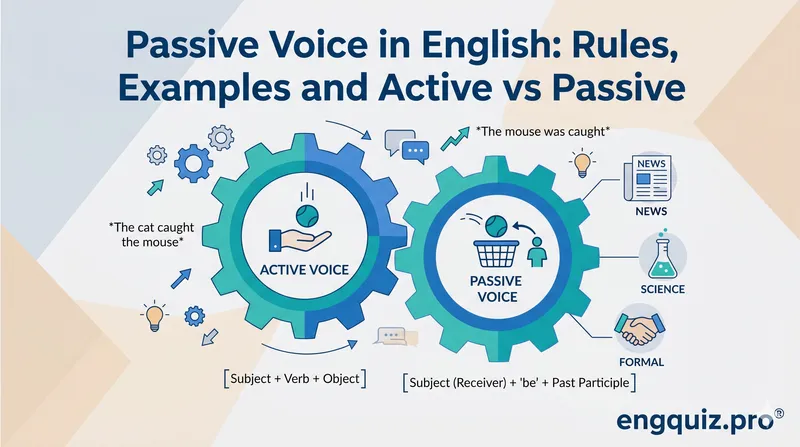
Passive Voice in English: Rules, Examples and Active vs Passive
The passive puts the receiver of an action first: "The letter was written." Learn to form it in every tense, when to use it, and 5 common mistakes.
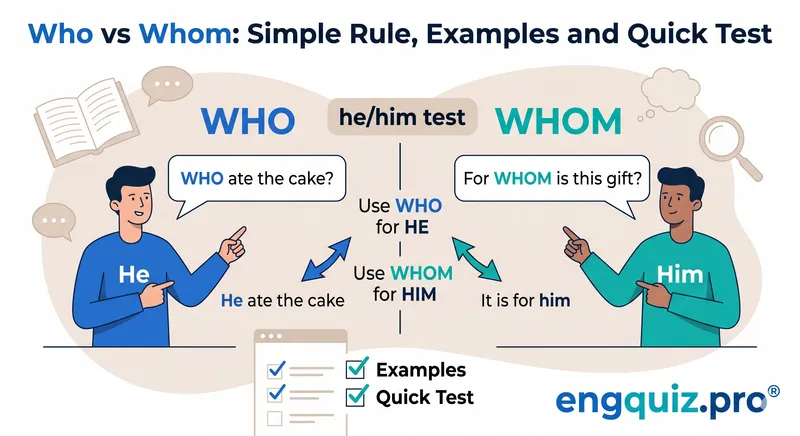
Who vs Whom: Simple Rule, Examples and Quick Test
Confused by who vs whom? Use the he/him test: if he fits, use who; if him fits, use whom. Examples, common mistakes and a 5-question quiz inside.