5 Common English Grammar Mistakes (And How to Fix Them)
The five most common English grammar mistakes learners make, whatever their level. Each has one clear rule that fixes it. Learn them and practise today.
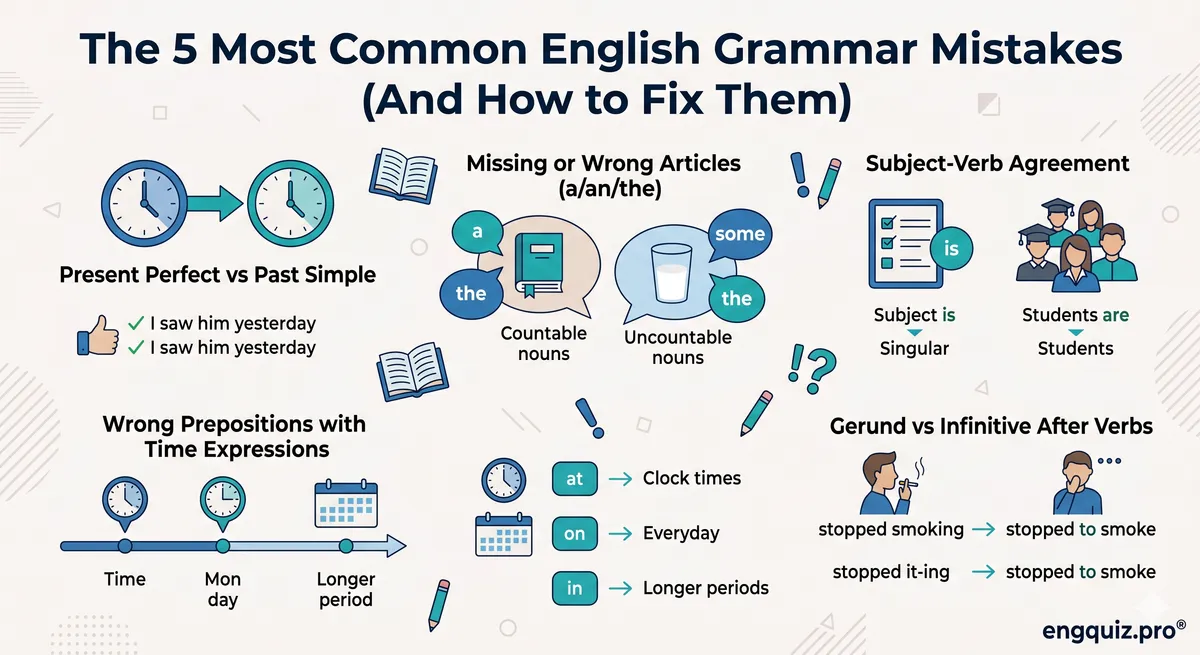
Quick answer: The five most common English grammar mistakes are (1) present perfect vs past simple confusion, (2) missing or wrong articles, (3) subject-verb agreement errors, (4) wrong prepositions with time expressions, and (5) gerund/infinitive errors after verbs. Each one has a rule you can learn in under five minutes.
Why These Five Mistakes?
After analysing thousands of learner exercises, five grammar mistakes appear again and again, in the writing of A2 beginners and B2 upper-intermediates alike. They are not random errors. They follow predictable patterns rooted in how we learn language.
This guide explains each mistake clearly, shows you why it happens, and gives you the fix, plus a practice exercise so the correction sticks. If you are an adult returning to English study, English Grammar Lessons for Adults explains how these patterns connect to the typical adult learning path.
Mistake 1: Present Perfect vs Past Simple
This is the single most common error among B1 and B2 learners.
What learners write:
I have seen him yesterday.Did you ever try Thai food?
Why it happens:
Many languages do not have a separate present perfect tense. Learners either translate directly from their first language or apply the simpler past simple to all past situations.
The fix:
Past simple = a finished action at a specific time in the past Present perfect = a past action with a connection to now
| Signal word | Tense to use |
|---|---|
| yesterday, last week, in 2020, ago | Past simple |
| ever, never, just, already, yet, today, so far | Present perfect |
Corrected examples:
✓ I saw him yesterday. (specific past time) ✓ Have you ever tried Thai food? (life experience, no specific time)
Practice: Go to our Present Perfect vs Past Simple guide for a complete explanation and exercise. A closely related future-tense error is mixing up will and be going to; see will vs going to for the future for the same "speaker intention" logic applied to future time.
Mistake 2: Missing or Wrong Articles (a / an / the)
English articles are notoriously difficult - especially for speakers of Chinese, Japanese, Korean, Russian, or other languages with no article system.
What learners write:
She is doctor.I bought a milk at the shop.Can you pass the salt?✓ (this one is actually correct - and confusing to learners)
Why it happens:
The rules for a/an/the/no article involve four different concepts at once: countability, specificity, shared knowledge, and register. Most learners try to memorise rules without understanding the underlying logic.
The fix:
Three questions decide which article to use:
-
Is the noun countable or uncountable?
- Countable (singular) → needs a/an or the: a book, the book
- Uncountable → no article or some/the: milk, some milk, the milk we bought
-
Is it the first mention or a known reference?
- First mention → a/an: I saw a dog.
- Known reference → the: The dog barked all night.
-
Is it a general statement?
- General → no article: Doctors need good communication skills.
- Specific → the: The doctor I saw yesterday was excellent.
Corrected examples:
✓ She is a doctor. (any doctor, first mention of a role) ✓ I bought some milk at the shop. (uncountable, unspecified)
Mistake 3: Subject-Verb Agreement
Simple in theory, constantly broken in practice, especially in longer sentences where the subject and verb are separated.
What learners write:
The list of options are very long.A group of students were waiting outside.Everyone have a question.
Why it happens:
When a prepositional phrase (of options, of students) comes between the subject and the verb, learners match the verb to the nearest noun instead of the actual subject.
The fix:
Always find the head noun of the subject, the core noun, ignoring any of phrases or relative clauses and match the verb to it.
| Subject | Head noun | Correct verb |
|---|---|---|
| The list of options | list (singular) | is |
| A group of students | group (singular) | was |
| Everyone / anybody / nobody | always singular | has |
| The information | uncountable = singular | is |
| The team / staff / police | collective (British: plural OK) | are (British) / is (American) |
Corrected examples:
✓ The list of options is very long. ✓ Everyone has a question.
Mistake 4: Wrong Prepositions with Time Expressions
In, on, at: three tiny words that cause enormous confusion.
What learners write:
I'll see you on the morning.The meeting is at Monday.She was born in 14 March.
Why it happens:
Each language maps time prepositions differently. The English system (at for clock times, on for days and dates, in for months/years/periods) is logical but requires deliberate memorisation.
The fix:
| Preposition | Use with | Examples |
|---|---|---|
| at | clock times, specific moments | at 9 a.m., at noon, at midnight, at the weekend (British) |
| on | days, dates | on Monday, on 14 March, on my birthday, on New Year's Day |
| in | months, years, seasons, longer periods | in March, in 2024, in spring, in the morning, in the 20th century |
Memory trick: Think of zoom levels. At = a precise point (microscope). On = a specific day (calendar). In = a broader period (telescope).
Corrected examples:
✓ I'll see you in the morning. ✓ The meeting is on Monday. ✓ She was born on 14 March.
Mistake 5: Gerund vs Infinitive After Verbs
Some verbs are followed by a gerund (-ing form); others take an infinitive (to + verb); some take both, but with different meanings.
What learners write:
I enjoy to play tennis.She avoided to make eye contact.He stopped to smoke.✓ or ✗, depending on meaning
Why it happens:
There is no simple phonological or grammatical rule that predicts which form follows which verb. Learners must learn the patterns over time, and there are enough exceptions to make it genuinely hard.
The fix:
Gerund (-ing) after: enjoy, avoid, finish, suggest, consider, keep, miss, practise, risk, imagine, can't stand, can't help
I enjoy playing tennis. She avoided making eye contact.
Infinitive (to + verb) after: want, decide, hope, plan, promise, refuse, manage, seem, need, expect, agree, offer
He decided to leave early. They refused to sign the contract.
Both (same meaning): begin, start, continue, like, love, hate, prefer
She loves reading / to read. (both correct)
Both (different meaning): stop, remember, forget, try, regret
| Verb | + gerund | + infinitive |
|---|---|---|
| stop | He stopped smoking. (quit) | He stopped to smoke. (paused, in order to smoke) |
| remember | I remember meeting her. (past memory) | I remember to call her. (don't forget) |
| try | Try adding more salt. (experiment) | Try to arrive on time. (attempt) |
Practice Exercise
Correct the error in each sentence:
- I have visited Rome last summer.
- She is engineer at a tech company.
- The number of applications have increased this year.
- The event starts at Tuesday evening.
- I look forward to hear from you.
Answers:
- I visited Rome last summer. (specific past time → past simple)
- She is an engineer. (singular countable job → a/an)
- The number of applications has increased. (head noun: number, singular)
- The event starts on Tuesday evening. (day → on)
- I look forward to hearing from you. (look forward to = preposition + gerund)
What to Do Next
Each of these mistakes has its own exercise on EngQuiz Pro. The fastest way to fix a grammar mistake is not to memorise the rule; it is to practice until the correct form feels wrong to skip.
Pick the mistake you make most often, do the exercise, and check back in a week. If you are working towards upper-intermediate, the B1 to B2 grammar roadmap shows how these mistakes fit into the full progression.
Honourable mentions: five more high-frequency errors
These didn't make the top five but show up nearly as often in our learner corpus:
- Conditional confusion: mixing if + present and if + would in the wrong half of the sentence. See our pillar on conditional sentences as one system for all five types.
- Make vs do collocations: make a decision / do homework don't follow a logical rule; they're fixed pairings. The make vs do contrast sorts the most common ones.
- Overusing the active voice in formal writing: academic and report English uses the passive voice far more than learners expect, especially when the agent isn't important.
- Who vs whom: the he/him replacement test settles this in two seconds, but learners avoid whom entirely and lose points in formal writing.
- Mixing much / many / a lot of: registers and countability both matter; much is rare in affirmative speech.
Three Illustrative Learner Errors
These three examples are illustrative. They do not describe specific learners, but each error is a common pattern at B1–B2 level. The pattern in each case is more useful than the individual mistake.
Example 1: I work here for three years (B1)
A B1 learner has been told the present perfect rule three times and "knows" it. But the learner's everyday speech still produces I work here for three years. The reason is not the rule. It is the absence of forced practice in spontaneous speech. A useful fix: write three personal sentences with since/for at the start of each daily journal entry, then read them aloud. After some weeks of this routine, I have worked here for three years comes automatically.
Lesson: Knowing the rule and producing the form are different skills. The bridge is forced, low-stakes daily production.
Example 2: I went to the supermarket (A2)
A Japanese A2 learner's writing is often full of dropped articles: I went to supermarket, I am student, Capital of Japan is Tokyo. Japanese has no equivalent of a/an/the, so this is a textbook L1-transfer error. The fix is often not more rules, because the learner can recite them. The fix is reading aloud: copy short news headlines from a Japanese English-language newspaper (NHK World, Japan Times) and read them out loud, twice each. The pattern of "the + noun" goes in through the ear, not through memorisation.
Lesson: L1-transfer errors often need an auditory anchor, not more grammar drilling. Read aloud what good English actually looks like.
Example 3: The team are happy (B2)
A B2 learner working in a London-based agency keeps producing The team are happy, The company have launched. The manager corrects these, but the corrections seem inconsistent. The reason: the learner reads the UK press (BBC, Guardian), which routinely uses plural verbs with collective nouns. The "error" is not an error in British English; it is a register mismatch with the formal business writing the manager wants. A personal rule helps: plural is fine in informal speech; in formal client emails, default to singular (The team is happy).
Lesson: Some "errors" are register or variety mismatches, not grammar gaps. Make the implicit standard explicit.
Frequently Asked Questions
Knowing a rule and using it automatically are different skills. Conscious grammar knowledge takes 6–12 weeks of deliberate practice to become instinctive. The key is consistent, low-stakes practice: short exercises every day beat one long session per week.
Yes, though they make a different set. Native speakers often confuse less/fewer, misuse apostrophes, and use double negatives informally. The mistakes in this guide are specifically patterns from learner error analysis.
Subject-verb agreement errors and article mistakes are the most noticeable to native speaker employers and examiners. Present perfect/past simple errors are very common and often forgiven at B1 level but penalised at B2+.
New Articles

How to Embed a Free English Grammar Quiz on Your Website (WordPress, Google Sites, Moodle)
Step-by-step instructions for adding a free, interactive English grammar quiz to WordPress, Google Sites, Moodle, or any page that accepts HTML. No plugin, no sign-up, no ads.
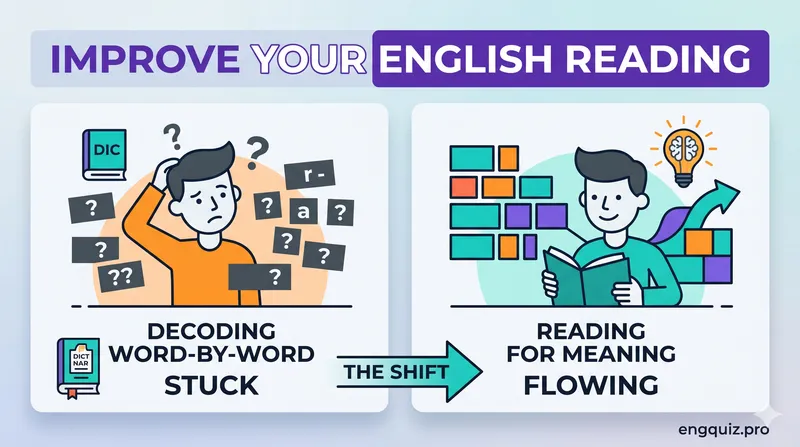
How to Improve English Reading and Actually Understand It
Why the level of the text you choose matters more than the hours you put in, and five exercises that build reading comprehension.
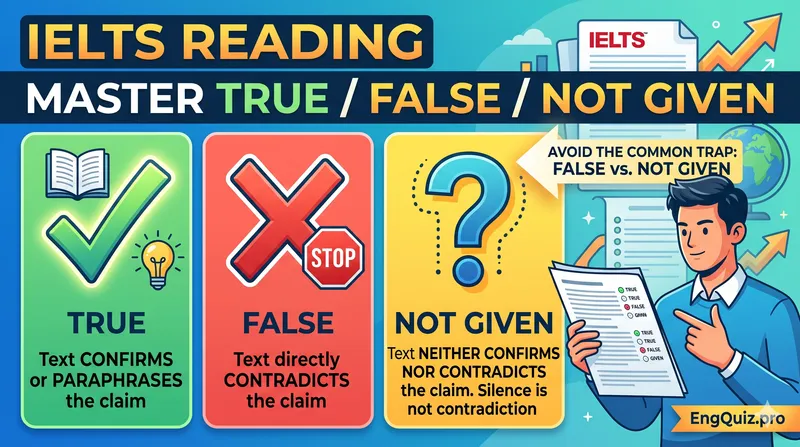
IELTS Reading: How to Master True/False/Not Given
True/False/Not Given is the most-failed IELTS Reading task. Learn the one rule that fixes it, and practise free on real B2/C1 passages with instant feedback.
Related Articles
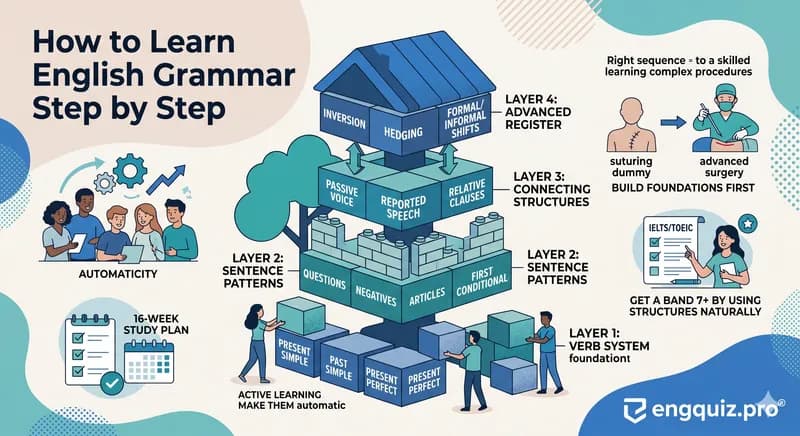
How to Learn English Grammar Step by Step: A 4-Layer Framework
Most learners study English grammar in the wrong order. Here is a four-layer step-by-step framework, with exam-angle advice and exercises to start today.
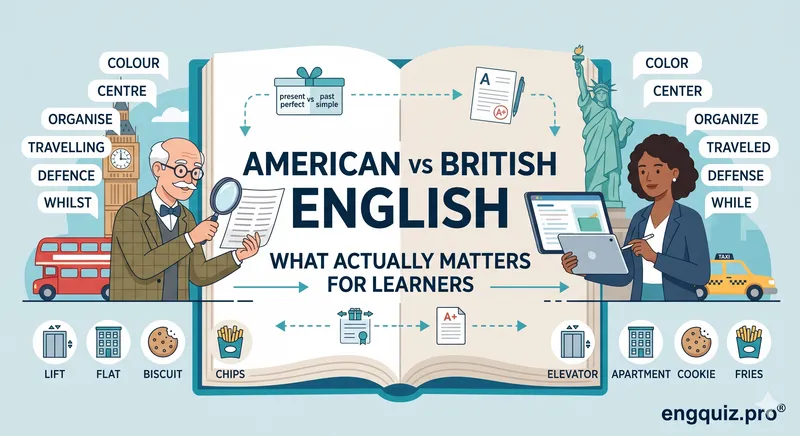
American vs British English: What Actually Matters for Learners
Spelling, vocabulary, or grammar: which differences between American and British English actually affect your exam score, and what can you safely ignore?