How to Go from B1 to B2 English: A Practical Roadmap
Stuck at B1 English? This practical roadmap shows you exactly what to study, in what order, to reach B2, with a realistic timeline and free exercises.
Introduction
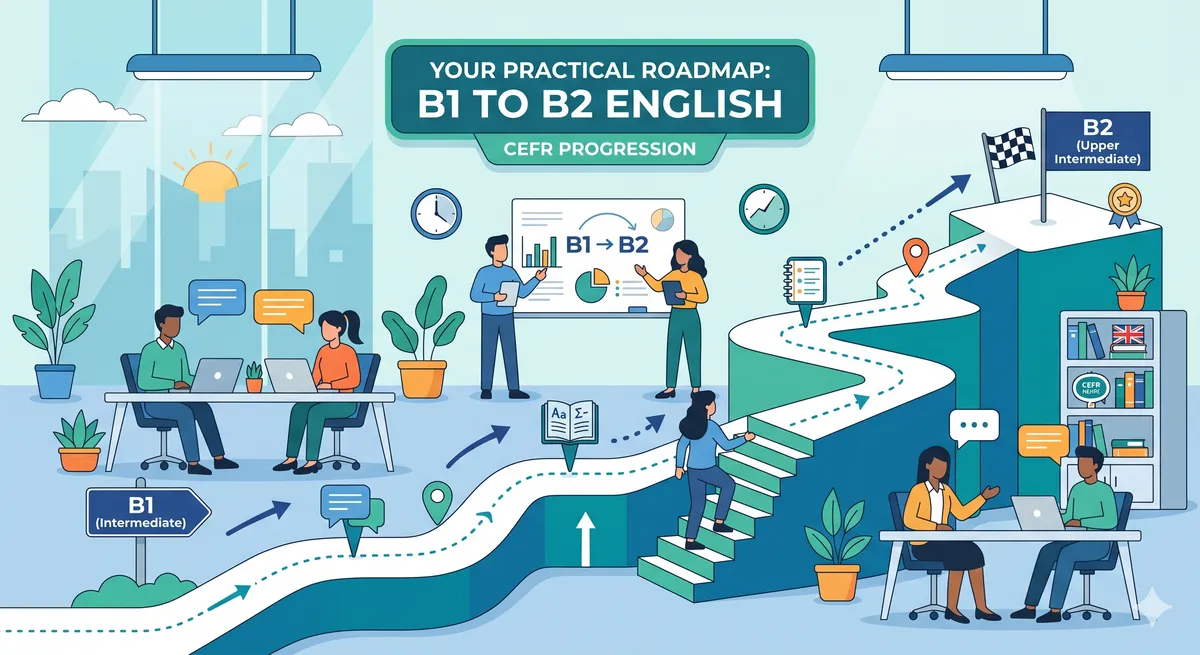
The B1 plateau is one of the most discussed frustrations in language learning. At B1, you can communicate: you can travel, have simple conversations, and understand most of what you read. And then progress seems to slow almost to a stop.
This guide explains why the plateau happens, what specifically separates B1 from B2, and gives you a concrete study roadmap to move through it. For a full comparison of all CEFR levels, see our CEFR Levels Explained guide. If you are not yet sure you are solid at B1, start with What Is B1 English Level? (the level definition this roadmap assumes); for the level just below, see what A2 (Elementary) English looks like in practice.
Quick answer: Moving from B1 to B2 takes 300–400 hours of deliberate practice. The key gaps are: mastery of perfect tenses and conditionals, academic/professional vocabulary (4,000+ word families), and the ability to produce extended, coherent speech and writing on unfamiliar topics. A structured 6–12 month plan can get you there.
Why the B1 Plateau Happens
At B1, you have enough English to survive. The communication breakdowns that pushed you to study harder (being misunderstood, not understanding basic conversations) are now rare. Without a clear failure signal, motivation to push harder drops.
Simultaneously, the type of learning that worked to get you to B1 stops working as well:
- You already know the most common 2,000 words, so new vocabulary is less frequent and harder to encounter naturally
- Grammar distinctions become finer (mixed conditionals vs third conditional; present perfect continuous vs simple)
- Reading at a comfortable level reinforces what you already know instead of pushing your limits
The solution: Intentionally remove the comfort. B2 requires uncomfortable practice: reading at the edge of your comprehension, speaking about topics you do not know the vocabulary for yet, writing with correction on your output.
What Separates B1 from B2: The Gap Analysis
Grammar gaps (the most fixable)
| Skill | B1 command | B2 requirement |
|---|---|---|
| Past tenses | Can use past simple and basic present perfect | Accurate use of past perfect, present perfect continuous, and past continuous in narrative |
| Conditionals | First and second conditional | All four types + mixed conditionals (If I had studied harder, I would be in a better position now) |
| Passive voice | Recognises passive, uses basic forms | Produces passive across all tenses, including get-passive and causative |
| Modals | can, should, must, might | Modal perfects: must have been, should have done, could have + pp |
| Relative clauses | Basic defining clauses (the man who) | Non-defining clauses, reduced relatives (the man sitting by the door) |
| Reported speech | Basic tense backshift | Full backshift, reporting verbs (claim, insist, warn, acknowledge) |
| Gerunds/infinitives | Basic common verbs | Verbs with meaning change (stop smoking vs stop to smoke) |
Vocabulary gaps (takes the most time)
| Level | Word families | Registers |
|---|---|---|
| B1 | ~2,500–3,000 | Everyday, informal |
| B2 | ~4,000–5,000 | + Academic, professional, semi-formal |
The vocabulary gap is the biggest barrier. Moving from 3,000 to 5,000 word families requires reading extensively at the right level, using graded readers or authentic texts on topics you care about.
Skills gaps (require regular output practice)
| Skill | B1 | B2 |
|---|---|---|
| Speaking | Can hold a conversation on familiar topics | Can hold a conversation on unfamiliar topics without strain |
| Writing | Can write a coherent personal email or message | Can write structured essays, formal emails, and summaries |
| Reading | Can understand most texts on familiar topics | Can understand complex texts, including implied meaning |
| Listening | Can follow slow-to-normal speed | Can follow natural speed; can follow debates and lectures |
The 12-Month B1 → B2 Roadmap
This plan assumes approximately 1 hour of focused study per day (30 hours/month, 360 hours/year).
Months 1–3: Fix the Grammar Foundation
Target: Master the grammar structures that appear at every turn above B1.
| Week | Focus | Resource |
|---|---|---|
| 1–2 | Past perfect: formation and use | Grammar exercises + reading texts with past narrative |
| 3–4 | Present perfect continuous vs simple; future-time choice (will vs going to) | EngQuiz Pro B1 exercises |
| 5–6 | Third conditional | Conditional exercises, writing 5 sentences daily |
| 7–8 | Mixed conditionals | B2 grammar exercises |
| 9–10 | Passive voice (all tenses + causative) | Rewrite active → passive, do cloze exercises |
| 11–12 | Modal perfects | EngQuiz Pro B2 exercises |
Daily habits:
- 15 minutes grammar exercise
- 10 minutes review of wrong answers (understand why, not just what)
Months 4–6: Build Vocabulary Systematically
Target: Add 1,000 word families to your active vocabulary (production, not just recognition).
| Week | Focus |
|---|---|
| 13–16 | Academic vocabulary: 200 words from the Academic Word List |
| 17–20 | Professional vocabulary: 200 words relevant to your field |
| 21–24 | Collocations: make a decision, reach an agreement, raise awareness, set a deadline |
Method (the three-exposure rule): You need to encounter a word in context at least 7–10 times before it becomes active vocabulary. Use spaced repetition flashcards (Anki, or a notebook system), encounter the word in reading, and use it in writing the same week you learn it.
Reading input: Read one BBC/Guardian article or a graded reader chapter per day. Look up words you encounter more than twice, and skip one-off words.
Months 7–9: Develop Speaking and Writing Output
At this stage you have the grammar and vocabulary. Now you need to produce at B2 level.
Speaking:
- 3× per week: 5-minute spoken response to a question (record yourself)
- Topics: describe a problem, give your opinion on a news story, compare two options
- Review your recording once a week to identify grammar errors and vocabulary gaps
Writing:
- 2× per week: 150-word structured paragraph (argument/analysis, not personal narrative)
- Format: topic sentence + 2–3 supporting points + conclusion sentence
- Get feedback if possible, from a teacher or language exchange partner
Target: By Month 9, you can write a coherent 250-word essay without significant grammar errors.
Months 10–12: Consolidation and Test Simulation
If you have an exam target (IELTS, FCE, TOEIC), spend these months on exam-specific practice. If you do not have an exam, focus on authentic content that challenges you.
Authentic content strategy:
- Choose one podcast series in English on a topic you care about, and listen to one episode per day
- Choose one book in English (non-fiction is better than fiction for vocabulary density)
- Aim to read/listen to content where you understand 80–90% without looking anything up
Self-assessment: Redo the B2 grammar exercises from Month 1. If you score 80%+ on B2 exercises and can write a structured 250-word essay with minimal errors, you are at B2. Looking further ahead? What C1 (Advanced) English looks like in practice shows what comes next: the structures, vocabulary, and exam thresholds for the move to C1.
Signs You Have Reached B2
You are at B2 when:
- You can have a 10-minute conversation on an unfamiliar topic without running out of language
- You can read a serious newspaper article on any topic and understand the main argument without a dictionary
- You can write a formal email with appropriate register and no basic grammar errors
- You understand 80%+ of a podcast or news broadcast at natural speed
- On a B2 grammar exercise, you score 75%+ on structures like modal perfects, mixed conditionals, and passive voice
Practice This Now
EngQuiz Pro has free grammar exercises at B1 and B2 level targeting the exact grammar gaps in this roadmap. Start with your weakest area from the gap analysis above.
→ Start a free B1/B2 grammar exercise →
Common patterns at B1
A common pattern for learners moving from B1 to B2:
The single biggest determiner of how long this transition takes is not "talent". It is whether the learner has honest feedback on their output. Almost every learner stuck at B1 for more than a year has the same pattern: a lot of passive input (films, music, scrolling English social media) and almost no produced English that anyone has corrected. Once a learner starts producing one paragraph of written English a day, getting it corrected, and rewriting it, the B1 plateau breaks. Almost universally. The grammar problem is real, but it is downstream of the feedback problem.
If you want the full sourcing behind the B1→B2 gap analysis above (corpora, references, and the editorial review process), see our methodology page.
Example learner path: from IELTS 5.5 to 6.5 in 11 months
(Illustrative example. Linh is not a real learner. The plan shows a typical path from B1 to B2.)
Starting point. Linh works at a marketing agency and has taken IELTS once, scoring an overall 5.5, solidly B1. Reading is her strongest skill (6.0). Writing drags the score down (5.0). She wants overall 6.5 for a Master's application in the UK.
Diagnostic. Linh's Writing Task 2 essay was readable but had two consistent problems: she used past simple where present perfect was needed (I work here for three years) and her essays were heavy on examples but light on argument structure. Both are classic B1 → B2 transition gaps. She had almost no production routine.
The plan.
- Months 1–3. Linh wrote one 150-word "opinion paragraph" daily on a topic from the news. She submitted them weekly to a teacher for grammar correction, then rewrote each one after seeing the corrections. The rewrite step turned out to be the actual learning, not the first draft. Grammar focus: present perfect with for/since, third conditional, and reported speech.
- Months 4–6. Linh switched to one full Task 2 essay (250+ words) per week with the same rewrite routine. She added 30 minutes of B2 grammar drilling per day; modal perfects and advanced passive voice were the biggest gaps from her diagnostic. She also began shadowing BBC News clips for 10 minutes daily to improve fluency markers in speaking.
- Months 7–9. The essay routine continued, but Linh added topic-vocabulary lists from the Coxhead Academic Word List (specifically the sub-lists relevant to education, technology, and society, the three IELTS topic blocks she found weakest). Speaking practice moved to weekly Cambly sessions focused on Task 2 questions.
- Months 10–11. Full-mock IELTS practice: one full timed test per week, marking against the band descriptors. Errors that recurred were turned into a one-page "personal error sheet" she reviewed before each mock.
Example result. Linh sat the IELTS again and scored overall 6.5 (Reading 7.0, Listening 6.5, Speaking 6.0, Writing 6.0). Her Writing band, the original bottleneck, moved a full band from 5.0 to 6.0. Almost all of the movement came from the daily-paragraph rewrite routine; in this example, she keeps writing one new paragraph and rewriting one previous one per day.
Takeaway for your own roadmap. The grammar studied in months 1–6 matters, but in this example the rewrite step, looking at corrected work and producing it again, is the real engine. Self-study courses rarely include this step; if yours doesn't, build it in. If you are an adult returning to English study, as in this example, English Grammar Lessons for Adults addresses the specific mindset shifts around tenses, articles, and prepositions that matter most at this stage.
Frequently Asked Questions
Officially, 300–400 guided hours. In practice, learners who study 1 hour per day for 12 months (365 hours) with deliberate, focused practice reliably reach B2. Many learners take longer because their practice is passive: listening without active processing, or reading without vocabulary expansion.
Yes. Structured self-study with good materials is sufficient. The main risks of self-study are (1) not getting feedback on your writing, which lets errors fossilise; and (2) not practising speaking, which keeps your production below your comprehension. Both can be addressed with a language exchange partner or periodic teacher check-ins.
Cambridge B2 First tests B2 level, so if you genuinely are at B2, you should be able to pass. The exam requires familiarity with the specific task types (open cloze, word formation, essay writing), so exam preparation on top of your language skills is essential even for strong B2 learners.
Long-term plateaus almost always indicate that input is comfortable and output is absent or uncorrected. Comfortable input does not push your grammar or vocabulary ceiling. Add writing with feedback and speaking with error correction to your routine; these are the fastest escape routes from a long plateau.
New Articles

How to Embed a Free English Grammar Quiz on Your Website (WordPress, Google Sites, Moodle)
Step-by-step instructions for adding a free, interactive English grammar quiz to WordPress, Google Sites, Moodle, or any page that accepts HTML. No plugin, no sign-up, no ads.
How to Improve English Reading and Actually Understand It
Why the level of the text you choose matters more than the hours you put in, and five exercises that build reading comprehension.
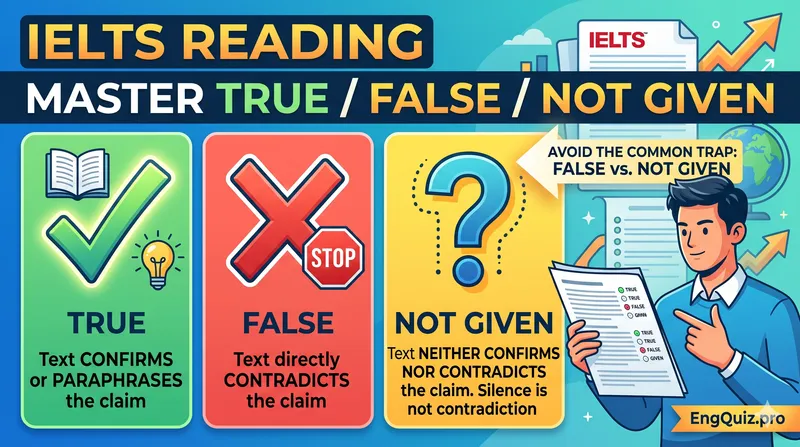
IELTS Reading: How to Master True/False/Not Given
True/False/Not Given is the most-failed IELTS Reading task. Learn the one rule that fixes it, and practise free on real B2/C1 passages with instant feedback.
Related Articles

What Is A1 English Level? Skills, Grammar & First Words
A1 is absolute beginner English at the start of the CEFR scale. Learn what A1 means, the first grammar and words, and how long it takes to reach A2.
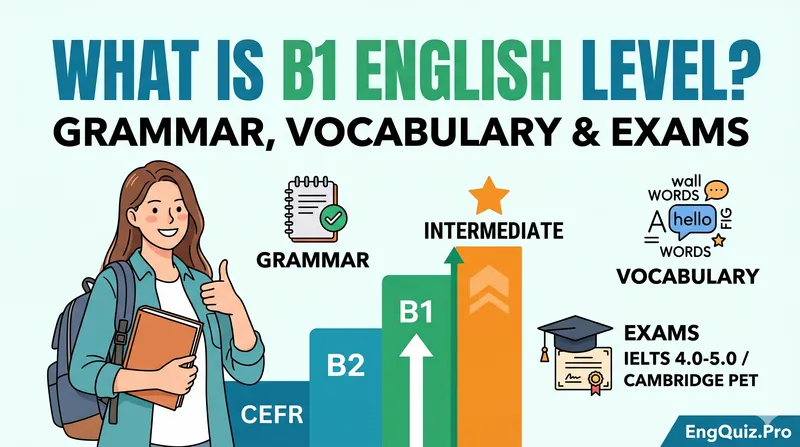
What Is B1 English Level? Grammar, Vocabulary & Exams
B1 is intermediate English: the level where you stop surviving and start communicating. Learn B1 grammar, vocabulary, exam scores, and how to reach it.
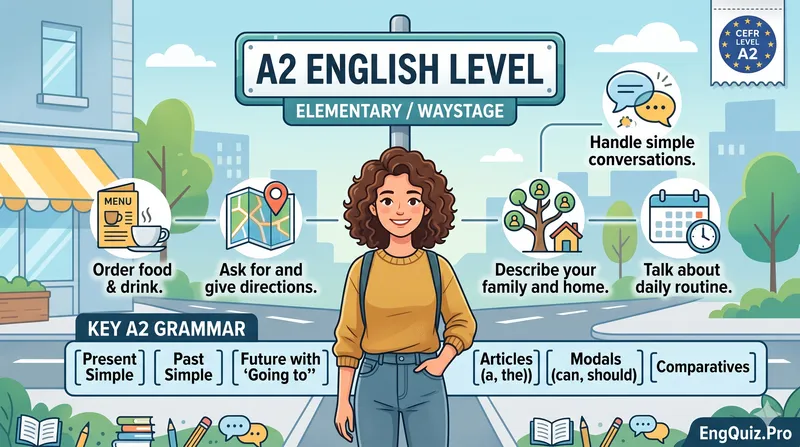
What Is A2 English Level? Grammar, Vocabulary & Exams
A2 is the elementary CEFR level: survival English for everyday situations. Learn A2 grammar, vocabulary, exam scores, and how long it takes to reach it.