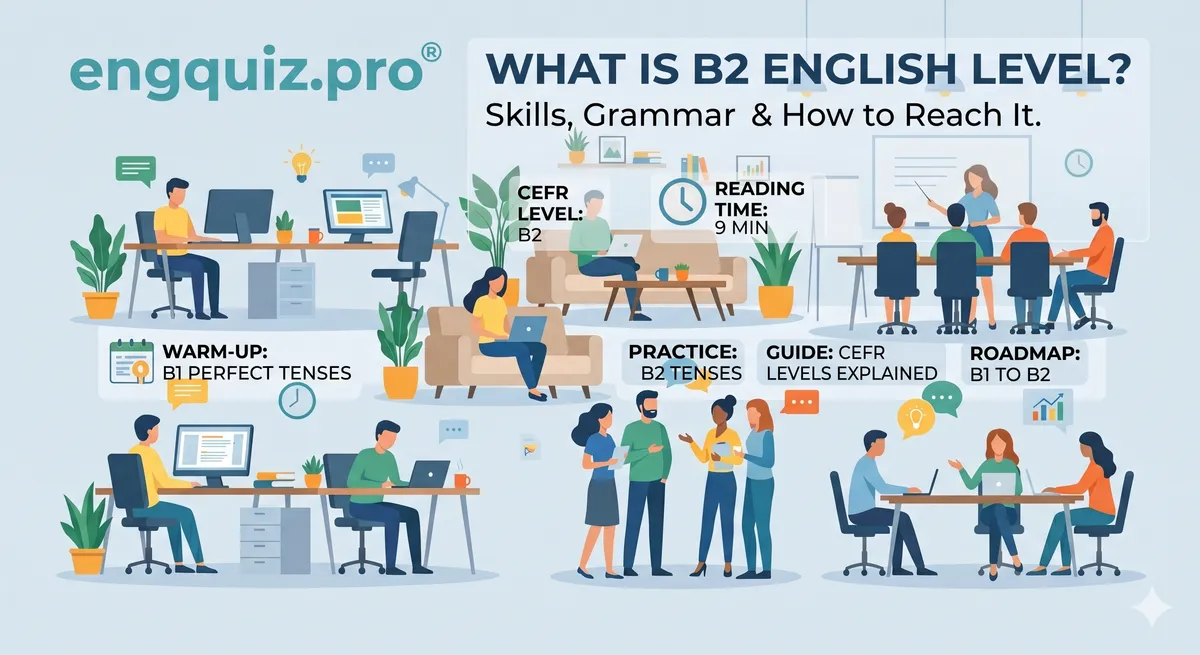
What Is B2 English Level? Skills, Grammar & How to Reach It
B2 is the most searched CEFR level, and for good reason. This guide explains exactly what B2 English means, what grammar you need, and how to get there.
Introduction
B2 is the most searched CEFR level on Google, and the most important for learners who want to use English professionally. It is the point at which you stop needing constant support and start being able to communicate independently.
Whether you are preparing for Cambridge B2 First (FCE), aiming for an IELTS Band 6.0, or just trying to work effectively in English, this guide tells you exactly what B2 means and what it takes to reach it. For a full overview of all CEFR levels, see our CEFR Levels Explained guide.
Quick answer: B2 (Upper-Intermediate) means you can understand complex texts, communicate fluently with native speakers on familiar and unfamiliar topics, and produce clear, detailed writing. It is the minimum level for most international universities and many multinational employers.
What B2 Means in Practice
The official CEFR descriptor for B2 reads: "Can understand the main ideas of complex text on both concrete and abstract topics, including technical discussions in their field of specialisation. Can interact with a degree of fluency and spontaneity that makes regular interaction with native speakers quite possible without strain for either party."
In everyday terms:
| Skill | What B2 looks like |
|---|---|
| Reading | Can read newspaper articles, professional emails, and reports without a dictionary for most words |
| Writing | Can write clear essays, formal emails, and summaries with appropriate structure and vocabulary |
| Listening | Can follow most TV programmes, podcasts, and conversations at natural speed |
| Speaking | Can hold a conversation on unfamiliar topics without long pauses or constant searching for words |
B2 Grammar: What You Must Know
Grammar is the most concrete measure of B2. If you can produce and understand all of these structures accurately, you are at B2.
Tense system: mastery required
| Structure | Example |
|---|---|
| Present perfect continuous | She has been working on this project for three months. |
| Past perfect | By the time he arrived, we had already left. |
| Past perfect continuous | They had been negotiating for weeks before the deal collapsed. |
| Future perfect | By December, they will have finished the report. |
| Future continuous | This time tomorrow, I'll be flying to Tokyo. |
Conditionals: all four types
| Type | Structure | Example |
|---|---|---|
| Zero | If + present, present | If you heat water to 100°C, it boils. |
| First | If + present, will | If she calls, I'll let you know. |
| Second | If + past, would | If I were you, I'd apply for the job. |
| Third | If + past perfect, would have | If I had studied harder, I would have passed. |
B2 learners should also recognise mixed conditionals: If I had studied harder, I would be in a better job now.
Passive voice: extended use
- Active → passive transformations with all tenses
- Get-passive: The car got stolen. (less formal)
- Causative have: I had my hair cut. / She had her phone fixed.
Modal perfects
| Modal perfect | Meaning | Example |
|---|---|---|
| must have + pp | deduction about the past | She must have left already. |
| can't have + pp | negative deduction | He can't have finished; it was only five minutes. |
| should have + pp | criticism or regret | You should have told me earlier. |
| might/could have + pp | past possibility | She might have misunderstood. |
Gerunds and infinitives, with meaning differences
At B2, learners must know the pairs where meaning changes:
- I stopped smoking. (I quit) vs I stopped to smoke. (I paused in order to smoke)
- I remember meeting her. (past memory) vs I remember to call her. (duty, don't forget)
Other key B2 structures
- Relative clauses with reduction: The man sitting by the door is my manager. B2 candidates should also choose between who and whom correctly in formal writing; see the he/him replacement test.
- Emphasis with inversion: Rarely have I seen such a well-organised team.
- Reported speech with tense backshift: She said she had been waiting for hours.
- Cleft sentences: What I need is more time.
- Discourse markers: Nevertheless, In spite of this, As a result
B2 Vocabulary: What You Need
Vocabulary at B2 covers roughly 4,000–5,000 word families. More importantly, it includes:
- Academic vocabulary: analyse, demonstrate, evaluate, significant, whereas
- Professional vocabulary: negotiate, implement, propose, deadline, criteria
- Formal collocations: raise awareness, come to a conclusion, bear in mind
- Idioms in context: cut corners, get the ball rolling, read between the lines
A reliable test: if you can read a Guardian or BBC News article on any topic and understand 90%+ of the words without looking them up, your vocabulary is at B2.
At B2 the most useful habit is to learn vocabulary as word families rather than isolated entries. Knowing manage / management / manager / manageable / manageably as one unit gives you four B2 First Use-of-English answers from a single root. Our word formation guide walks through the affixation, compounding and conversion patterns that make this possible, with the workplace and academic word families that examiners reward most.
B2 Exams: What Certificates Prove B2?
| Exam | B2 Qualification | Notes |
|---|---|---|
| Cambridge | B2 First (FCE) | Most widely recognised in Europe |
| IELTS | Band 5.5–6.5 | Band 6.0 is the typical B2 threshold |
| TOEFL iBT | 72–94 | Common for US university applications |
| TOEIC | 785–900 | Workplace-focused; less academic |
| Duolingo English Test | 105–125 | Accepted by many universities since 2020 |
How Long Does It Take to Reach B2?
Starting from B1, reaching a solid B2 takes approximately 300–400 hours of guided study. This means:
- 1 hour per day → 10–14 months
- 2 hours per day → 5–7 months
The B1→B2 transition is where most learners plateau. The reason: at B1, you can communicate. There is no longer an obvious communication breakdown to motivate improvement. Progress becomes invisible, and motivation drops.
How to break through the plateau:
- Move to authentic input. Read English newspapers, not just textbooks. Watch unscripted video without subtitles (start with 70%, then 50%, then 0%).
- Write with feedback. A daily 100-word journal entry reviewed by a teacher or app accelerates writing faster than any workbook.
- Target grammar gaps specifically. Use exercises calibrated to B2 grammar to find and fix specific weak points.
- Speak more, produce more. B1 learners often understand B2 input but cannot produce it. Talking time is irreplaceable.
Common Mistakes That Keep Learners Stuck at B1
Mistake 1: Over-relying on simple past
Many B1 learners use past simple where B2 requires the past perfect:
After I ate, she arrived.→ ✓ After I had eaten, she arrived.
Mistake 2: Avoiding conditionals
B1 learners know first and second conditionals but avoid third:
I would tell you if I know.→ ✓ I would have told you if I had known.
Mistake 3: Using formal vocabulary incorrectly
B2 vocabulary is not just about knowing more words; it is about using them in the right register. "The report manifested significant inadequacies" sounds unnatural; "The report showed significant weaknesses" is B2.
B2 Practice Exercises
Try these B2-level tasks to assess yourself:
Task 1 (Grammar): Complete the sentence with the correct form. If the meeting hadn't been cancelled, we ___ (finish) the project by now. → Answer: would have finished (third conditional + present time)
Task 2 (Vocabulary): Choose the correct collocation. She decided to raise / grow awareness about the issue. → Answer: raise awareness (fixed collocation)
Task 3 (Writing): Write 3 sentences about a recent news event using: past perfect, a discourse marker, and a modal perfect.
Practice This Now
EngQuiz Pro has free B2-level exercises targeting the exact grammar structures listed above: modal perfects, conditionals, advanced passive voice. No sign-up required.
→ Start a free B2 grammar exercise →
B2 in real-world contexts
The CEFR descriptor for B2 is abstract. Here is what it looks like in practice across the situations learners actually face:
At work (international company in your home country)
- You can lead a status update meeting in English without writing a script first.
- You can write a clear project email, including diplomatic disagreement, without your manager rewriting it.
- You can read most internal Slack/Teams discussions and pick up tone, not just literal meaning.
- You may still ask colleagues to slow down on industry-specific jargon, especially in fast cross-team calls.
At university (taught in English)
- You can read most lecture notes and a textbook chapter at roughly the same speed as a native classmate, with occasional dictionary checks for low-frequency vocabulary.
- You can write a 1 500-word essay with clear paragraph structure, a thesis statement, and supporting evidence, but you will probably have a small number of consistent grammar errors per page (article use, preposition collocations, present-perfect-vs-past-simple).
- You can participate in seminars and group work; debates may still feel fast.
In everyday life abroad
- You can rent a flat, open a bank account, and handle bureaucracy, though you will sometimes ask for a sentence to be repeated.
- You can hold a long conversation with a native speaker on a topic that genuinely interests you.
- You can watch most non-specialist films and TV without subtitles, with comfort on familiar genres and gaps on heavy regional accents or rapid comedy.
What B2 does not mean
It is worth being honest about the ceiling at this level, because over-claiming B2 is one of the most common mistakes on CVs and university applications.
- B2 is not native-equivalent. Native speakers will usually notice you are not native within 30 seconds through pronunciation, idiom choice, and the speed at which you reformulate when something goes wrong.
- B2 is not automatic. You can still feel mental effort when you write or speak; fluency improves further at C1. (What C1 (Advanced) English actually looks like in practice maps out the grammar, vocabulary, and exam thresholds that come next.)
- B2 is not error-free. Examiners and proficiency tests expect a small number of slips per page at this level; what they look for is whether errors impede communication. Frequent basic errors (subject-verb agreement, wrong article, wrong tense) push you back into B1 territory.
- B2 is not a guarantee of any specific exam score. The IELTS 6.0 → CEFR B2 conversion is approximate; many B2 candidates score IELTS 5.5 on test day, and many B1+ candidates score IELTS 6.0. Exams test more than language level (timing, task type, exam strategy).
How to consolidate B2: the four-week sprint
If you have just arrived at B2 and want to lock it in, here is the highest-yield four-week routine. It is structured to attack the specific grammar and lexical gaps that examiners flag at this level.
- Daily, 20 min: one B2 grammar exercise set targeting one structure (modal perfects on Monday, third conditional on Tuesday, advanced passive on Wednesday, reported speech on Thursday, mixed review Friday). Mark which questions you got wrong; do only those again on the weekend.
- Three times a week, 30 min: read a Guardian Long Read or BBC Future article. Note 5 collocations per article (verb + noun pairings, e.g. raise concerns, draw conclusions, address an issue). These collocations carry the writing band score from 6.0 → 7.0.
- Weekly, 60 min: write a 250-word essay against a Cambridge B2 First or IELTS Writing Task 2 prompt. Mark your own mistakes against a teacher-style rubric: task response, organisation, range, accuracy. The single most useful habit at B2 is honest self-marking.
- Once at week 4: retake the free 30-question CEFR test. Compare the result to your starting score. If it has shifted from "B2 low" to "B2 high" or "C1 low", the routine is working. If it hasn't, the bottleneck is almost always insufficient output (writing/speaking), not insufficient input.
If you would like the full sourcing behind our B2 grammar and vocabulary lists, see the methodology page.
Frequently Asked Questions
B2 is often called "upper-intermediate", not fluent. You can communicate well and follow most conversations, but you may struggle with very fast, idiomatic, or technical speech. True fluency, where English feels as automatic as your first language, is typically C1–C2.
Many multinational companies list B2 (or "upper-intermediate") as the minimum for roles that involve regular English communication. Some require C1 for client-facing or senior roles. A B2 First certificate or IELTS 6.0 is commonly requested as evidence.
Yes. An overall IELTS Band Score of 6.0 corresponds roughly to CEFR B2. Different institutions set their own threshold; many UK universities require 6.5 for undergraduate admission and 7.0 for postgraduate.
The clearest sign: can you hold a 10-minute conversation about an unfamiliar topic (politics, economics, science) without running out of language? If you struggle but can manage, you are probably at the B1/B2 boundary. If you manage comfortably, you are likely at B2. For the full B1 picture, see What Is B1 English Level?.
B2 First (FCE) is a Cambridge English exam that certifies you have reached B2 level. Passing it does not mean you are exactly at B2; you could be high B2 or even low C1. The exam tests whether you have at least B2 ability.
New Articles
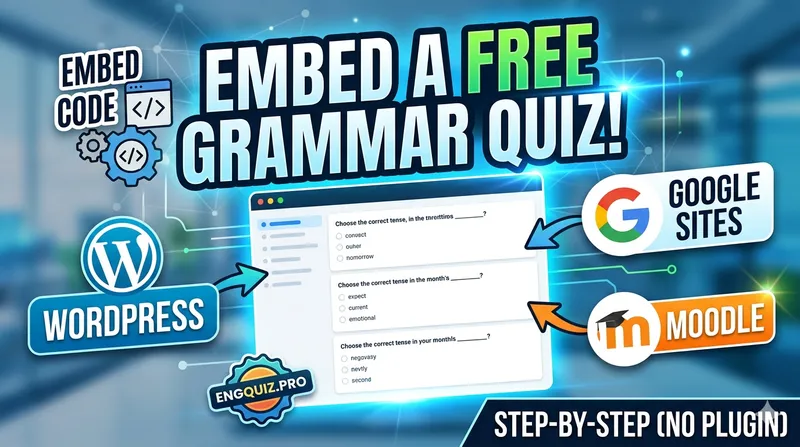
How to Embed a Free English Grammar Quiz on Your Website (WordPress, Google Sites, Moodle)
Step-by-step instructions for adding a free, interactive English grammar quiz to WordPress, Google Sites, Moodle, or any page that accepts HTML. No plugin, no sign-up, no ads.
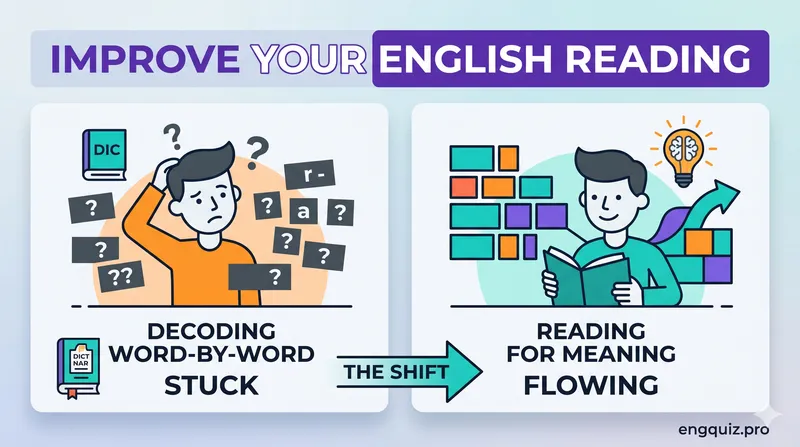
How to Improve English Reading and Actually Understand It
Why the level of the text you choose matters more than the hours you put in, and five exercises that build reading comprehension.
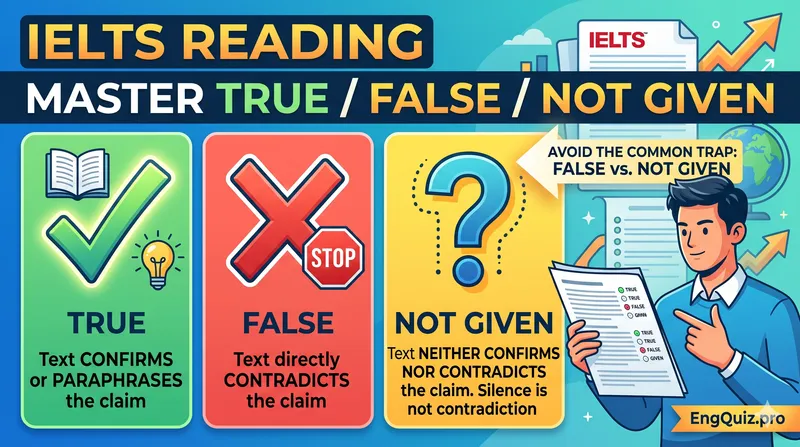
IELTS Reading: How to Master True/False/Not Given
True/False/Not Given is the most-failed IELTS Reading task. Learn the one rule that fixes it, and practise free on real B2/C1 passages with instant feedback.
Related Articles
What Is A1 English Level? Skills, Grammar & First Words
A1 is absolute beginner English at the start of the CEFR scale. Learn what A1 means, the first grammar and words, and how long it takes to reach A2.
What Is B1 English Level? Grammar, Vocabulary & Exams
B1 is intermediate English: the level where you stop surviving and start communicating. Learn B1 grammar, vocabulary, exam scores, and how to reach it.
What Is A2 English Level? Grammar, Vocabulary & Exams
A2 is the elementary CEFR level: survival English for everyday situations. Learn A2 grammar, vocabulary, exam scores, and how long it takes to reach it.