Free English Level Test: Find Your CEFR Level (A2 to C1) in 10 Minutes
Not sure if you are A2, B1, or B2? Take our free 30-question English level test or self-check with the CEFR can-do checklist. No sign-up.
Introduction
Most English level tests tell you a score. The CEFR framework tells you what you can actually do. This guide shows you two ways to find your real level: a free 30-question grammar assessment (~15 minutes) that returns a CEFR level instantly, and a structured self-check using the official CEFR can-do descriptors across reading, writing, listening, and speaking.
Quick answer: The fastest way to find your level is to take our free 30-question CEFR English level test: no sign-up, instant result. If you prefer to assess yourself with the official descriptors, the grammar check and can-do checklist below cover A2 to C1+.
▶ Take the test now
Start the free CEFR level test →: 30 questions, ~15 minutes, instant result. No email or account required.
Why CEFR Self-Assessment Works Better Than Scores
A score of 68% on a random test tells you almost nothing. CEFR descriptors tell you:
- Can I understand a professional email in English? (B1 threshold)
- Can I write a persuasive essay without constant dictionary lookups? (B2–C1 threshold)
- Can I follow a fast-paced debate on an unfamiliar topic? (C1–C2)
Self-assessment, when done honestly, is actually one of the most reliable indicators of language ability, precisely because learners know what they struggle with better than any one-hour test can reveal.
Step 1: Quick Grammar Placement Check
Try to complete each sentence without looking anything up. Note which ones you skip or guess.
Level A2 (Elementary)
- She ___ (go) to school every day. → goes
- There ___ (be) a cat in the garden. → is
- I ___ (not / like) spicy food. → don't like
Level B1 (Intermediate)
- I ___ (live) here since 2020. → have lived
- If it rains, we ___ (stay) inside. → will stay
- She asked me where I ___ (work). → worked
Level B2 (Upper-Intermediate)
- By the time he arrived, we ___ (already / leave). → had already left
- If I ___ (be) you, I would apologise. → were
- The report ___ (write) by the team last week. → was written
Level C1 (Advanced)
- ___ (Have) I known earlier, I would have told you. → Had
- It is essential that she ___ (be) informed immediately. → be
- Rarely ___ (have) I seen such dedication. → have I
Reading your results:
| Correct answers | Approximate level |
|---|---|
| 1–3 | A2 |
| 4–6 | B1 |
| 7–9 | B2 |
| 10–12 | C1–C2 |
This is a quick grammar indicator, not a full placement test. Your level in reading, writing, listening, and speaking may differ.
Want a more reliable result? Our free 30-question CEFR level test covers grammar across all six CEFR bands (A1–C2) and returns a calibrated level with a personalised study plan. It takes about 15 minutes and runs in your browser, with no account and no email.
Step 2: CEFR Can-Do Checklist
Tick each statement that is mostly true for you today. Be honest; this is for your own benefit.
Reading
- I can read simple texts about familiar topics (menus, signs, basic emails) → A2
- I can understand the main points in newspaper articles on familiar topics → B1
- I can read complex professional emails and understand implied meaning → B2
- I can read demanding texts (legal documents, academic papers) with ease → C1
Writing
- I can write a short, simple message or postcard → A2
- I can write a personal email describing an experience or event → B1
- I can write a clear essay arguing a point, with supporting evidence → B2
- I can write complex reports with precise, appropriate register → C1
Listening
- I can follow slow, clear speech on familiar topics → A2
- I can understand the main points of radio programmes on familiar topics → B1
- I can follow extended speech and complex arguments → B2
- I can follow unscripted speech, accents, and indirect expression → C1
Speaking
- I can describe my routine and answer simple personal questions → A2
- I can handle most travel situations and express my opinion simply → B1
- I can interact with fluency with native speakers without strain → B2
- I can use language flexibly for social, academic, and professional purposes → C1
Reading your results:
- Mostly A2 ticks → You are at A2, possibly reaching B1 in some skills. See what A2 (Elementary) English looks like in practice to confirm the fit and plan the move to B1.
- Mostly B1 ticks → You are at B1. See What Is B1 English Level? to confirm the fit, then review B2 descriptors for stretch goals
- Mostly B2 ticks → You are at B2; start practising C1 grammar and vocabulary
- Mostly C1 ticks → You are at C1 or above. See what C1 (Advanced) English looks like in practice for the grammar, vocabulary, and exam mapping.
Step 3: Find Your Weakest Skill
Almost every learner has one skill that lags behind the others. This is your priority area.
| If your weakest skill is... | Focus on... |
|---|---|
| Reading | Extensive reading: graded readers at your level, then authentic articles |
| Writing | Daily journal writing + grammar exercises targeting your B-level errors |
| Listening | Podcasts and YouTube at natural speed; shadowing technique |
| Speaking | Structured speaking practice with a partner or app; record yourself |
How Long to Reach Each Level from Here?
| From | To | Estimated hours | Approximate timeline (1h/day) |
|---|---|---|---|
| A2 | B1 | 200–300 hours | 7–10 months |
| B1 | B2 | 300–400 hours | 10–14 months |
| B2 | C1 | 400–500 hours | 14–18 months |
These are guided-study hours: time spent actively doing grammar exercises, reading with comprehension checks, or speaking with feedback. Passive exposure (background TV, music) counts for much less.
What to Do After Your Self-Assessment
Once you know your approximate level:
-
Confirm it with the calibrated assessment. Take our free 30-question CEFR test for a benchmarked second opinion. The questions are calibrated against the CEFR descriptors and the official Cambridge / IELTS band ranges referenced in CEFR Levels Explained.
-
Set a realistic goal. Moving one full CEFR level takes 300–500 hours of deliberate practice. Half a level (e.g., solid B1 to shaky B2) takes 100–150 hours.
-
Focus on your bottleneck. If your grammar is B2 but your vocabulary is B1, vocabulary is your bottleneck. Grammar practice beyond your current gap returns diminishing results.
-
Track progress monthly. Redo the assessment every 4–6 weeks. CEFR progress is slow to start and then feels sudden; most learners notice a jump rather than a gradual rise.
How our assessment differs from the self-check above
The grammar placement check on this page is a 12-item indicator. The full CEFR level test is calibrated against the framework on the methodology page: 30 items spread across the six CEFR bands, with distractor difficulty tuned to the target level so the result distinguishes high-A2 from low-B1, high-B1 from low-B2, and so on. Both are free and run in your browser.
Grammar Practice at Your Level
EngQuiz Pro has free grammar exercises calibrated to each CEFR level. Start with the level you scored in Step 1:
- A2 exercises: Articles, present simple, basic questions
- B1 exercises: Present perfect, past continuous, first conditional
- B2 exercises: Modal perfects, passive voice, conditionals (all types)
- C1 exercises: Inversion, cleft sentences, advanced passives
No account required. Start an exercise, get instant feedback, and see a detailed explanation for every answer.
Frequently Asked Questions
No. Official exams (Cambridge, IELTS, TOEIC) are standardised across thousands of test-takers. This self-assessment gives you a useful approximation, especially if you are honest about your weaknesses. Use it to guide your study, not to put on a CV.
The UK Home Office requires at least B1 for most visa categories (spouse visa, tier 2 work visa). The IELTS Life Skills test at B1 is the most common way to prove this.
IELTS 6.0 corresponds roughly to B2 on the CEFR scale. Different institutions set their own minimum; many UK universities require 6.5 (also B2, towards the upper end).
Every 6–8 weeks of active study is a reasonable interval. Retesting too often (weekly) can be discouraging because progress is not linear. Retesting too infrequently (annually) means you miss opportunities to adjust your study focus.
A1 is below A2. If you found the A2 grammar questions above difficult, you are likely at A1. For a full A1 breakdown (what it means, the first grammar to study, and how to move to A2), see What Is A1 English Level?. EngQuiz Pro's exercise bank focuses on A2 and above, where learners have enough grammar to start doing productive exercises.
New Articles

How to Embed a Free English Grammar Quiz on Your Website (WordPress, Google Sites, Moodle)
Step-by-step instructions for adding a free, interactive English grammar quiz to WordPress, Google Sites, Moodle, or any page that accepts HTML. No plugin, no sign-up, no ads.
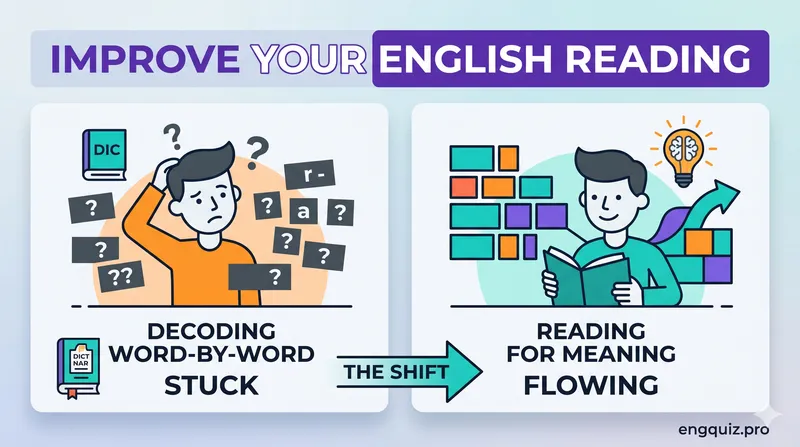
How to Improve English Reading and Actually Understand It
Why the level of the text you choose matters more than the hours you put in, and five exercises that build reading comprehension.
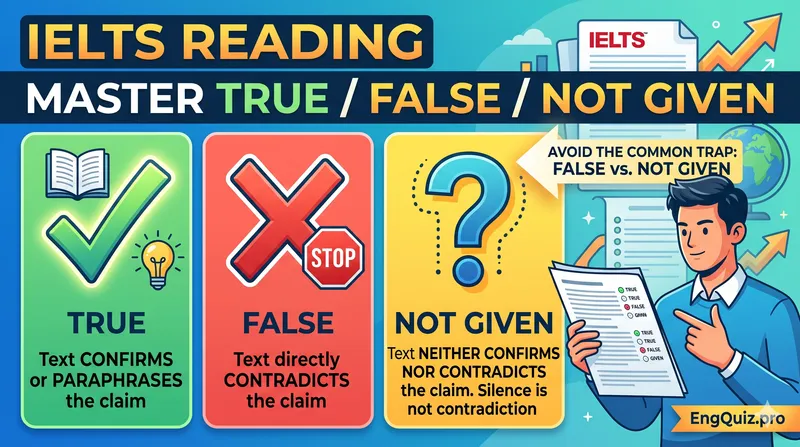
IELTS Reading: How to Master True/False/Not Given
True/False/Not Given is the most-failed IELTS Reading task. Learn the one rule that fixes it, and practise free on real B2/C1 passages with instant feedback.
Related Articles

What Is A1 English Level? Skills, Grammar & First Words
A1 is absolute beginner English at the start of the CEFR scale. Learn what A1 means, the first grammar and words, and how long it takes to reach A2.
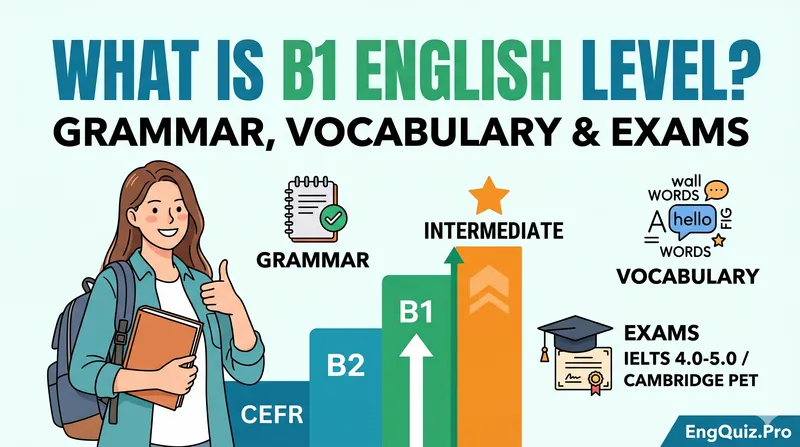
What Is B1 English Level? Grammar, Vocabulary & Exams
B1 is intermediate English: the level where you stop surviving and start communicating. Learn B1 grammar, vocabulary, exam scores, and how to reach it.
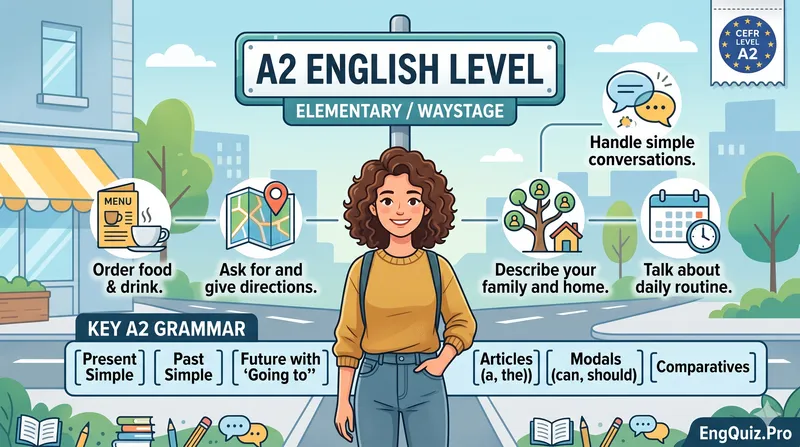
What Is A2 English Level? Grammar, Vocabulary & Exams
A2 is the elementary CEFR level: survival English for everyday situations. Learn A2 grammar, vocabulary, exam scores, and how long it takes to reach it.