IELTS Grammar: The 10 Most Tested Structures (With Examples)
Master IELTS grammar by targeting these 10 structures, the ones that separate Band 6.0 from Band 7.0 in Writing and Speaking. Examples + exercises.
Introduction
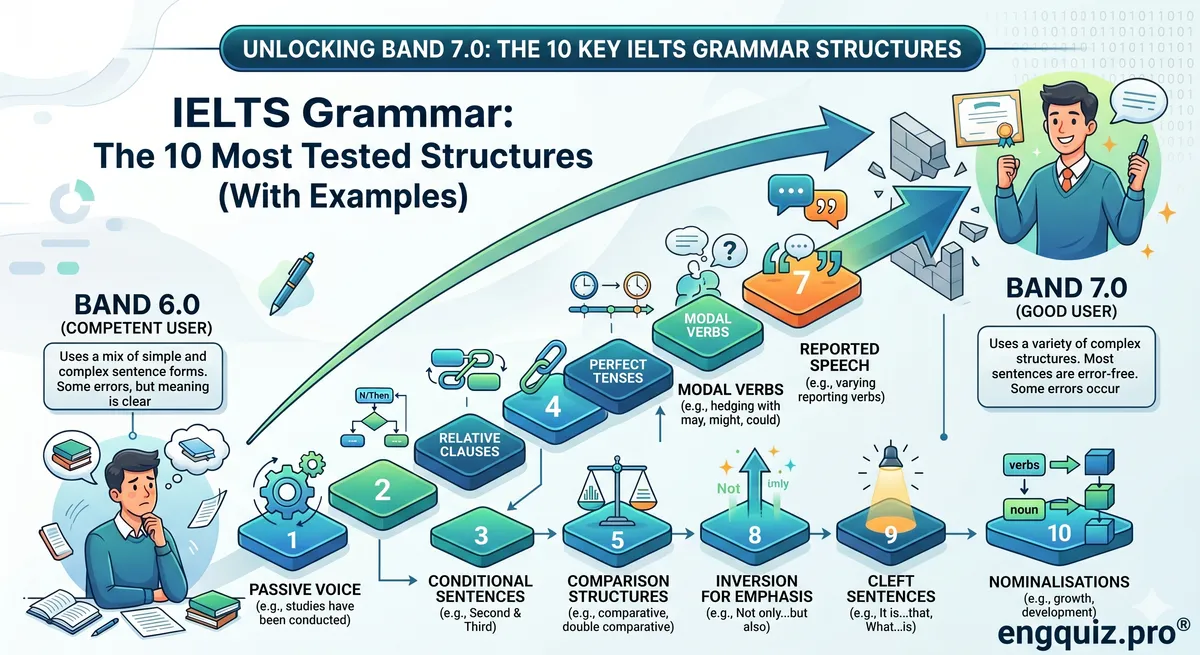
IELTS does not have a dedicated grammar section; grammar is assessed through your Writing and Speaking scores. But there are 10 grammar structures that appear in the highest-scoring Band 7+ responses, and that are conspicuously absent in Band 5–6 answers.
If you learn these 10 structures and practise using them accurately, you will meet the Grammatical Range and Accuracy criteria that IELTS examiners use to award higher band scores. Not sure whether IELTS is the right exam for you? See our IELTS vs TOEIC vs Cambridge guide first.
Quick answer: The 10 most tested IELTS grammar structures are: passive voice, conditional sentences (all types), relative clauses, perfect tenses, comparison structures, modal verbs, reported speech, inversion for emphasis, cleft sentences, and nominalisations. Using a variety of these structures accurately is what separates Band 6.0 from Band 7.0.
How Grammar Is Assessed in IELTS
In IELTS Academic Writing:
| Band | Grammatical Range and Accuracy description |
|---|---|
| 5.0 | Uses a limited range of structures; errors are frequent and may impede communication |
| 6.0 | Uses a mix of simple and complex sentence forms; some errors, but meaning is clear |
| 7.0 | Uses a variety of complex structures; most sentences are error-free; some errors occur |
| 8.0 | Wide range of structures used with full flexibility and accuracy; rare minor errors |
Key insight: Moving from Band 6 to Band 7 is primarily about range (using more complex structures) and accuracy (using them without error). You need both.
Structure 1: Passive Voice
The passive voice is essential in IELTS Academic writing, which often discusses processes, research, and phenomena, not personal actions.
Formation: be + past participle (in any tense)
| Tense | Passive form | Example |
|---|---|---|
| Present simple | is/are + pp | Greenhouse gases are released into the atmosphere. |
| Past simple | was/were + pp | The policy was introduced in 2015. |
| Present perfect | has/have been + pp | Several studies have been conducted on this topic. |
| Future | will be + pp | The report will be published next month. |
| Modal | must/should be + pp | These emissions must be reduced significantly. |
IELTS usage: Describing graphs, processes (Task 1), and stating general facts (Task 2) all frequently require passive voice.
Structure 2: Conditional Sentences
IELTS Writing Task 2 often asks for causes, effects, hypotheticals, and recommendations, all of which require the five conditional types working as one system.
| Type | Form | Use in IELTS |
|---|---|---|
| Zero | If + present, present | General truths, scientific facts |
| First | If + present, will | Likely future scenarios |
| Second | If + past, would | Hypothetical arguments, policy suggestions |
| Third | If + past perfect, would have | Historical analysis, counterfactuals |
| Mixed | If + past perfect, would | Past cause, present effect |
Band 7+ examples:
- If governments invested more in public transport, carbon emissions would fall significantly. (second conditional, policy recommendation)
- Had the policy been introduced earlier, fewer people would have been affected. (inverted third conditional, historical analysis)
Structure 3: Relative Clauses
Relative clauses allow you to combine information and avoid short, simple sentences that signal a Band 5–6 range.
| Type | Example |
|---|---|
| Defining | People who exercise regularly tend to live longer. |
| Non-defining | The report, which was published last year, found significant differences. |
| Reduced defining | The policy introduced in 2020 has had mixed results. |
| Relative of place | This is the city where the policy was first tested. |
Practice: Take any two-sentence idea and combine them with a relative clause. "The study was conducted in 2022. The study found significant results." → "The study conducted in 2022 found significant results."
Structure 4: Perfect Tenses
IELTS Writing Task 1 (trend graphs) and Task 2 (background context, result statements) both require perfect tenses.
| Tense | Use | Example |
|---|---|---|
| Present perfect | Recent trends, current state | Rates have increased significantly over the past decade. |
| Present perfect continuous | Ongoing process | Researchers have been investigating this phenomenon for years. |
| Past perfect | Earlier past action in a narrative | By 2010, the government had already implemented three policies. |
| Future perfect | Prediction by a deadline | By 2030, emissions will have fallen by 40%. |
Structure 5: Comparison Structures
IELTS Academic Task 1 requires you to compare data. Task 2 often requires comparing perspectives or solutions.
| Structure | Example |
|---|---|
| Comparative adjective | Urban populations grew faster than rural ones. |
| Superlative | The highest proportion was recorded in 2020. |
| as … as | Renewable energy is not as expensive as it was a decade ago. |
| While / whereas | While developed nations reduced emissions, developing countries saw an increase. |
| In contrast to | In contrast to the UK, France maintained stable employment rates. |
| Double comparative | The more urbanised a population, the greater the demand for infrastructure. |
Structure 6: Modal Verbs
Modal verbs allow you to hedge claims, make recommendations, and discuss possibilities, all essential for Band 7+ writing.
| Modal | Use | Example |
|---|---|---|
| must | strong obligation, logical deduction | Governments must take immediate action. |
| should | recommendation | Schools should teach critical thinking skills. |
| may / might | possibility, hedging | This trend may reverse in coming decades. |
| could | suggestion, possibility | Taxation could be used as an incentive. |
| would | hypothetical | An investment in infrastructure would create jobs. |
| can / cannot | possibility, impossibility | Technology cannot solve all environmental problems. |
Band 7+ insight: Vary your modals. Band 5–6 essays often use only should and must. Band 7+ essays use may, might, could, would, and tend to for appropriate hedging. The other underused choice point at Band 6–7 is the future: examiners notice when candidates default to will for every future reference; see will vs going to for the future for when each form is more appropriate (predictions vs already-formed plans).
Structure 7: Reported Speech
IELTS Task 2 may ask you to discuss opinions, research, or arguments, which require accurate reported speech.
| Direct | Reported |
|---|---|
| "Globalisation benefits everyone." | Some argue that globalisation benefits everyone. |
| "We will reduce emissions by 2030." | The government stated that it would reduce emissions by 2030. |
| "Stop using single-use plastics." | Campaigners urge governments to stop using single-use plastics. |
Reporting verbs for IELTS: argue, suggest, claim, indicate, demonstrate, reveal, contend, assert, propose, acknowledge, note
Structure 8: Inversion for Emphasis
Inversion is a C1 structure that signals grammatical range to IELTS examiners. It is particularly effective at the start of a paragraph for emphasis.
| Structure | Example |
|---|---|
| Not only…but also | Not only does air pollution damage health, but it also reduces economic productivity. |
| Rarely | Rarely have governments acted so decisively on climate change. |
| Under no circumstances | Under no circumstances should personal data be sold to third parties. |
| Negative adverbials | Seldom is a problem as simple as it first appears. |
| Conditional inversion | Were governments to invest more in education, inequality would decrease. |
Usage tip: One or two inversions per essay is appropriate. More than that sounds forced.
Structure 9: Cleft Sentences
Cleft sentences emphasise a specific element of a clause:
| Type | Example |
|---|---|
| It is/was… that | It is education that makes the greatest difference. |
| What… is | What the data clearly shows is that the trend has reversed. |
| The reason… is (that) | The reason crime has fallen is that more resources were invested in prevention. |
Structure 10: Nominalisations
Nominalisation (turning verbs or adjectives into nouns) is a hallmark of academic register. IELTS examiners award higher band scores for academic vocabulary.
| Verb/Adjective | Nominalisation | Example |
|---|---|---|
| grow | growth | Economic growth has slowed. |
| develop | development | Sustainable development is a priority. |
| argue | argument | The argument for taxation is persuasive. |
| significant | significance | The significance of this trend cannot be ignored. |
| improve | improvement | There has been a measurable improvement. |
| reduce | reduction | A significant reduction in emissions was observed. |
Your Band Score Grammar Roadmap
| Current band | Priority structures to add |
|---|---|
| 5.0–5.5 | Passive voice, basic conditionals, present perfect |
| 5.5–6.0 | Relative clauses, comparison structures, reported speech |
| 6.0–6.5 | Perfect tenses (all), modal range, nominalisations |
| 6.5–7.0 | Inversion, cleft sentences, mixed conditionals |
| 7.0+ | Consistent accuracy across all structures + register control |
Practise IELTS Grammar Now
EngQuiz Pro has free B2 grammar exercises targeting the exact structures assessed in IELTS Writing and Speaking: passive voice, conditionals, perfect tenses, and more. No sign-up required.
→ Start a free IELTS-level grammar exercise →
Go deeper: theory pages for each structure
Each of the 10 structures above has a dedicated theory page on EngQuiz.Pro. The theory pages give you the full form table, signal words, common mistakes, and direct links to practice exercises:
- Perfect tenses (Structure 4): Present Perfect and Past Perfect; for stressing duration before a past moment, the Past Perfect Continuous
- Passive voice (Structure 1): pattern reference covered across the tense theory pages, especially past simple and present perfect
- Conditionals (Structure 2): conditionals hub; jump to first, second, third or mixed conditionals
- Relative clauses (Structure 3): relative clauses hub, including defining vs non-defining and when to omit the relative pronoun
- Modal verbs (Structure 6): modals hub
- Reported speech (Structure 7): covered in the tense theory pages with full back-shifting tables
If you would like to see how we source and review the grammar coverage on these pages, see our methodology page.
Frequently Asked Questions
No, there is no separate grammar section. Grammar is assessed as part of Writing (Grammatical Range and Accuracy criterion) and Speaking (Grammatical Range and Accuracy criterion). Both criteria account for 25% of each section's score.
Most UK universities require an overall IELTS Band 6.0–6.5 for undergraduate admission and 6.5–7.0 for postgraduate. Individual section minimums vary; writing and reading sections often have specific floor requirements.
Frequent basic errors (subject-verb agreement, wrong tense, wrong article) signal a Band 5 range. Occasional complex errors do not significantly penalise a Band 7 candidate, as examiners expect some slips at this level. The key distinction: errors that impede communication vs errors that do not.
A structural template helps with organisation (Task Response and Coherence criteria), but memorised phrases are penalised if examiners suspect rote learning. Learn the grammar structures, not fixed phrases.
New Articles

How to Embed a Free English Grammar Quiz on Your Website (WordPress, Google Sites, Moodle)
Step-by-step instructions for adding a free, interactive English grammar quiz to WordPress, Google Sites, Moodle, or any page that accepts HTML. No plugin, no sign-up, no ads.
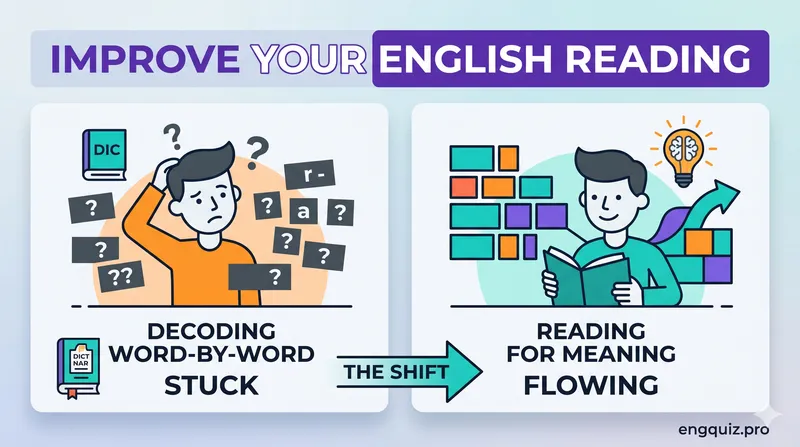
How to Improve English Reading and Actually Understand It
Why the level of the text you choose matters more than the hours you put in, and five exercises that build reading comprehension.
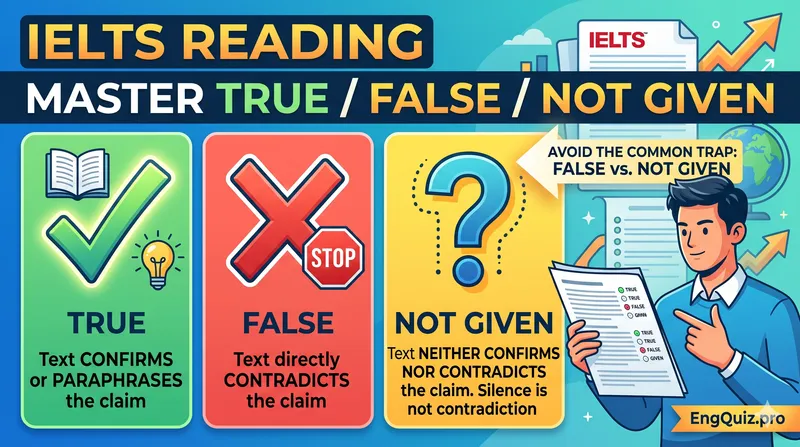
IELTS Reading: How to Master True/False/Not Given
True/False/Not Given is the most-failed IELTS Reading task. Learn the one rule that fixes it, and practise free on real B2/C1 passages with instant feedback.
Related Articles
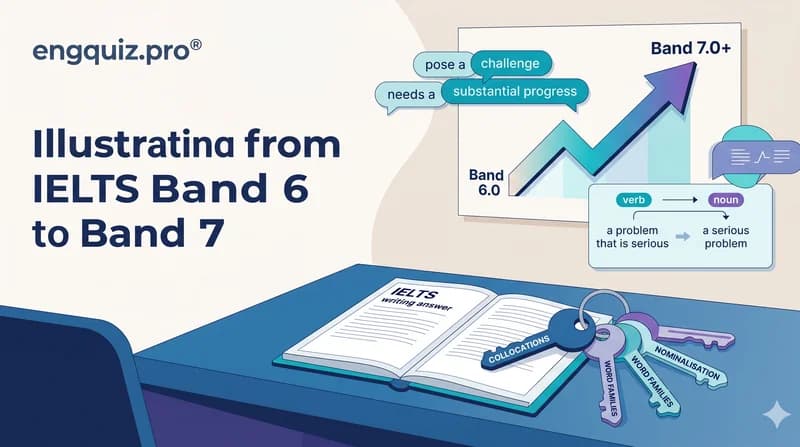
Academic Vocabulary for IELTS Writing: How to Move From Band 6 to Band 7
Lexical Resource is 25% of your IELTS Writing score, and most learners attack it backwards. Here is what Band 7 vocabulary actually looks like, and how to get there.
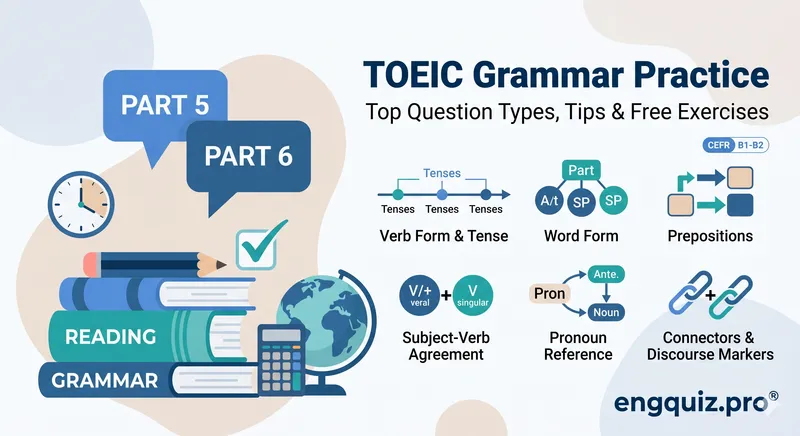
TOEIC Grammar Practice: Top Question Types, Tips & Free Exercises
Preparing for TOEIC? This guide covers the top grammar patterns tested in the TOEIC Reading section, with practice tips and free exercises at B1–B2 level.
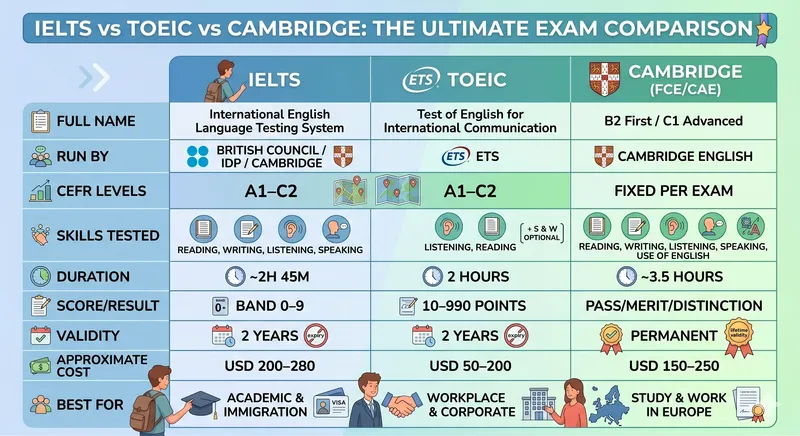
IELTS vs TOEIC vs Cambridge: Which English Exam Is Right for You?
Choosing between IELTS, TOEIC, and Cambridge exams? This guide compares all three: format, cost, recognition, and which one fits your goal.