TOEIC for Vietnamese Learners: Common Mistakes, Tips & Free Practice
Vietnamese learners face specific TOEIC challenges: articles, tenses, and listening speed. Fix the four weak points that hurt your score most.
Introduction
Vietnam has one of the most active TOEIC testing communities in Asia. Hundreds of thousands of Vietnamese learners take the TOEIC exam every year for university graduation requirements, government employment, and corporate promotion.
Yet many Vietnamese learners score below their potential, not because they lack vocabulary or grammar knowledge, but because of a specific set of errors that arise from the differences between Vietnamese and English. This guide targets those errors directly.
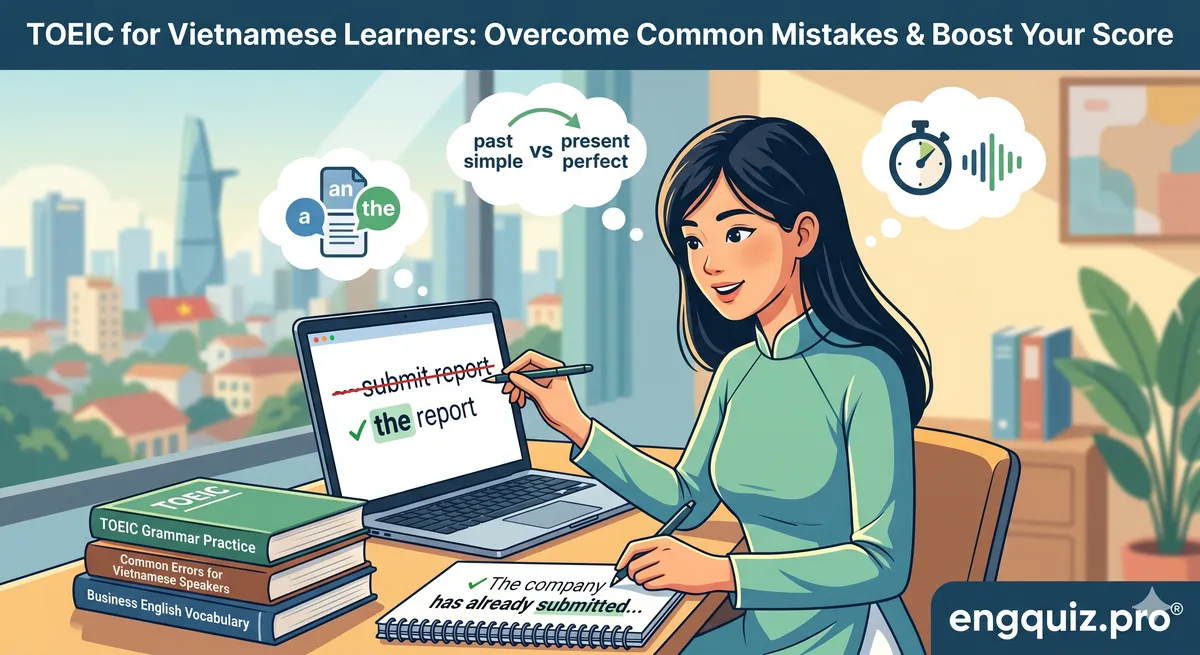
Quick answer: Vietnamese learners most commonly lose TOEIC points on: articles (a/an/the, which Vietnamese does not have), verb tenses (especially present perfect and passive voice), preposition collocations, and listening speed. Fixing these four areas has the highest return on study time.
Why Vietnamese Learners Face Specific TOEIC Challenges
Vietnamese is an analytic, isolating language. It does not use:
- Articles (no equivalent of a, an, the)
- Verb conjugation (verbs do not change form for tense; time is shown by time words)
- Grammatical gender (no he/she distinction in older dialects)
- Inflectional morphology (no -ed, -ing, -s endings)
These four structural differences produce predictable learner errors in English, exactly the kinds that appear in TOEIC Part 5 questions.
The 4 Most Common TOEIC Errors for Vietnamese Learners
Error 1: Articles (a / an / the)
Vietnamese has no article system. Whether a noun is specific or general, definite or indefinite, is understood from context, not from a grammatical marker. In English, articles are mandatory in most noun phrases.
Common mistakes:
Please send report to manager.✓ Please send the report to the manager. (specific, known to both parties)
We need information about project.✓ We need some information about the project.
TOEIC strategy for articles:
- Is the noun specific and known to both speaker and listener? → the
- Is the noun mentioned for the first time? → a / an
- Is it uncountable or plural in a general sense? → no article
- Job titles after be: She is a manager. (with article, one of many managers)
Practice drill: Every time you read an English sentence today, stop at every noun phrase and ask: why is there an article here, or why isn't there one?
Error 2: Verb Tenses, Especially Present Perfect and Passive
Vietnamese shows time through adverbs (đã = past, sẽ = future, đang = ongoing). English encodes time directly in the verb form. This creates systematic confusion.
Most problematic for TOEIC:
Present perfect vs past simple:
The company already submit the report.✓ The company has already submitted the report. (recent action with present relevance)
The decision make last week.✓ The decision was made last week.
TOEIC passive patterns you must know:
| Active | Passive |
|---|---|
| They reviewed the proposal. | The proposal was reviewed. |
| Someone has sent the invoice. | The invoice has been sent. |
| They will announce results Friday. | Results will be announced Friday. |
| We are processing your application. | Your application is being processed. |
Quick test: In TOEIC Part 5, if the subject of the sentence cannot do the action (e.g., the report cannot submit itself), the verb must be passive.
Error 3: Preposition Collocations
Vietnamese prepositions (ở, tại, vào, với, cho, về) do not map directly onto English prepositions. Many English preposition uses are fixed collocations; they cannot be translated logically.
High-frequency TOEIC prepositions Vietnamese learners often get wrong:
| Incorrect | Correct | Note |
|---|---|---|
| interested in | fixed collocation | |
| comply with | fixed collocation | |
| result in | cause = result in; effect = result from | |
| apply for a job | application process | |
| discuss (no preposition) | discuss is transitive, so no about is needed | |
| contact (no preposition) | contact someone directly | |
| arrive at/in | arrive at (small place), arrive in (city/country) |
TOEIC strategy: Learn collocations as chunks, not individual words. Comply with, responsible for, interested in, result in: memorise these as fixed phrases.
Error 4: Listening Speed and Connected Speech
Vietnamese has a stress-timed rhythm at the syllable level. English is stress-timed at the word level, meaning unstressed syllables are reduced, swallowed, or linked together. This creates the "too fast" perception that many Vietnamese learners report.
TOEIC Listening patterns that reduce:
| Written | Spoken |
|---|---|
| going to | "gonna" |
| want to | "wanna" |
| have to | "hafta" |
| Did you | "Dijja" |
| Could you | "Coudja" |
| I would have | "I would've" |
TOEIC Listening Parts 3 and 4 use natural connected speech, not the slow, clear pronunciation of Part 1 and 2 photos/statements.
Strategy: Listen to TOEIC Part 3/4 audio at 1.0× speed first, then at 1.25× speed during practice. Train your ear to hear reduced forms as complete words.
TOEIC Score Requirements in Vietnam
| Context | Typical TOEIC Requirement |
|---|---|
| University graduation (public universities) | 450–550 depending on institution |
| Civil service / government jobs | 450–650 depending on grade |
| Private corporation entry-level | 500–600 |
| Multinational company / foreign-owned firm | 700–800 |
| Promotion or management roles | 750–850 |
| International roles (regular English communication) | 800+ |
How to Prepare Efficiently
Weeks 1–4: Foundation
- Review the six grammar patterns in our TOEIC Grammar Practice guide
- Learn 200 high-frequency TOEIC words (business vocabulary: negotiate, implement, proposal, deadline)
- Do 15 Part 5 questions per day with explanation review
Weeks 5–8: Pattern Training
- Do one full Part 5 + Part 6 set (46 questions) every two days, timed
- Review every wrong answer and understand why it was wrong, not just what was right
- Practise TOEIC Listening Parts 1–4 with transcript: listen, then read, then listen again
- Drill the five conditional sentence types; Vietnamese has no morphological conditional, so if + would / if + past errors are particularly common in Part 6 cloze items
Weeks 9–12: Full Practice Tests
- Do one full TOEIC Reading section (75 minutes, 100 questions) per week
- Target Part 7 last, focusing on question types: inference, reference, NOT questions
- Analyse score by part: identify your weakest part and double time there
TOEIC Practice for Vietnamese Learners
EngQuiz Pro has free B1 and B2 grammar exercises targeting the exact structures Vietnamese learners find hardest: articles, tenses, passive voice, and prepositions. No sign-up required.
→ Start Free TOEIC-Level Grammar Practice →
Tóm tắt nhanh (tiếng Việt)
Phần tóm tắt ngắn dành cho người học Việt Nam. Toàn bộ nội dung chi tiết ở các phần phía trên bằng tiếng Anh.
TOEIC là gì? Bài thi đánh giá tiếng Anh giao tiếp trong môi trường công việc, do ETS (Mỹ) phát triển và IIG Việt Nam quản lý. Phổ biến nhất với mục đích tốt nghiệp đại học và xin việc tại Việt Nam.
Điểm số cần đạt:
- 450 điểm: chuẩn tốt nghiệp tại hầu hết các trường công lập (tương đương B1 CEFR).
- 500–600 điểm: yêu cầu của các trường top như FTU, HUST, NEU.
- 700–800 điểm: yêu cầu của các công ty đa quốc gia cho vị trí senior.
4 lỗi phổ biến nhất của người Việt:
- Mạo từ (a / an / the): tiếng Việt không có mạo từ nên đây là lỗi đầu tiên cần luyện. Đặc biệt là the trước danh từ đã xác định.
- Thì hoàn thành (present perfect): người Việt thường dùng quá khứ đơn thay cho hiện tại hoàn thành. Ví dụ sai: I worked here for 3 years → đúng: I have worked here for 3 years.
- Câu bị động (passive voice): TOEIC Part 5 và Part 6 kiểm tra rất nhiều dạng bị động ở các thì khác nhau.
- Giới từ (prepositions): in / on / at dùng cho thời gian; for / since dùng cho khoảng thời gian; by / until dùng cho hạn chót.
Tốc độ nghe (Part 1–4): Bài nghe TOEIC chạy ở tốc độ tự nhiên (~150 từ/phút). Người Việt thường chỉ luyện ở tốc độ chậm (~120 từ/phút) nên dễ mất điểm. Khuyến nghị: nghe BBC Learning English hoặc TED-Ed mỗi ngày 15–20 phút.
Lộ trình 8 tuần đề xuất:
- Tuần 1–2: Ngữ pháp cơ bản: mạo từ, thì hiện tại đơn, hiện tại hoàn thành. Làm 30 câu Part 5 mỗi ngày.
- Tuần 3–4: Bị động, mệnh đề quan hệ, câu điều kiện. Bắt đầu luyện Part 6 (đoạn văn điền từ).
- Tuần 5–6: Toàn bộ Part 7 (đọc hiểu): tốc độ đọc + scanning. Bài full mock một tuần một lần.
- Tuần 7–8: Full mock 2 lần/tuần. Chữa lỗi và làm lại các câu sai.
Đăng ký thi: IIG Việt Nam (iigvietnam.com) có lịch thi hàng tháng ở Hà Nội, TP. Hồ Chí Minh, Đà Nẵng và các tỉnh lớn. Lệ phí dao động từ 1.000.000 đến 1.500.000 VND tùy thời điểm.
Lưu ý: Phần tóm tắt tiếng Việt được biên soạn để tham khảo nhanh. Nội dung chi tiết và ví dụ đầy đủ ở các phần tiếng Anh phía trên; luyện đọc tiếng Anh là một phần trong quá trình chuẩn bị cho TOEIC.
Frequently Asked Questions
Requirements vary by institution. Most public universities in Vietnam require 450 (B1 threshold). Some competitive universities (FTU, HUST, NEU) require 500–600. Check your specific university's policy, as requirements have been updated frequently in recent years.
Yes. The TOEIC Listening & Reading test administered by IIG Vietnam is the same exam as the one taken worldwide, using official ETS materials. Scores are directly comparable.
You can retake the TOEIC at any time; there is no waiting period. TOEIC test dates in Vietnam are available monthly through IIG Vietnam testing centres in Hanoi, Ho Chi Minh City, Da Nang, and other cities.
TOEIC is most recognised in Asia. In Europe, most employers and universities prefer Cambridge or IELTS. If you are targeting a job at a multinational company in Vietnam, TOEIC is exactly what they want. For study abroad in English-speaking countries, IELTS or TOEFL is required.
It depends on your goal. TOEIC is cheaper, shorter, and specifically valued by Vietnamese employers and universities. IELTS is required for immigration to the UK, Australia, or Canada, and for most foreign university applications. If you want to study or live abroad, start with IELTS. If your goal is a domestic career or government role, TOEIC is more directly relevant.
New Articles

How to Embed a Free English Grammar Quiz on Your Website (WordPress, Google Sites, Moodle)
Step-by-step instructions for adding a free, interactive English grammar quiz to WordPress, Google Sites, Moodle, or any page that accepts HTML. No plugin, no sign-up, no ads.
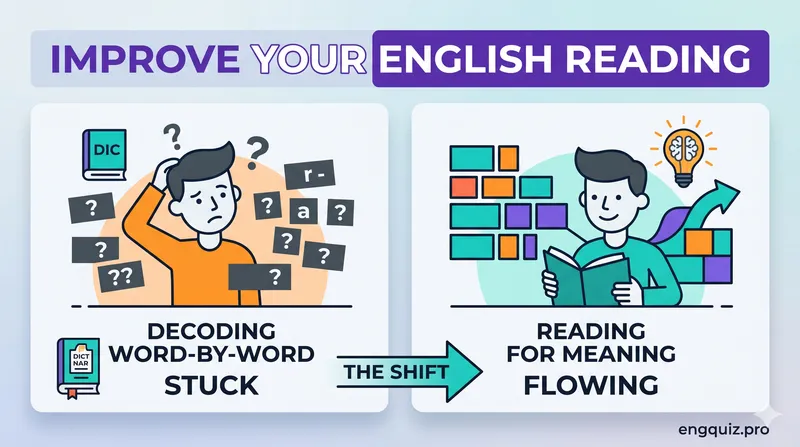
How to Improve English Reading and Actually Understand It
Why the level of the text you choose matters more than the hours you put in, and five exercises that build reading comprehension.
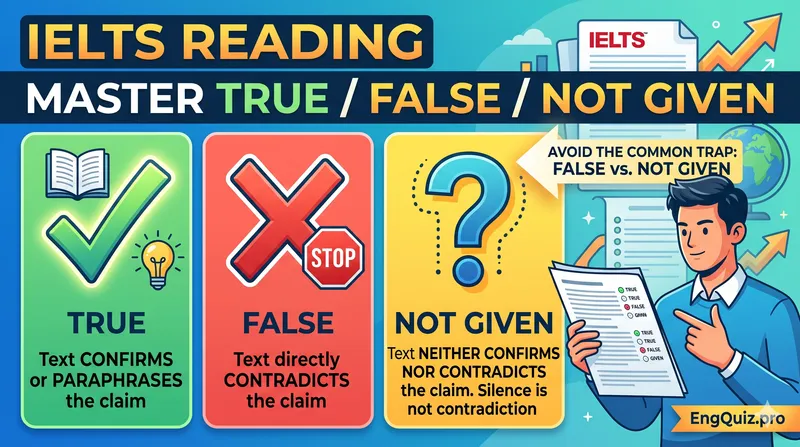
IELTS Reading: How to Master True/False/Not Given
True/False/Not Given is the most-failed IELTS Reading task. Learn the one rule that fixes it, and practise free on real B2/C1 passages with instant feedback.
Related Articles
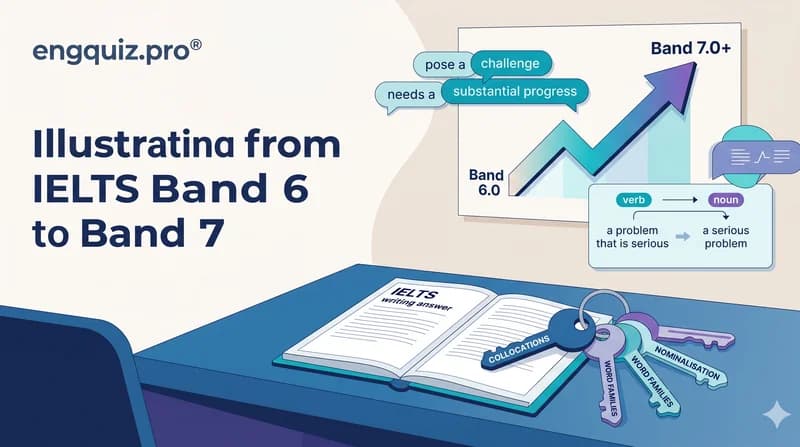
Academic Vocabulary for IELTS Writing: How to Move From Band 6 to Band 7
Lexical Resource is 25% of your IELTS Writing score, and most learners attack it backwards. Here is what Band 7 vocabulary actually looks like, and how to get there.
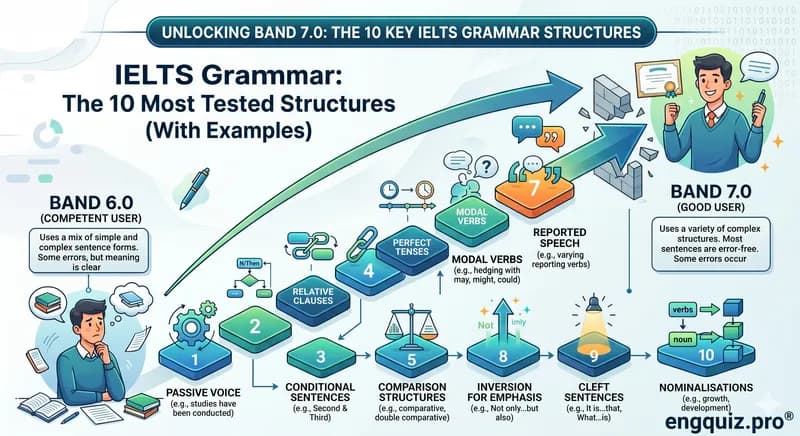
IELTS Grammar: The 10 Most Tested Structures (With Examples)
Master IELTS grammar by targeting these 10 structures, the ones that separate Band 6.0 from Band 7.0 in Writing and Speaking. Examples + exercises.
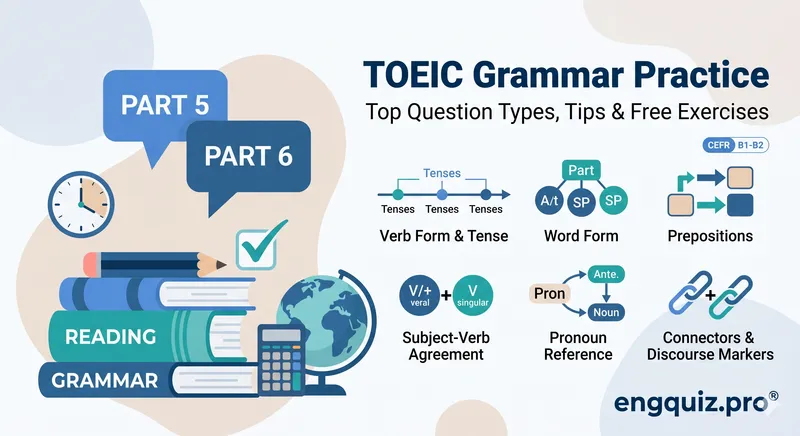
TOEIC Grammar Practice: Top Question Types, Tips & Free Exercises
Preparing for TOEIC? This guide covers the top grammar patterns tested in the TOEIC Reading section, with practice tips and free exercises at B1–B2 level.