TOEIC Grammar Practice: Top Question Types, Tips & Free Exercises
Preparing for TOEIC? This guide covers the top grammar patterns tested in the TOEIC Reading section, with practice tips and free exercises at B1–B2 level.
Introduction
The TOEIC exam is not a general grammar test; it tests a very specific set of patterns that appear in workplace communication. Understanding which grammar points appear most often in the TOEIC Reading section, and practising those specifically, is far more efficient than revising all of English grammar.
This guide covers the top grammar question types in TOEIC Part 5 and Part 6, explains the patterns that repeat most often, and gives you a targeted practice plan.
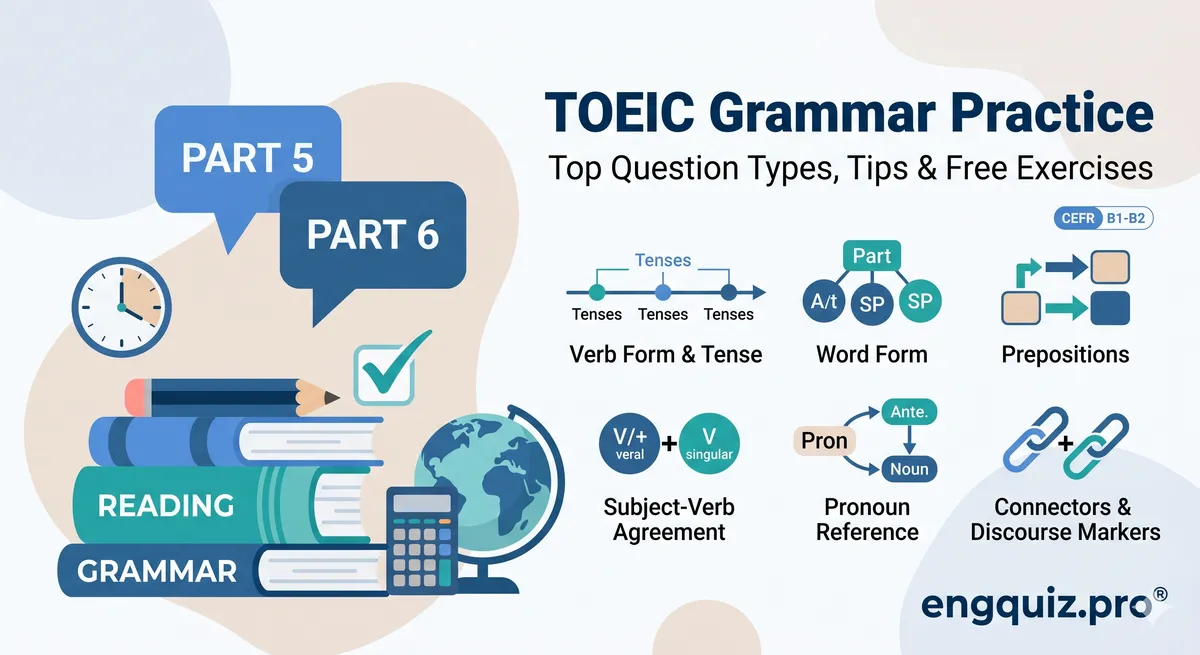
Quick answer: TOEIC grammar questions (Parts 5 and 6) most commonly test: verb form and tense, vocabulary in context, prepositions, pronoun reference, subject-verb agreement, and word form (noun/adjective/adverb). Master these six areas to maximise your score.
How Grammar Appears on the TOEIC
The TOEIC Reading section has three parts:
| Part | Format | Questions | Grammar relevance |
|---|---|---|---|
| Part 5 | Incomplete sentences | 30 questions | Very high: pure grammar/vocabulary |
| Part 6 | Incomplete texts | 16 questions | High: grammar in context |
| Part 7 | Reading comprehension | 54 questions | Lower: comprehension, not grammar |
Most test-takers lose the most points in Parts 5 and 6. Part 7 rewards reading stamina and vocabulary; Parts 5 and 6 reward grammar pattern recognition.
The Top 6 TOEIC Grammar Patterns
1. Verb Form and Tense
TOEIC questions frequently ask you to choose between different verb forms. Time expressions are often your strongest clue.
Common patterns:
| Time expression | Tense to use |
|---|---|
| currently, now, at the moment | Present continuous |
| always, every day, usually | Present simple |
| last year, in 2023, ago | Past simple |
| since, for (ongoing) | Present perfect |
| by the time, by next month | Future perfect |
| while, when (past narrative) | Past continuous |
Part 5 also tests the will / be going to contrast for the future; see will vs going to for the prediction-vs-plan distinction examiners look for.
Example TOEIC question: The board ___ the merger proposal when the announcement was made. (A) discuss (B) is discussing (C) was discussing (D) has discussed
Answer: (C) because when + past event → the longer past action in progress = past continuous
2. Word Form (Parts of Speech)
TOEIC questions often test whether you can recognise which part of speech fits the sentence: noun, verb, adjective, or adverb.
Strategy: Look at the word's position in the sentence.
- After the/a/an → noun
- Before a noun → adjective
- After be (linking verb) → adjective or noun
- Modifies a verb or adjective → adverb
Example: The ___ of the new policy will take effect next Monday. (A) implement (B) implemented (C) implementation (D) implementing
Answer: (C) because position after the → noun; implementation (noun form)
Common word family patterns:
| Base | Noun | Verb | Adjective | Adverb |
|---|---|---|---|---|
| explain | explanation | explain | explanatory | – |
| manage | management | manage | managerial | managerially |
| efficient | efficiency | – | efficient | efficiently |
| approve | approval | approve | approved | – |
For the full system behind these patterns (the suffix rules that turn a verb into its noun, adjective and adverb forms), see our word formation guide. Word-form questions reward learners who recognise -tion, -ment, -al, -ly as productive rules, not as isolated word endings to memorise.
3. Prepositions
Preposition errors are extremely common in the TOEIC because many prepositions are fixed collocations: there is no logic to memorise, only patterns.
High-frequency TOEIC prepositions:
| Collocation | Example |
|---|---|
| responsible for | She is responsible for the project. |
| apply for | Please apply for the position online. |
| interested in | We are interested in your proposal. |
| result in | The merger resulted in significant savings. |
| comply with | All staff must comply with the new regulations. |
| refrain from | Please refrain from using mobile phones. |
| succeed in | The team succeeded in meeting the deadline. |
| consist of | The report consists of three sections. |
| due to | The delay was due to technical issues. |
| in charge of | Who is in charge of procurement? |
Time prepositions (also frequently tested):
- on Monday, on 15 May, on time
- at 9 a.m., at noon, at the end of
- by Friday (deadline), by the time
- until Thursday (up to that point)
- within two weeks (inside a time frame)
4. Subject-Verb Agreement
TOEIC Part 5 regularly places a long prepositional phrase between the subject and verb to confuse test-takers.
Strategy: Find the head noun (subject), ignore the of phrase, then choose the verb.
Example: The quality of all submitted reports ___ reviewed by the director every Friday. (A) are (B) is (C) were (D) have been
Answer: (B) because the subject is quality (singular) → is reviewed
Key agreement rules for TOEIC:
| Subject | Verb agreement | Example |
|---|---|---|
| The number of | Singular | The number of applications is growing. |
| A number of | Plural | A number of applicants have withdrawn. |
| Either / neither (alone) | Singular | Either option is acceptable. |
| Either A or B | Agrees with B | Either the manager or the staff are invited. |
| Everyone / anyone / no one | Singular | Everyone has submitted the form. |
5. Pronoun Reference
TOEIC Part 6 (incomplete texts) often requires you to choose a pronoun that refers correctly to a noun mentioned earlier. Higher-level test items also test relative-pronoun choice in formal writing, particularly who vs whom, which trips up B2 candidates aiming for 800+.
Key pronoun types:
| Pronoun | Use |
|---|---|
| it / its / itself | singular thing or company |
| they / their / them / themselves | plural, or gender-neutral singular (informal) |
| he / she / his / her | when gender is stated |
| those / these | refers to previously mentioned plural noun |
Example: The HR team has updated its recruitment policy. (not their: the team is treated as singular in formal style; its refers to the team)
6. Connectors and Discourse Markers
TOEIC Part 6 tests whether you can choose the correct connector (also called a transition word or discourse marker) in context.
Contrast:
- however, although, despite, in spite of, even though, while, whereas, nevertheless
Addition:
- furthermore, moreover, in addition, also, as well as
Result:
- therefore, as a result, consequently, thus, hence
Condition:
- provided that, as long as, unless, on condition that: these all introduce conditional clauses; see conditional sentences as one system for the underlying tense logic
Concession:
- even though, despite the fact that, while
Example: The project was completed on time. ___, the client requested several additional changes. (A) Therefore (B) However (C) Moreover (D) Otherwise
Answer: (B) because the second sentence contrasts with the first (on time → but changes requested)
TOEIC Grammar Practice Tips
1. Time yourself strictly
Part 5 should take no more than 12–15 minutes (about 25–30 seconds per question). If you stop and think for more than 30 seconds, guess and move on.
2. Eliminate first
TOEIC Part 5 options are often designed with two obvious distractors and two plausible answers. Eliminate the clearly wrong options first, then decide between the remaining two.
3. Watch for Part 6 traps
Part 6 questions test grammar in context: the answer in one blank may depend on a verb form or pronoun introduced in an earlier sentence. Always read the full paragraph before answering.
4. Learn word families for word form questions
Word form questions (noun/verb/adjective/adverb) make up roughly 20–25% of Part 5. Learning the four forms of 100 high-frequency business words is one of the most efficient score improvements available.
TOEIC Score and CEFR Level
| TOEIC Score | CEFR | What this means for practice |
|---|---|---|
| 550–780 | B1 | Focus on tense accuracy, word form, and basic agreement |
| 785–900 | B2 | Focus on preposition collocations, connector logic, pronoun reference |
| 905–990 | C1 | Fine-tune vocabulary precision and reading speed |
Practise TOEIC Grammar Now
EngQuiz Pro has free grammar exercises at B1 and B2 level targeting the exact structures that appear in TOEIC Parts 5 and 6: verb forms, agreement, and more. No sign-up required.
→ Start a free TOEIC-level grammar exercise →
A dedicated TOEIC Parts 5 & 6 exercise set is on the roadmap; when it ships, this section will link straight to it. In the meantime, present perfect vs past simple, since vs for, the passive voice (heavy on business and announcement-style TOEIC items), and gerunds vs infinitives are the four highest-yield comparison pages for TOEIC Part 5 candidates.
If you are targeting TOEIC for a specific country, the TOEIC for Vietnamese learners guide covers the country-specific score thresholds and common L1 transfer errors.
Frequently Asked Questions
Parts 5 and 6 together have 46 questions (30 + 16). Of these, roughly half are pure grammar; the other half test vocabulary in context. Grammar accuracy in these sections directly determines a large portion of your Reading score.
At B1 level (TOEIC ~600), most questions are about recognising the correct verb tense and basic word form. At B2 level (TOEIC ~800), the questions become more about preposition collocations, pronoun reference, and choosing the right connector, which requires broader reading experience.
Word form questions (Part 5) respond quickly to targeted study: learning the four forms of 100–200 business words can raise your score by 30–50 points in 2–4 weeks. Tense and agreement questions require more systematic grammar practice.
Many Vietnamese government agencies and corporations require a TOEIC score of 450 (B1 threshold) for entry-level positions and 700–750 for senior roles. International companies typically require 700–800. Check your specific employer's stated requirement.
New Articles
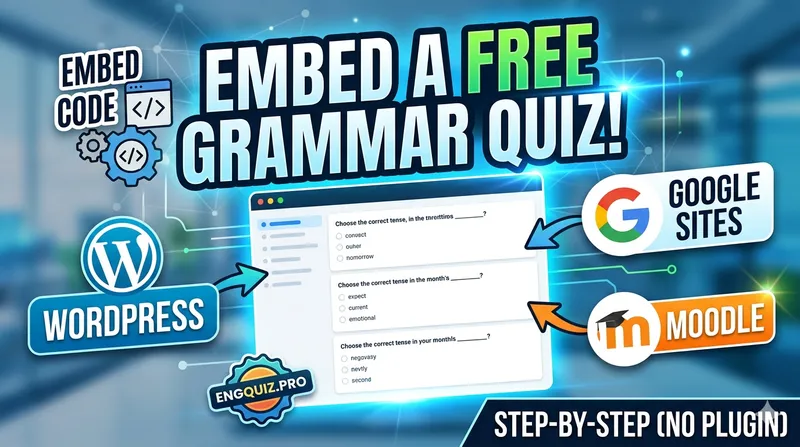
How to Embed a Free English Grammar Quiz on Your Website (WordPress, Google Sites, Moodle)
Step-by-step instructions for adding a free, interactive English grammar quiz to WordPress, Google Sites, Moodle, or any page that accepts HTML. No plugin, no sign-up, no ads.
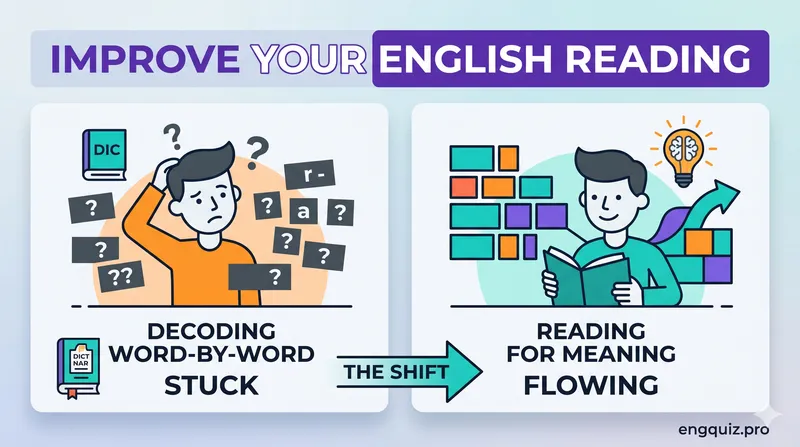
How to Improve English Reading and Actually Understand It
Why the level of the text you choose matters more than the hours you put in, and five exercises that build reading comprehension.
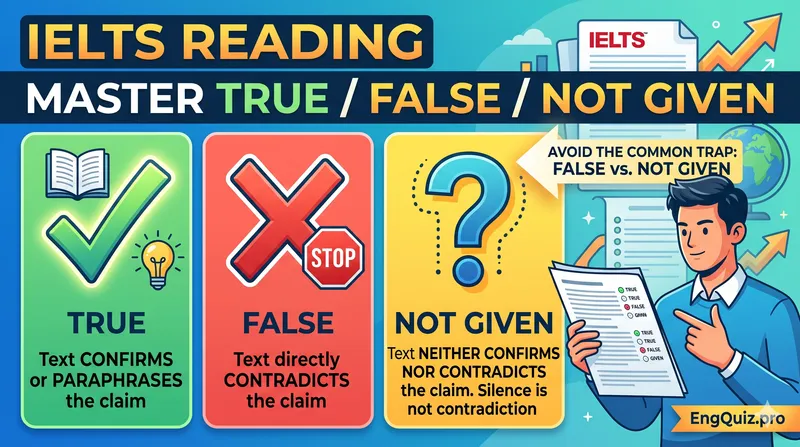
IELTS Reading: How to Master True/False/Not Given
True/False/Not Given is the most-failed IELTS Reading task. Learn the one rule that fixes it, and practise free on real B2/C1 passages with instant feedback.
Related Articles
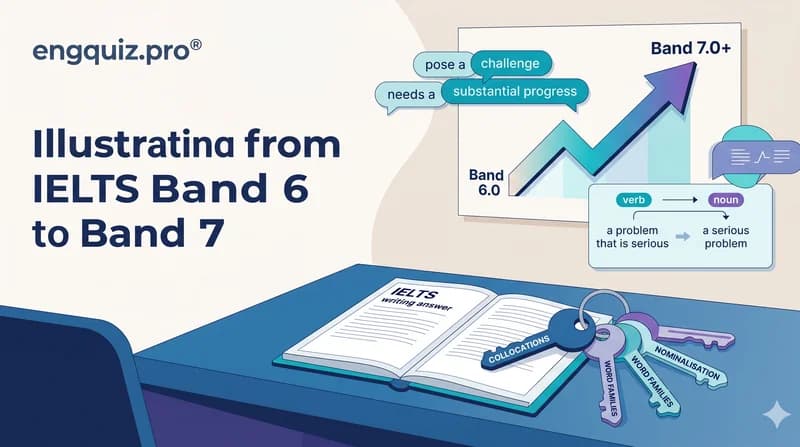
Academic Vocabulary for IELTS Writing: How to Move From Band 6 to Band 7
Lexical Resource is 25% of your IELTS Writing score, and most learners attack it backwards. Here is what Band 7 vocabulary actually looks like, and how to get there.
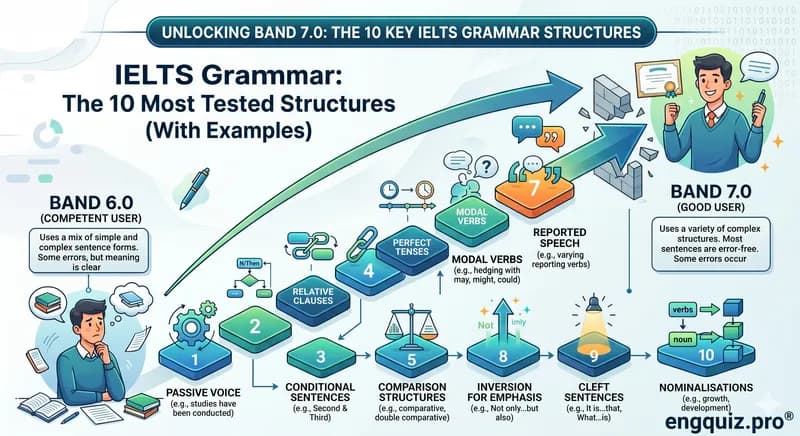
IELTS Grammar: The 10 Most Tested Structures (With Examples)
Master IELTS grammar by targeting these 10 structures, the ones that separate Band 6.0 from Band 7.0 in Writing and Speaking. Examples + exercises.
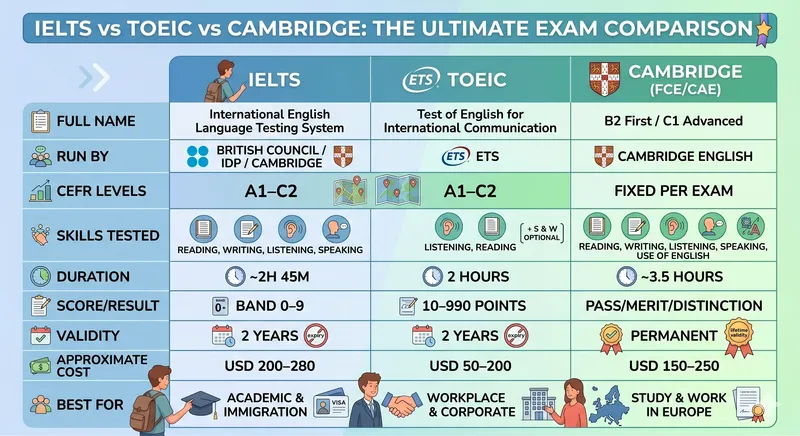
IELTS vs TOEIC vs Cambridge: Which English Exam Is Right for You?
Choosing between IELTS, TOEIC, and Cambridge exams? This guide compares all three: format, cost, recognition, and which one fits your goal.