20 Essential Business English Phrasal Verbs (With Examples)
Business English phrasal verbs you will hear every day in meetings, emails, and calls. Learn the 20 most important ones with real workplace examples.
Why business English phrasal verbs matter
Native English speakers use phrasal verbs constantly in workplace communication: meetings, emails, phone calls, and presentations. Non-native speakers who use them confidently sound more fluent and natural; those who avoid them sound formal and textbook-like.
This guide covers the 20 most important business English phrasal verbs, the ones you will hear (and need to produce) in real workplace English.
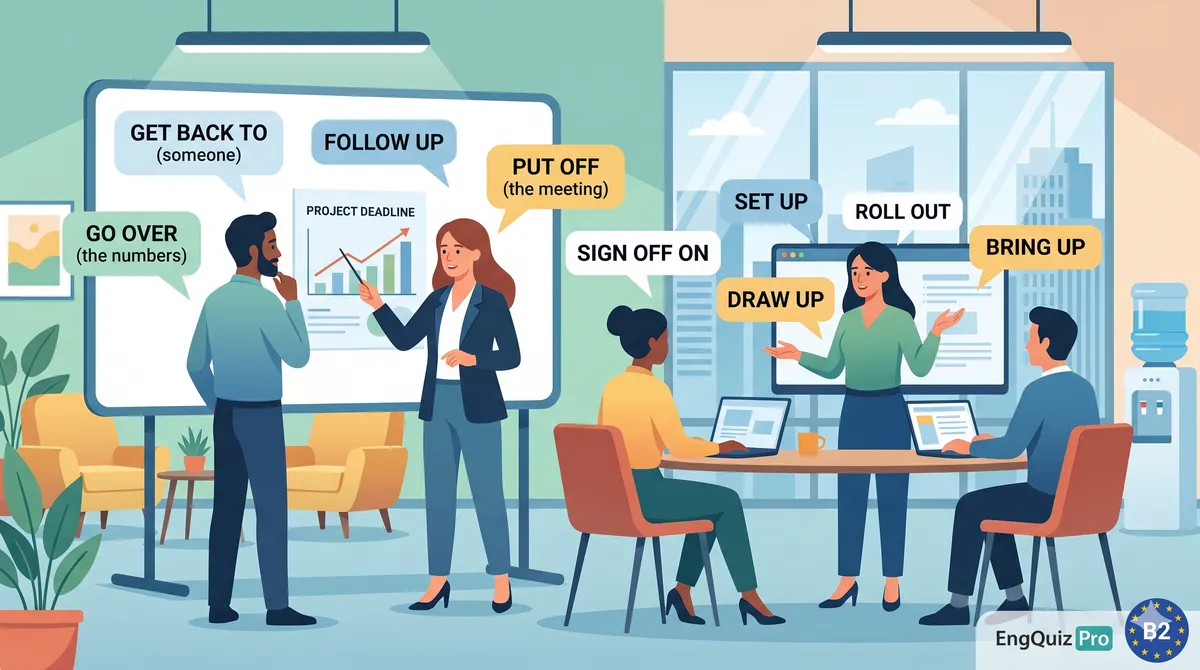
Quick answer: The 20 essential business English phrasal verbs are set up, call off, put off, push back, bring forward, take on, hand over, follow up, wrap up, roll out, get back to, go over, bring up, put forward, come up with, back down, give in, draw up, sign off on, and fall through. Each has a formal equivalent (see the comparison table below).
A learner who says "We need to postpone the meeting" is correct but sounds like a textbook. A fluent speaker says "We need to push back the meeting". Both communicate the same thing, but the phrasal verb signals that you are comfortable with informal-professional English, the register of most internal business communication.
Important note: Phrasal verbs are appropriate in emails, meetings, and calls among colleagues. In very formal contexts (legal contracts, board-level reports, investor communications), prefer the formal alternatives, and use the passive voice (The contract has been signed, Approval will be granted by Friday) when the actor is less important than the action.
Group 1: Meetings and Decisions
1. set up / set something up
Meaning: arrange or organise something Formal equivalent: arrange, organise, establish
- Can you set up a meeting for Thursday afternoon?
- We need to set up a system for tracking customer feedback.
2. call off / call something off
Meaning: cancel a meeting or event Formal equivalent: cancel
- The client called off the meeting at the last minute.
- We had to call off the product launch due to supply issues.
3. put off / put something off
Meaning: postpone to a later time Formal equivalent: postpone, defer
- We've put off the budget review until next month.
- Don't put off the difficult conversations; they only get harder.
4. push back / push something back
Meaning: delay or reschedule Formal equivalent: reschedule, defer
- Can we push back the deadline by two weeks?
- The launch has been pushed back to Q3.
5. bring forward / bring something forward
Meaning: move an event to an earlier time Formal equivalent: advance, reschedule (earlier)
- The board has brought forward the annual review to March.
- They want to bring forward the product launch.
Group 2: Projects and Tasks
6. take on / take something on
Meaning: accept new work or responsibility Formal equivalent: accept, assume responsibility for
- She has taken on three new clients this quarter.
- Are you sure you can take on another project right now?
7. hand over / hand something over
Meaning: transfer responsibility or documents to someone else Formal equivalent: transfer, delegate
- He will hand over his accounts to the new manager next week.
- Please hand over all the project files before you leave.
8. follow up / follow up on something
Meaning: check on progress or continue after an initial contact Formal equivalent: check on, pursue
- I'll follow up with the client tomorrow morning.
- Can you follow up on the proposal we sent last week?
9. wrap up / wrap something up
Meaning: finish or conclude Formal equivalent: conclude, finalise
- Let's wrap up this meeting; we've covered everything.
- We need to wrap up the project before the end of the quarter.
10. roll out / roll something out
Meaning: launch or implement gradually across a wider area Formal equivalent: launch, implement, deploy
- We plan to roll out the new software in phases.
- The training programme has been rolled out across all departments.
Group 3: Communication
11. get back to (someone)
Meaning: contact someone again with information or a response Formal equivalent: respond to, follow up with
- I'll get back to you with the figures by end of day.
- She promised to get back to me after checking with her team.
12. go over / go over something
Meaning: review or examine in detail Formal equivalent: review, examine
- Can we go over the contract before signing?
- Let me go over the main points from today's meeting.
13. bring up / bring something up
Meaning: introduce a topic in a discussion Formal equivalent: raise, mention, introduce
- He brought up the budget issue at the last minute.
- I need to bring up a concern about the timeline.
14. put forward / put something forward
Meaning: propose or suggest an idea formally Formal equivalent: propose, submit, present
- She put forward an interesting suggestion during the workshop.
- Several solutions have been put forward, but none approved yet.
15. come up with / come up with something
Meaning: produce an idea or solution Formal equivalent: devise, generate, produce
- We need to come up with a solution by Friday.
- The team came up with three viable options.
Group 4: Negotiations and Agreements
16. back down / back down from something
Meaning: withdraw from a position or demand Formal equivalent: concede, withdraw, retreat
- After an hour of negotiation, they finally backed down on the pricing.
- Neither side was willing to back down.
17. give in / give in to something
Meaning: stop resisting; agree after pressure Formal equivalent: concede, yield
- We eventually gave in to their terms on the delivery schedule.
- Don't give in to pressure; stand by your position.
18. draw up / draw something up
Meaning: prepare a document formally (contract, plan, report) Formal equivalent: prepare, draft, compose
- The legal team is drawing up the contract now.
- Can you draw up a proposal for the new service?
19. sign off on / sign off on something
Meaning: give final approval Formal equivalent: approve, authorise
- The director needs to sign off on all expenses over £5,000.
- Has the budget been signed off on yet?
20. fall through / fall through (no object)
Meaning: fail to happen; collapse (deals, plans) Formal equivalent: collapse, fail, be unsuccessful
- The deal fell through at the last stage.
- Our plans for expansion fell through due to funding problems.
Formal vs Phrasal: When to Use Each
| Context | Register | Example |
|---|---|---|
| Email to a colleague | Informal-professional | Let's set up a call for Thursday. |
| Email to a client | Formal | I would like to arrange a call for Thursday. |
| Internal meeting | Informal-professional | Can we go over the numbers? |
| Board presentation | Formal | I would like to review the financial performance. |
| Contract / legal document | Formal only | Phrasal verbs are rarely appropriate here |
Practice Exercise
Replace the formal word with the correct phrasal verb:
- We need to postpone the deadline by one week. → push back
- Can you arrange a meeting for next Tuesday? → set up
- The project was cancelled due to budget cuts. → called off
- She proposed a new strategy during the workshop. → put forward
- The deal collapsed at the final stage. → fell through
Practise Business Phrasal Verbs Now
EngQuiz Pro has free B2 multiple-choice and B1 gap-fill exercises on phrasal verbs in professional contexts, with instant feedback and worked examples. No sign-up required.
Frequently Asked Questions
Phrasal verbs are appropriate in most internal business communication and emails to familiar contacts. For emails to new clients, senior stakeholders, or external partners, prefer formal equivalents. The rule: match the register of the person you're writing to.
Yes. These 20 are all high-frequency in everyday professional English. In a typical business week, you would encounter most of them in meetings, emails, or calls. They are not slang; they are standard professional vocabulary.
Separable phrasal verbs can have their object between the verb and particle (set the meeting up) or after (set up the meeting). If the object is a pronoun, it must go in the middle (set it up, not set up it). Most transitive phrasal verbs are separable; intransitive ones (fall through, back down) are not.
Phrasal verbs have a particle (adverb) that changes the meaning of the verb (give = donate; give in = yield). Prepositional verbs use a preposition without changing the core verb meaning (apply for, depend on). The distinction matters grammatically: phrasal verb objects can be placed before the particle; prepositional verb objects cannot.
Yes. Make a decision, do business, make an offer, do a report are fixed verb-noun collocations, much like phrasal verbs. They are not interchangeable and don't follow a logical rule. See the make vs do contrast for the most common business pairings learners get wrong.
New Articles
How to Embed a Free English Grammar Quiz on Your Website (WordPress, Google Sites, Moodle)
Step-by-step instructions for adding a free, interactive English grammar quiz to WordPress, Google Sites, Moodle, or any page that accepts HTML. No plugin, no sign-up, no ads.
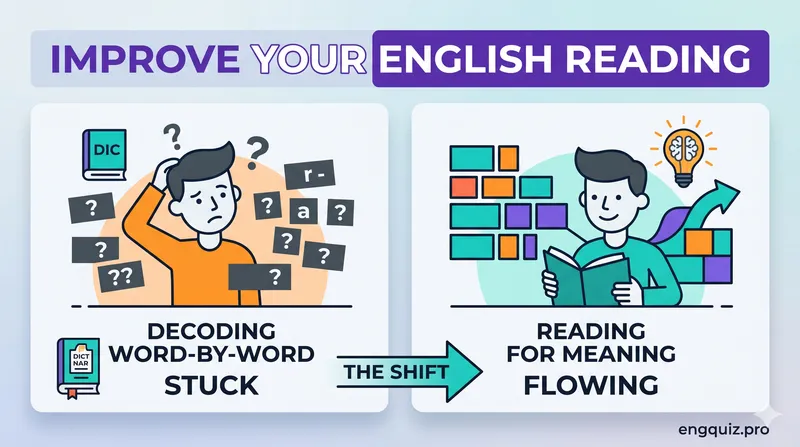
How to Improve English Reading and Actually Understand It
Why the level of the text you choose matters more than the hours you put in, and five exercises that build reading comprehension.
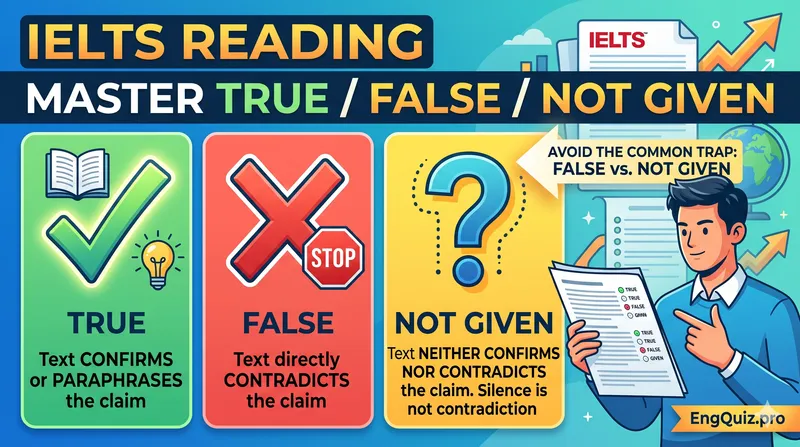
IELTS Reading: How to Master True/False/Not Given
True/False/Not Given is the most-failed IELTS Reading task. Learn the one rule that fixes it, and practise free on real B2/C1 passages with instant feedback.
Related Articles
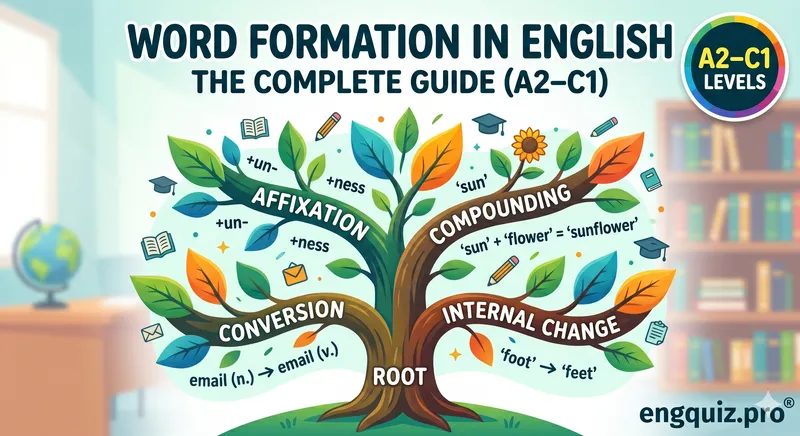
Word Formation in English: The Complete Guide (A2-C1)
Word formation in English explained: affixation, compounding, conversion and internal change, plus how each type maps to CEFR levels A2 to C1.
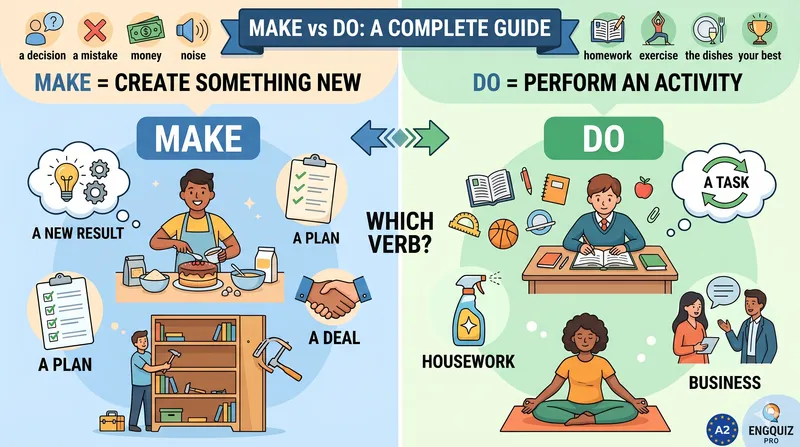
Make or Do: Complete Guide + 60 Collocations (A2-B1)
Make or do? Use make for creating something new; use do for tasks, work and activities. Includes full collocation lists, examples and a practice quiz.