American vs British English: What Actually Matters for Learners
Spelling, vocabulary, or grammar: which differences between American and British English actually affect your exam score, and what can you safely ignore?
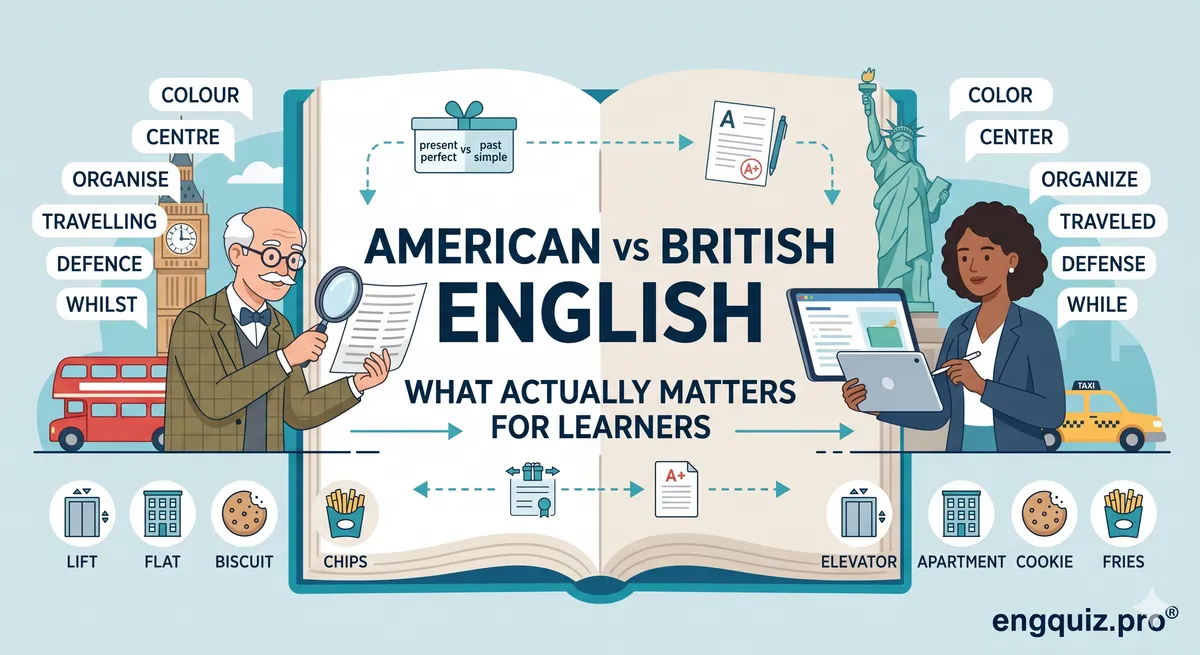
The one thing that actually costs marks
American and British English share almost identical grammar. The differences are mostly in spelling conventions and vocabulary, and the one thing that costs marks is mixing both systems in the same document.
Quick answer: About 90% of American and British English is identical. Spelling differs (color / colour, organize / organise), some vocabulary differs (elevator / lift, sidewalk / pavement), and a small set of grammar habits differs (present perfect usage, collective nouns, prepositions of time). Pick one variety per document and stay consistent; that single choice protects more marks than any vocabulary list ever will.
Two accountants, one ledger
Imagine two accountants at the same firm, working in different offices, asked to record expenses using the same ledger template. Nobody told them which currency symbol to use. One writes "$" and one writes "£". Their numbers are correct. Their arithmetic is the same. The underlying system is identical. But if one of them accidentally copies the other's symbol halfway through a report, the finance department flags it as an error.
That's American and British English. Two people resolving the same ambiguities in slightly different rooms, with no shared memo. Neither version is broken. The only real error is switching mid-document and signalling to the reader that you weren't paying attention.
How it actually works
Layer 1: Spelling is visible, but not dangerous
Spelling differences are the most obvious and the least likely to confuse a native speaker. A British reader understands "color" instantly; an American reader has no trouble with "colour." These differences won't block communication.
The main patterns:
| British | American | Pattern |
|---|---|---|
| colour, honour, neighbour | color, honor, neighbor | -our → -or |
| realise, recognise, organise | realize, recognize, organize | -ise → -ize |
| centre, theatre, litre | center, theater, liter | -re → -er |
| travelled, cancelled | traveled, canceled | -ll- → -l- before a suffix |
| defence, licence (noun) | defense, license | -ce → -se |
Common learner mistake: Writing "colour" in one paragraph and "color" in the next. The reader doesn't think "interesting dialect". They think "this writer wasn't careful."
Fix: Pick one system at the start of any piece of writing and finish with it.
Layer 2: Vocabulary is where real confusion lives
This is where communication gaps actually occur. The same object, the same concept, a different word, and neither speaker offers a translation.
| British English | American English |
|---|---|
| lift | elevator |
| flat | apartment |
| boot (of a car) | trunk |
| bonnet (of a car) | hood |
| biscuit | cookie |
| chips | fries |
| crisps | chips |
| autumn | fall |
| post | |
| mobile | cell phone |
| GP (doctor) | primary care physician |
| queue | line |
| fortnight | two weeks |
| solicitor | attorney / lawyer |
| CV | résumé |
Notice how many of these are everyday nouns: things you'd encounter in a reading passage or TOEIC conversation. Not knowing "fortnight" (two weeks) can cost you a comprehension question.
Common learner mistake: Learning vocabulary exclusively from one variety and then sitting an exam that uses the other. A Vietnamese learner who studied with American textbooks sees "autumn" in an IELTS passage and hesitates, even though they know the word "fall" perfectly.
Fix: When you learn a word, note its equivalent in the other variety. One extra note per card.
Layer 3: Grammar conventions are where marks are actually at stake
Most grammar is identical. But three patterns diverge enough to matter in an exam.
a) Present perfect vs past simple
British English uses the present perfect more often for recent events:
- British: "I've just arrived." / "She's already eaten."
- American: "I just arrived." / "She already ate."
Both are grammatically correct. However, IELTS marking is based on British conventions, so using past simple for recent events in formal writing will read as less precise to a British examiner.
b) Collective nouns
British English treats collective nouns (team, government, company) as plural:
- British: "The team are preparing for the final."
- American: "The team is preparing for the final."
In IELTS Task 1 or Task 2, British examiners accept both, but mixing them signals inconsistency.
c) "Have got" vs "have"
British English uses "have got" for possession in spoken and informal contexts:
- British: "Have you got a pen?"
- American: "Do you have a pen?"
Both are standard. The grammar test: "have got" cannot replace "have" in past tense ("I had a pen", never "I had got a pen" for simple possession).
What matters in IELTS and TOEIC
IELTS (British standard): IELTS accepts both American and British spelling, but not both in the same response. The official marking guidance flags spelling inconsistency under Lexical Resource. A Band 6 candidate might write "realize" in paragraph one and "recognise" in paragraph two. The content is fine, but the inconsistency signals limited language control. A Band 7 candidate chooses British throughout and uses "recognise," "analyse," and "behaviour" consistently.
The present perfect point matters here too. A Band 5 IELTS Writing Task 2 response: "Scientists recently discovered that air pollution affects cognitive development." A Band 7 response in British convention: "Scientists have recently discovered that air pollution affects cognitive development." In formal British academic writing, the present perfect signals recency more precisely.
TOEIC (American standard): TOEIC passages are written in American English. The vocabulary table above is your reading comprehension cheat sheet. "Resume" appears instead of "CV"; "attorney" instead of "solicitor"; "mail" instead of "post." For TOEIC Part 7, spotting these vocabulary gaps is often the difference between 4/5 and 5/5 on a reading set.
CEFR general: At B1–B2, examiners are not penalising variety choice; they're assessing range and accuracy within whichever variety you use. Consistency matters more than correctness of variety.
Easy traps to fall into
Trap: "Gotten" American English uses "gotten" as the past participle of "get." British English dropped it centuries ago. American: "She's gotten better at chess." British: "She's got better at chess" or "She's improved at chess." Fix: Don't use "gotten" in IELTS writing, where it reads as an Americanism and signals inconsistency if the rest of your answer is British.
Trap: Prepositions after days and times British: "We met on Monday. The match is at the weekend." American: "We met Monday. The game is on the weekend." The missing "on" before days and "at" → "on" before "the weekend" are the most common preposition differences. In IELTS speaking, British examiners expect "at the weekend". "On the weekend" won't be penalised, but it can subtly flag inconsistency.
Trap: Punctuation in abbreviations British English does not use a full stop after Mr, Dr, Mrs, Ms. American English does: Mr., Dr., Mrs., Ms. In formal writing for IELTS: "Dr Singh" (no full stop). In TOEIC business emails: "Dr. Kim" (with full stop). Mixing them in an academic essay distracts.
Trap: "While" vs "whilst" "Whilst" is a formal British alternative to "while." American English does not use "whilst." In IELTS Task 2, "whilst" is a natural formal connector for British examiners, but using it in TOEIC writing looks stilted. Know where you're writing.
At-a-glance comparison table
The 25 most-encountered differences for B1–B2 learners. If a single column on the left feels familiar but the right is mostly new (or vice versa), you have already picked a dialect. Make it explicit and stay in it.
| Category | British English (UK) | American English (US) |
|---|---|---|
| Spelling: -our / -or | colour, favour, neighbour, behaviour | color, favor, neighbor, behavior |
| Spelling: -re / -er | centre, theatre, metre, litre | center, theater, meter, liter |
| Spelling: -ise / -ize | organise, realise, recognise | organize, realize, recognize |
| Spelling: -yse / -yze | analyse, paralyse | analyze, paralyze |
| Spelling: -ll- / -l- | travelled, travelling, cancelled | traveled, traveling, canceled |
| Spelling: -ogue / -og | catalogue, dialogue, programme | catalog, dialog, program |
| Past tense (irregulars) | learnt, dreamt, burnt, spelt | learned, dreamed, burned, spelled |
| Past participle of get | got (I've got it) | gotten (I've gotten it) |
| Tense with just / yet / already | present perfect (I've just eaten) | past simple also accepted (I just ate) |
| Collective nouns | plural or singular (the team are / is) | singular only (the team is) |
| Apartment / Flat | flat | apartment |
| Lift / Elevator | lift | elevator |
| Lorry / Truck | lorry | truck |
| Pavement / Sidewalk | pavement | sidewalk |
| Petrol / Gas | petrol | gas / gasoline |
| Holiday / Vacation | holiday | vacation |
| Biscuit / Cookie | biscuit | cookie |
| Chips / Crisps | crisps (thin); chips (thick / fries) | chips (thin); fries (thick) |
| Trousers / Pants | trousers | pants (in the US, pants = trousers) |
| Autumn / Fall | autumn | fall |
| Mobile / Cell | mobile (phone) | cell (phone) |
| Cinema / Movie theater | cinema | movie theater |
| Football | football (soccer) | football (American football); soccer = European football |
| Date format | DD/MM/YYYY (11 May 2026) | MM/DD/YYYY (May 11, 2026) |
| Punctuation: quotes | single quotes by default | double quotes by default |
If you would like the full source list, including registers and frequencies, see the Cambridge Dictionary British/American reference. An audio companion for the spelling-and-pronunciation pairs is on the roadmap.
Try these now
1. Error spotting: What's wrong with this IELTS essay opening?
"Over the past decade, researchers have recognized several key patterns in behaviour. A recent study also analyzes how color influences consumer behavior."
2. Transformation: Rewrite this sentence in British English:
"The government just announced that it is reorganizing the public transportation system."
3. Vocabulary gap: Match the British word to its American equivalent:
fortnight / boot / autumn / biscuit / queue
two weeks / cookie / trunk / line / fall
4. Choice justification: For an IELTS Task 2 essay, which is better?
A) "Mobile phone use has increased dramatically in recent years." B) "Cell phone use has increased dramatically in recent years." Why?
5. Production: Write two sentences about a recent news event, once in British style (using present perfect for recency) and once in American style (using past simple).
Answers below. Try the tasks first.
1. Two systems are mixed: "recognised" should be "recognized" (American, matching "behavior" and "color"), or the whole passage should use British spelling ("recognised," "behaviour," "colour"). Also, "analyzes" should be "analyses" in British English. The inconsistency is the core error.
2. British version: "The government have just announced that they are reorganising the public transport system." Changes: collective noun → plural, "reorganizing" → "reorganising," "transportation" → "transport."
3. fortnight = two weeks / boot = trunk / autumn = fall / biscuit = cookie / queue = line.
4. A is better for IELTS. "Mobile phone" is standard British English; "cell phone" is American. Since IELTS uses British conventions, A is the safer and more appropriate choice.
5. Example. British: "Scientists have confirmed that a new material conducts electricity more efficiently than copper." American: "Scientists confirmed that a new material conducts electricity more efficiently than copper."
Remember this
The moment you write "colour" in one sentence and "color" in the next, you haven't chosen a dialect; you've told the examiner you weren't watching.
Frequently Asked Questions
IELTS accepts both, as long as you are consistent within your answer. Cambridge English (B2 First, C1 Advanced, C2 Proficiency) is British by default but also accepts American spellings consistently used. The TOEIC accepts both. The rule across every major exam is the same: pick one and stay in it.
Whichever one you hear more often in your daily life. If your work is with American multinationals, your study materials should be American; if you are aiming for UK university entry, British. Most exam syllabuses accept both, so the choice is practical, not about being "more correct".
For exam purposes, treat Canadian as American-leaning with some British spellings, Australian as British-leaning, and Indian English as British-leaning. Exam markers do not penalise these varieties as long as the spelling and grammar choices are internally consistent.
They do, just less often, and never as the only correct option for completed past events. I just ate and I've just eaten are both acceptable in American English; in British English, only the second sounds natural. The American version is not wrong; it is a register and frequency difference, not a grammar gap.
Not on its own, but it can drag the Grammatical Range and Accuracy band down because inconsistency reads as carelessness. Examiners look for control, and "colour... color... colour" inside a 250-word essay signals lack of control even if every individual choice is acceptable on its own.
New Articles

How to Embed a Free English Grammar Quiz on Your Website (WordPress, Google Sites, Moodle)
Step-by-step instructions for adding a free, interactive English grammar quiz to WordPress, Google Sites, Moodle, or any page that accepts HTML. No plugin, no sign-up, no ads.
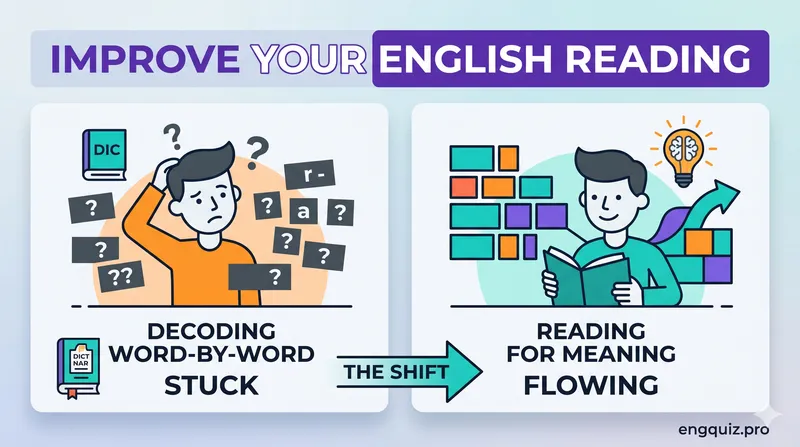
How to Improve English Reading and Actually Understand It
Why the level of the text you choose matters more than the hours you put in, and five exercises that build reading comprehension.
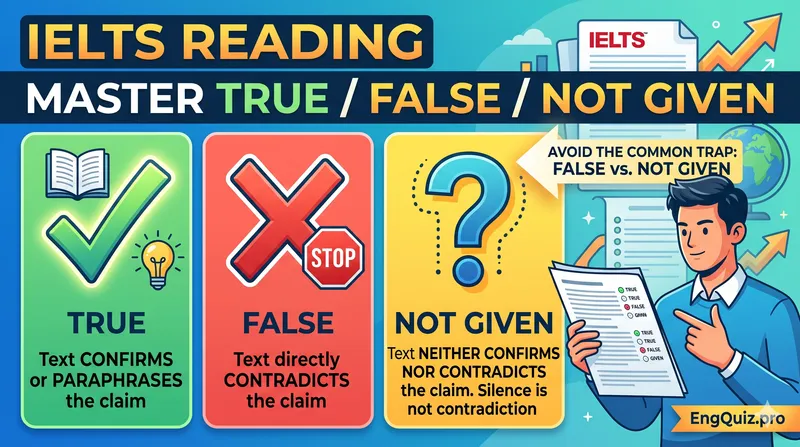
IELTS Reading: How to Master True/False/Not Given
True/False/Not Given is the most-failed IELTS Reading task. Learn the one rule that fixes it, and practise free on real B2/C1 passages with instant feedback.
Related Articles
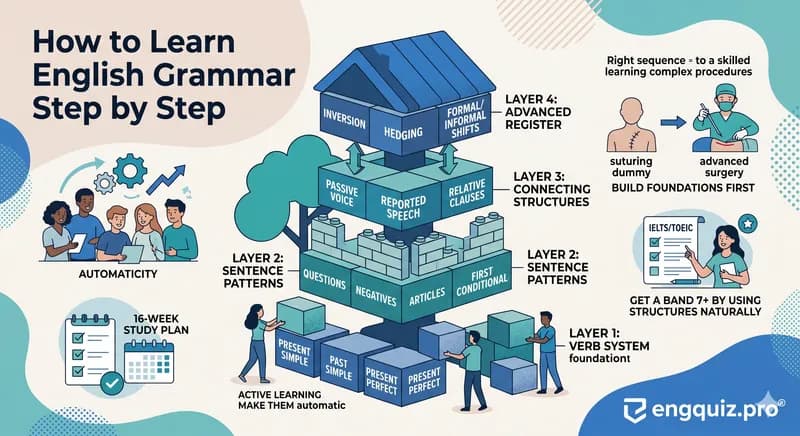
How to Learn English Grammar Step by Step: A 4-Layer Framework
Most learners study English grammar in the wrong order. Here is a four-layer step-by-step framework, with exam-angle advice and exercises to start today.
English Grammar Lessons for Adults: 5 Lessons That Make Patterns Stick
Five English grammar lessons for adults: how to use grammar books, the tense system, articles, prepositions, and an error-correction method that helps patterns stick.