Rules of English Grammar: The Core Patterns Behind Every Rule
Stop memorising hundreds of grammar rules. There are really only four underlying patterns, and once you see them everything else clicks into place.
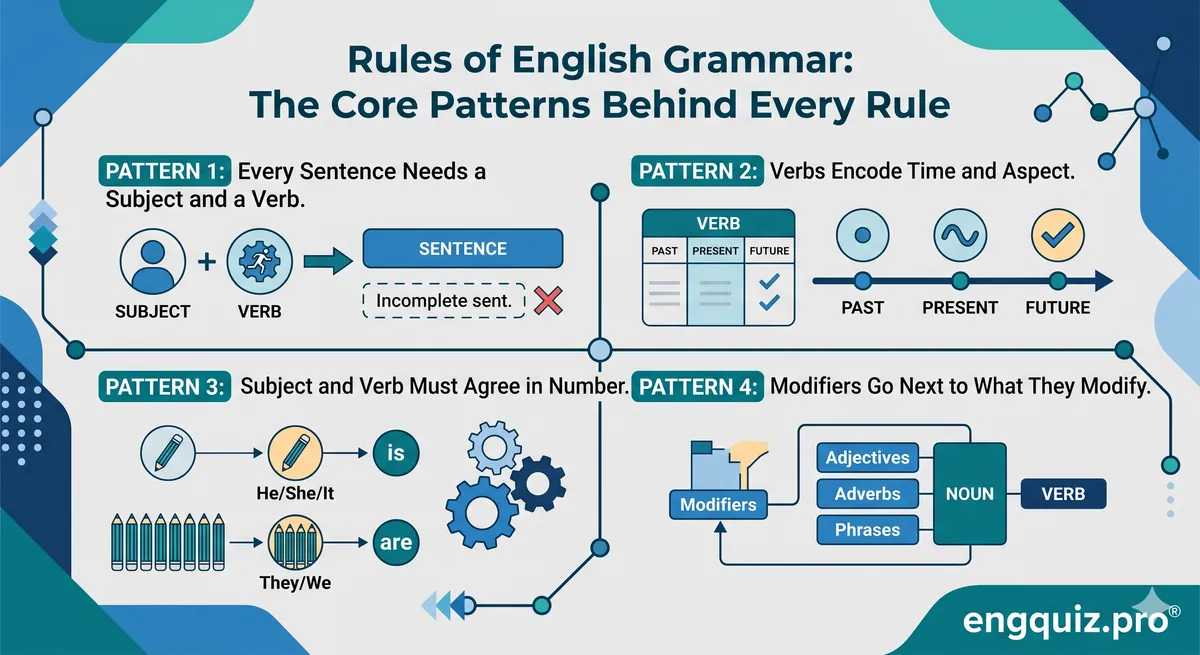
Four patterns, not four hundred rules
English doesn't have hundreds of grammar rules. It has four core patterns, and every rule you've ever been taught is just one of those patterns applied to a specific situation.
Quick answer: Every English sentence is built from four core patterns: (1) every sentence needs a subject and a verb, (2) words combine in fixed grammatical slots (Subject + Verb + Object + Modifier), (3) tense and aspect are encoded on the verb, and (4) reference words (a, the, this, that) signal what the listener should already know. Once you can see these four at work, the long lists of "rules" stop looking like a memorisation problem and start looking like a small set of patterns repeating.
Grammar as a formula
Think of a spreadsheet formula. =SUM(B2:B10) looks opaque until you realise it has three slots: the function name, an opening bracket, and a range. Once you understand the slots, you can write thousands of different formulas without memorising each one individually.
English sentences work the same way. Every sentence is a formula with labelled slots (Subject, Verb, Object, Modifier), and each slot accepts only certain types of words. Once you know the slots and what goes in them, you don't memorise sentences; you generate them. Grammar rules aren't laws handed down by an authority. They're descriptions of the slot system: how it behaves, what happens when slots interact, what errors look like when the wrong word fills a slot.
How it actually works
Pattern 1: Every sentence needs a Subject and a Verb
This is the first rule, and it's the only truly non-negotiable one in English.
The subject is who or what the sentence is about. The verb is what happens. Without both, you don't have a sentence; you have a fragment.
- The report → fragment (no verb)
- Was published → fragment (no subject in writing; acceptable only in speech when context supplies the subject)
- The report was published on Friday. → sentence
Common mistake at this layer:
"Because she was tired."
This has a subject ("she") and a verb ("was"), but "because" makes it a dependent clause, so it can't stand alone. It needs to attach to a main clause: "She left early because she was tired."
The fix: a sentence must have at least one independent clause, meaning a subject + verb combination that doesn't depend on another clause to make sense.
Pattern 2: Verbs encode two things, time and aspect
Most learners think tense = time. It doesn't. English verb forms encode time (past, present, future) and aspect (complete or ongoing). That's why there are twelve tense combinations rather than three.
| Aspect | Past | Present | Future |
|---|---|---|---|
| Simple (complete fact) | She left. | She leaves at 9. | She will leave. |
| Continuous (in progress) | She was leaving. | She is leaving. | She will be leaving. |
| Perfect (result visible now) | She had left. | She has left. | She will have left. |
| Perfect continuous (ongoing with result) | She had been leaving. | She has been leaving. | She will have been leaving. |
The key insight: aspect is the dimension most learners ignore. They focus on when and forget to ask how complete is this action from the speaker's perspective?
- She finished the proposal. (simple past: complete, we're moving on)
- She has finished the proposal. (present perfect: complete, and it's relevant right now)
The time is the same in both: past. The aspect is different. The second version says the result is present and relevant.
Common mistake at this layer:
"I am knowing the answer."
Certain verbs, called stative verbs, don't take continuous forms because they describe states, not actions: know, believe, understand, prefer, contain, belong. These verbs don't have an ongoing/complete contrast; they just exist.
The fix: "I know the answer."
Pattern 3: Subject and verb must agree in number
When the subject is singular, the verb takes a singular form. When the subject is plural, the verb takes a plural form. This sounds simple, and for most sentences it is. The traps are in the middle.
Trap A: Long subject, forgotten head noun
"The quality of the products in all three factories have improved."
The verb "have" is agreeing with "factories" (the nearest noun) instead of "quality" (the actual head noun, the subject). Fix: "The quality … has improved."
Trap B: Indefinite pronouns are always singular
Everyone, someone, anyone, nobody, each, either, neither: singular, always. "Everyone has submitted their report." (not "have")
Trap C: "Either … or" and "neither … nor"
The verb agrees with the subject closest to it: "Either the manager or the assistants are responsible." "Either the assistants or the manager is responsible."
Common learner mistake:
"The number of students have increased."
"The number" is singular (contrast: "A number of students have enrolled", where "a number" works as a determiner meaning "several," which is plural). The fix: "The number of students has increased."
Pattern 4: Modifiers go next to what they modify
Adjectives, adverbs, phrases, and clauses all describe something, and they must sit as close as possible to the word they describe. When they don't, the sentence either means something unintended or becomes ambiguous.
Adjective order for multiple adjectives: Opinion → Size → Age → Shape → Colour → Origin → Material → Purpose → Noun
- a beautiful old rectangular green French silver whittling knife (technically correct, never used)
- a small red Italian sports car (natural)
You don't memorise this order consciously. You feel when it's wrong. But knowing the principle helps when you hesitate.
Adverbs of frequency (always, usually, often, sometimes, rarely, never) go:
- Before the main verb: She often arrives late.
- After "be": She is often late.
- After auxiliaries: She has never been late.
Misplaced participial phrases:
"Walking to the station, the rain started heavily."
The phrase "walking to the station" should describe the subject of the main clause. But the subject is "the rain", and rain doesn't walk. Fix: "Walking to the station, I got caught in heavy rain."
This category of error (dangling modifier) is one of the most common errors in B2–C1 writing.
What this means for your exam
IELTS Writing Task 2: Band 5 candidates use mostly Pattern 1 and Pattern 2 in their simplest forms, producing correct simple sentences with no complexity:
"People use social media every day. It is popular. Some people say it is bad."
Band 7 candidates combine all four patterns. They control aspect (present perfect for consequences, past simple for evidence), agreement in complex subjects, and precise modifier placement:
"The widespread adoption of social media platforms over the past decade has fundamentally altered the way individuals form opinions on political issues, a shift that neither governments nor educational institutions have yet addressed systematically."
Notice: subject-verb agreement across a long noun phrase ("adoption … has"), aspect choice (present perfect for a result still visible now), and a correctly placed post-modifier clause ("that neither governments…").
TOEIC Part 5 (grammar multiple choice): Most Part 5 questions test exactly Patterns 2, 3, and 4:
- Tense/aspect selection (Pattern 2)
- Subject-verb agreement, especially after long noun phrases (Pattern 3)
- Correct modifier placement, especially choosing between adjective and adverb forms (Pattern 4)
A learner who understands the four patterns rather than memorising individual rules will handle novel sentence structures more reliably.
Where learners trip up
Trap: "It" as a dummy subject English requires a subject even when there's nothing to name. "It" fills the slot. In "It is raining," the word "it" refers to nothing; it just satisfies Pattern 1. "It is strange that nobody noticed." Again, a dummy subject. Learners sometimes omit it. "Is raining today" fails Pattern 1.
Trap: Double negatives Standard English uses one negative per clause. Two negatives cancel each other out, or produce ungrammatical sentences in formal writing. "I didn't see nobody." (non-standard) → "I didn't see anybody." or "I saw nobody." The fix: one negative element per clause.
Trap: Adjective vs adverb confusion Adjectives describe nouns; adverbs describe verbs, adjectives, or other adverbs. "She speaks very good." → "She speaks very well." (modifying the verb "speaks" needs an adverb) "He did a real quick job." → "He did a really quick job." ("really" modifies the adjective "quick") The test: what does this word describe? A noun → adjective. Anything else → adverb.
Trap: Stacked noun modifiers English allows nouns to modify other nouns: "a government health policy review committee meeting." Each noun modifies the one after it (right to left). This is grammatically legal but cognitively exhausting. When you write more than three stacked nouns, restructure with a preposition or relative clause. "A meeting of the committee reviewing government health policy" is clearer.
Try these now
1. Error spotting: What's wrong?
"The team of researchers have published their findings in three separate journals."
2. Tense/aspect choice: Which is correct and why?
A) "By the time you arrive, I finished the presentation." B) "By the time you arrive, I will have finished the presentation."
3. Modifier placement: Fix this sentence:
"Covered in mud, the match referee asked the players to leave the pitch."
4. Subject-verb agreement: Choose the correct verb:
"Neither the students nor the teacher (was / were) aware of the change."
5. Transformation (aspect): Rewrite this sentence to show that the action is still relevant now (not just a finished past fact):
"The company launched a new sustainability programme in 2023."
Answers below.
1. "The team … have": the head noun is "team" (singular collective noun). In American English: "has published." In British English, collective nouns can take plural verbs in informal writing, but in formal academic writing, singular is safer: "has published."
2. B is correct. "By the time you arrive" sets a future deadline. The action (finishing the presentation) will be complete before that deadline, so it calls for future perfect: "will have finished." Option A mixes future ("arrive") with simple past ("finished"), which breaks the time logic.
3. "Covered in mud" describes the players, not the referee. Fix: "Covered in mud, the players were asked by the referee to leave the pitch." Or: "The referee asked the mud-covered players to leave the pitch."
4. "Was." With "neither … nor," the verb agrees with the subject closest to it: "the teacher" (singular) → "was."
5. "The company has launched a new sustainability programme." Present perfect (have/has + past participle) signals that the action is complete but its result is present and relevant. You've shifted the aspect from "finished fact" (simple past) to "current relevance" (present perfect).
Remember this
Every grammar rule you'll ever encounter is Pattern 1, 2, 3, or 4 wearing a different costume. Find the pattern first, and the rule explains itself.
Go deeper: one spoke per pattern
Each of the four patterns has detailed coverage elsewhere on EngQuiz.Pro. Use this as a hub: pick the spoke that maps to the pattern you most often get wrong. And if terms like subject, clause, or phrase still feel fuzzy, start with the key grammar concepts reference, since every spoke below assumes them.
Pattern 1: agreement and word form
- Common English grammar mistakes (5 most frequent): subject-verb agreement errors, third-person -s, article choice
- Present Simple theory + form table, where third-person agreement first appears
- Articles guide (a / an / the / zero article)
- Word formation in English: the complete guide on how affixation, compounding, conversion and internal change generate the noun, verb, adjective and adverb forms a slot can demand
Pattern 2: tense and aspect
- Present Perfect vs Past Simple: the single biggest tense-choice trap for B1–B2 learners
- Since vs For: the duration / starting-point distinction that locks in present perfect use
- Present Perfect theory page
- Past Simple theory page
Pattern 3: clause logic and connectors
- Gerunds vs Infinitives: which verbs take which complement
- Who vs Whom (the he/him replacement test): pick the right relative pronoun in defining clauses
- Relative clauses theory: defining vs non-defining
- Conditional sentences: the five types as one system, the pillar guide to all five conditionals
- The passive voice: when and how to use it, the pillar guide for register-appropriate passive use
- Conditionals theory: quick-reference table
Pattern 4: register and discourse
- IELTS grammar structures: the structures that distinguish a Band 6 script from a Band 7
- American vs British English: register-relevant variation
- How to learn English grammar step by step: the four-layer sequenced approach
Find your level first
Not sure which pattern is your bottleneck? Take the free CEFR English level test or run the calibrated 30-question assessment and use the result to pick the right spoke above.
Frequently Asked Questions
The four patterns describe how the language behaves in general. There are well-documented exceptions (especially in irregular verbs, idiomatic prepositions, and historic spellings), but each exception is a specific item to memorise, not a new pattern. Once you internalise the patterns, the exceptions stand out clearly instead of getting tangled up with them.
Start with the structural pattern most often broken at your level. For A2 and B1, that is usually subject-verb agreement and tense form. For B2, it is the perfect aspect (especially present perfect vs past simple). For C1, it is register and complex clause subordination. Use a level check, for example the free CEFR level test, to find which pattern is causing the most errors in your own writing.
Mostly no. Fluent speakers internalise patterns from years of input and produce correct forms by pattern-matching, not by recalling a rule. As a learner, the rules are scaffolding: useful while you're building, but the goal is to get to the same automatic pattern-matching that native speakers use. Lots of reading and listening builds that intuition faster than memorising more rules.
You have internalised a rule when you produce the correct form in spontaneous speech or writing without stopping to think. A useful test: can you correct a learner's sentence on the fly, or do you have to translate it into the rule first? If you have to translate, the rule is still scaffolding. Keep using it, but pair it with active production practice so the pattern moves into your fast-thinking system.
Two patterns competing for the same situation. Present perfect vs past simple, will vs going to for the future, gerund vs infinitive after certain verbs: these are not about memorising more rules but about understanding what the speaker means. Once you ask "what does the speaker want to highlight?" rather than "which form is correct?", the contrast usually resolves itself.
New Articles

How to Embed a Free English Grammar Quiz on Your Website (WordPress, Google Sites, Moodle)
Step-by-step instructions for adding a free, interactive English grammar quiz to WordPress, Google Sites, Moodle, or any page that accepts HTML. No plugin, no sign-up, no ads.
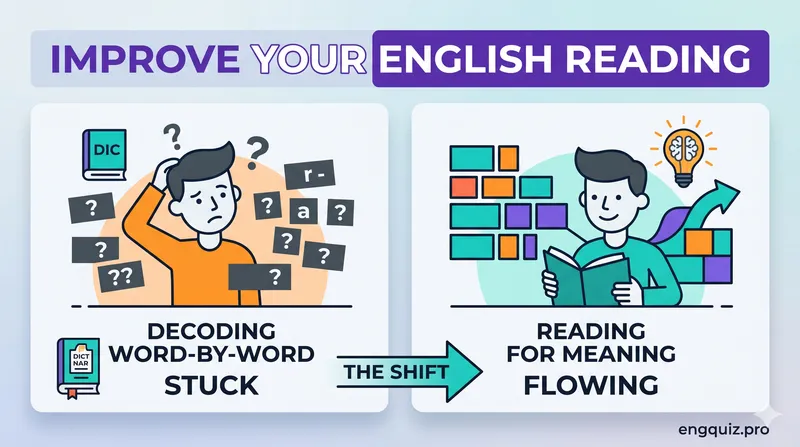
How to Improve English Reading and Actually Understand It
Why the level of the text you choose matters more than the hours you put in, and five exercises that build reading comprehension.
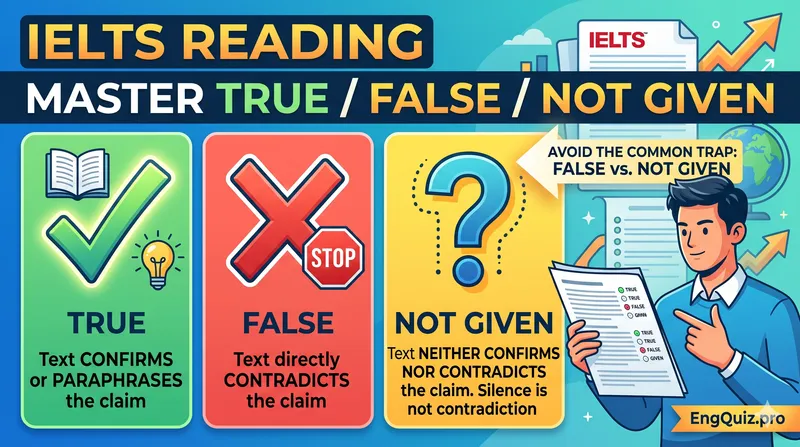
IELTS Reading: How to Master True/False/Not Given
True/False/Not Given is the most-failed IELTS Reading task. Learn the one rule that fixes it, and practise free on real B2/C1 passages with instant feedback.
Related Articles
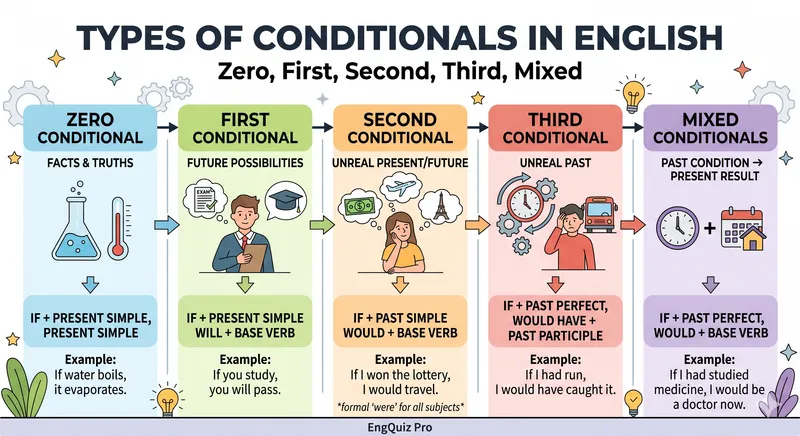
Types of Conditionals in English: Zero, First, Second, Third and Mixed
The 5 types of conditional sentences explained with formulas, examples and common mistakes: zero, first, second, third and mixed conditionals.
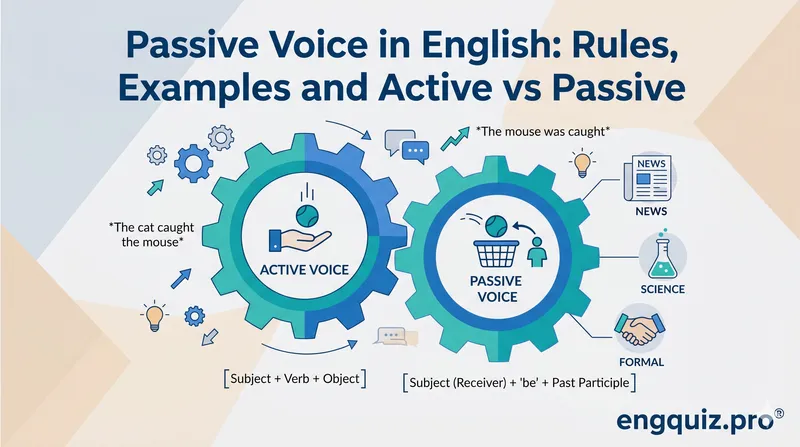
Passive Voice in English: Rules, Examples and Active vs Passive
The passive puts the receiver of an action first: "The letter was written." Learn to form it in every tense, when to use it, and 5 common mistakes.
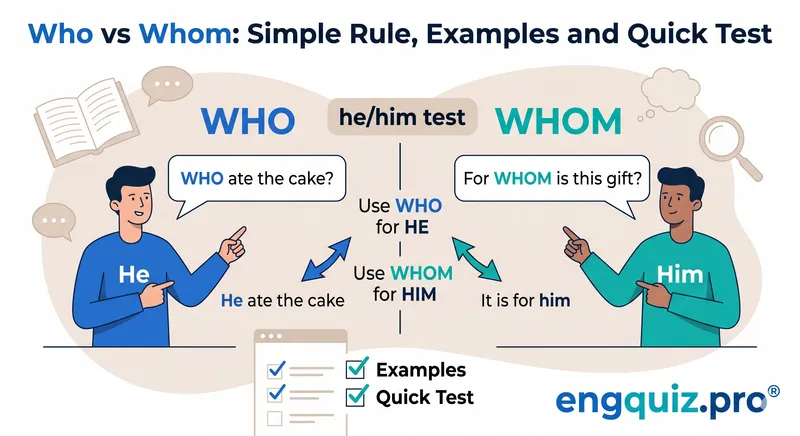
Who vs Whom: Simple Rule, Examples and Quick Test
Confused by who vs whom? Use the he/him test: if he fits, use who; if him fits, use whom. Examples, common mistakes and a 5-question quiz inside.