English Grammar Lessons for Adults: 5 Lessons That Make Patterns Stick
Five English grammar lessons for adults: how to use grammar books, the tense system, articles, prepositions, and an error-correction method that helps patterns stick.
A better question to ask about grammar
Grammar often doesn't click for adult learners until they stop asking "what is the rule?" and start asking "why does this sound wrong to a native speaker?" That question leads somewhere rules alone never do. Below are five English grammar lessons for adults that come out of that question. Each one targets a problem that adult learners commonly face.
Quick answer: The fastest way to fix adult English grammar is to stop treating rules as instructions and start treating them as patterns to internalise. Read grammar in context, speak it aloud, get corrections from real text, and build patterns into automatic recall, not just conscious recognition. Children learn through exposure; adults need rules plus exposure, in that order.
An example adult learner
(Illustrative example. Minh is not a real learner. The story shows a situation that many adult learners describe.)
Minh is thirty-one and works in an office where English is the shared language. In a team meeting, she realises that she can't produce the grammar well enough to speak naturally under pressure. She understands every word. She knows all the vocabulary. But her sentences come out awkward. She says "I am working here since three years" and watches her colleagues' faces do that small thing (not quite a wince, not quite a smile) where they register the error and move on.
Minh has studied English for years. She has passed school exams. She has read grammar books with colour-coded tables. And yet she keeps making the same errors under pressure, when it matters most.
If this sounds familiar, the answer is probably not another grammar book. It is a different question: what is actually going on here?
The five lessons below try to answer it.
Lesson 1: The grammar book is a map, not the territory
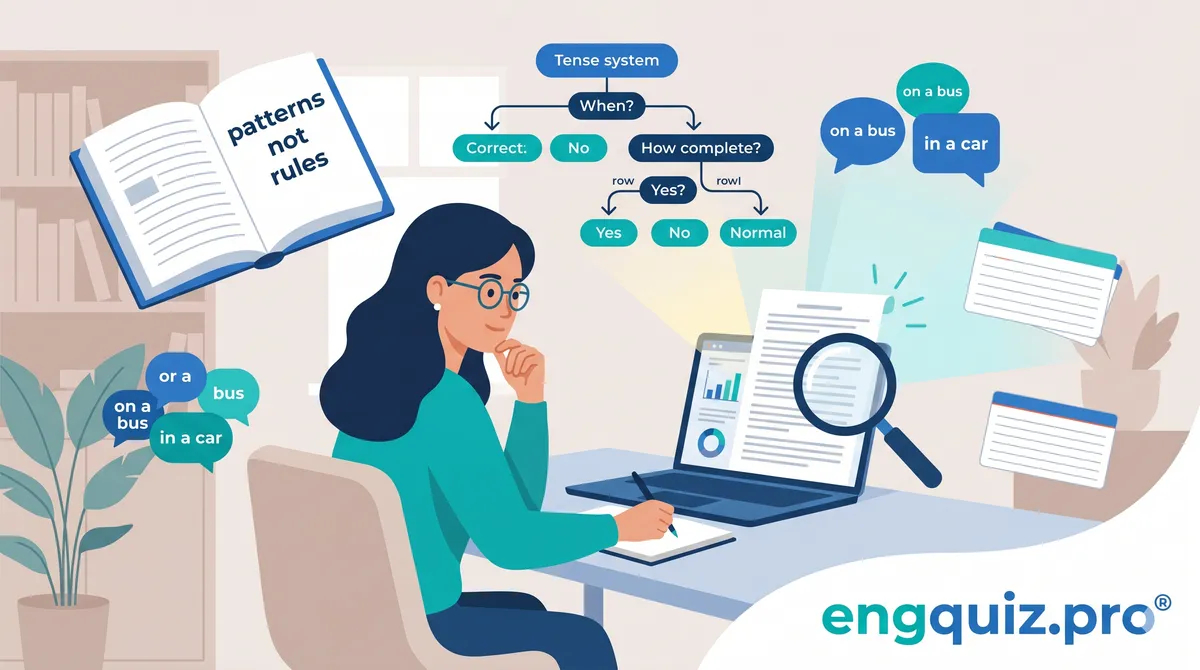
Many adult learners treat grammar books as instruction manuals. They expect to follow the steps and get the output. But grammar books describe patterns. They don't install them. Reading a rule about present perfect doesn't mean you've absorbed when it sounds right and when it doesn't.
Think of it this way. A book can tell you that coffee tastes bitter and aromatic. You could read twenty descriptions of coffee and still not know what it tastes like until you drink it. Grammar works the same way: reading the rule is not the same as having the pattern in your language system.
For adult learners specifically, this distinction is important. Adults are very good at memorising rules. They are very good at applying rules consciously, in calm conditions. They are much weaker at retrieving rules under pressure in real conversation. Children don't learn grammar from rules. They learn it from massive exposure to patterns. Adults can supplement with rules, but they still need the exposure.
What to change: stop treating grammar exercises as tick-box tasks and start using them as exposure events. For each exercise, read the correct answer aloud. Then immediately build a new sentence with the same structure about your own life. This is not a special technique from a book. It simply puts the pattern into use while it's still warm.
Lesson 2: The tense system is two questions, not twelve boxes
It is tempting to handle English tenses by trying to remember which of twelve boxes a sentence belongs in. Present simple. Present continuous. Present perfect. Present perfect continuous. And so on.
That's the wrong mental model. The tense system isn't twelve separate compartments. It's two questions stacked on top of each other:
Question 1: When? (Past, present, future) Question 2: How complete? (Simple = a whole fact, habit or event / Continuous = in progress at that time / Perfect = done before that time, with a link to it / Perfect continuous = in progress up to that time)
Once you see that aspect (how complete) is a separate dimension from time (when), the system reorganises itself. You aren't choosing between twelve options. You are answering two questions.
Take this sentence: "I have been working here since 2019."
Before the reframe, a learner might memorise this rule: "use present perfect continuous for actions that started in the past and continue now." The rule is technically accurate. But it is hard to apply fast enough in real speech.
After the reframe: When? Started in the past, still now → present. How complete? Still ongoing, result visible now → perfect continuous. Two answers. One correct form.
The gain here does not come from memorising more rules. It comes from having a better question to ask yourself.
Lesson 3: Articles will always be hard, and that's fine
Articles (a, an, the) are one of the hardest parts of English for speakers whose first languages don't have them. This includes speakers of Vietnamese, Mandarin, Japanese, Korean, and dozens of other languages.
The reason they're hard isn't that the rules are complicated. The rules are simple:
- A / an: first mention of something, or any member of a category (I saw a man outside.)
- The: both speaker and listener know which one (The man was wearing a grey coat.)
- No article: general statements about categories (I love coffee.)
The reason they're hard is that they require you to track the listener's state of knowledge in real time. What does the listener know? Have I mentioned this before? Is this specific or general? That tracking is effortless in your first language because you've been doing it since age two. In a second language, you're doing it consciously, and consciousness is slow.
What to expect: you may still make article errors now and then, under pressure or when you're tired. Accept this. The error to stop first is omitting articles entirely, because it is the most noticeable one. When you're unsure, ask one question: does the listener know which one? If yes, use the. If no, use a/an for one thing or no article for things in general. Aim to catch the obvious cases (a before consonant sounds, an before vowel sounds) without thinking.
A practical fix is to read British or American news articles aloud, slowly, and pay attention to every article. Don't analyse it. Just notice it. Try twenty minutes a day for two weeks. The goal is to start to feel article placement rather than calculate it.
Lesson 4: Prepositions are not logical, but they are learnable
In a room, at a party, on the train, by the window. Why on the train and not in the train? Why at a party and not in a party?
There isn't always a logical reason. Prepositions are collocations, which are fixed word partnerships that a language community has settled on over centuries. Trying to derive them from first principles is like trying to derive why traffic lights are red, amber, and green rather than some other colours. It's convention. You learn the convention.
What to change: stop asking "why on the train?" and start grouping prepositions by topic cluster.
Transport
On a bus, on a train, on a plane, on a bike, but in a car, in a taxi (because you sit enclosed inside, not atop or alongside).
Time
At a specific time (at 3 p.m.), on a specific day (on Tuesday), in a longer period (in March, in 2019).
Location
In an enclosed space (in the office), on a surface (on the desk), at a point (at the door).
Clusters, not rules. Write them on index cards grouped by semantic field. Drill the clusters, not the individual prepositions. A small set of groups is easier to review than a long list of single items.
Some cases don't fit a cluster. Idiomatic phrases like interested in, responsible for, depend on, and result in are best learned verb by verb, as you meet them.
Lesson 5: Error correction only works if you know why it's wrong
A common pattern in adult study goes like this. A teacher or textbook marks your errors and writes the correct form above them. You look at the correction, nod, and make the same error two days later.
The correction loop fails because you process only the surface fix, not the reason for the error. "She has gone there yesterday" → corrected to "She went there yesterday." But why? Because "yesterday" is a specific time reference, and specific time references signal completed, located-in-time events → simple past. If you have the correction but not the analysis, the pattern doesn't stick.
What works better is to explain each error to yourself. For every error you correct, write one sentence explaining why the original version was wrong and why the corrected version is right. Don't use grammar book language. Use plain language that you will actually remember. Here is an example of such a note:
"Yesterday means I'm pointing at a specific moment in the past, so present perfect can't work here. Present perfect doesn't point. It just says the result is still here now."
This takes longer per error. You will correct fewer errors per session. The point is to keep more of what you correct.
Where these lessons show up in exams
If you are preparing for IELTS or TOEIC, the same grammar traps appear in predictable places.
IELTS Writing Task 2: Typical grammar errors at Band 5–6 include article omission, tense inconsistency, and subject-verb agreement errors in long sentences. These errors often come from studying rule lists without enough exposure to felt pattern. The gap to Band 7 is often more practice, not better rules.
IELTS Speaking Part 3 (abstract discussion): Adult learners at B2 often speak correctly at sentence level but lose accuracy when they extend into longer turns. Conditional structures collapse under pressure. A learner says "If I would have more time, I will study more" instead of "If I had more time, I would study more." The fix isn't knowing the rule; it's having spoken that structure enough times that it runs automatically.
TOEIC Reading Parts 5 and 6: Part 5 tests articles and prepositions in single sentences. Part 6 puts the same gaps inside short texts such as emails and notices. If you misread an article, you can misread the scope of a noun phrase and choose the wrong answer. To prepare, read TOEIC practice texts aloud and notice every article and preposition without stopping to analyse each one.
Mistakes adult learners commonly make
Mistake 1: Translating grammar from your first language
Under pressure, it is tempting to build sentences in your first language and translate them word by word. When the two languages use different word order, word-by-word translation produces word-order errors. The fix is to think in fragments, not full translations. Start with the verb. Build out from there.
Mistake 2: Avoiding structures you aren't sure of
If you avoid conditional sentences and passive constructions because you don't feel confident in them, your writing stays accurate but simple. Accuracy at IELTS Band 5 is not the same as fluency at Band 7. Start using structures you aren't sure of and then check them. Get the discomfort over with in practice, not in the exam.
Mistake 3: Studying grammar in isolation from reading
Grammar and vocabulary are not separate systems. The more you read, the more grammar you absorb unconsciously. A common imbalance is an hour of grammar exercises and zero minutes of English reading per day. That ratio should be reversed. Grammar exercises help you notice patterns. Reading gives you patterns to notice.
Mistake 4: Expecting a straight line
Grammar accuracy does not improve in a straight line. Some weeks you may feel like you are getting worse. This happens because as you become more aware of a structure, you start noticing all the times you use it incorrectly. That heightened awareness looks like regression. It's actually progress. Push through it.
Five exercises to start with
These five exercises are a useful place to start. Do them today, while the ideas are fresh.
1. Tense rewrite: Take one paragraph from yesterday's news. Rewrite it switching all past simple verbs to present perfect and vice versa. Notice how the meaning shifts. What does the change signal to the reader?
2. Article audit: Write five sentences about your working day this week. Underline every article you used. For each one, ask: first mention or known? General or specific? Check your instinct against the rule.
3. Preposition cluster drill: Pick one transport preposition group (on a bus, on a train, in a car, in a taxi) and write five sentences using different vehicles. Say them aloud. Tomorrow, pick the time preposition group.
4. Error analysis: Find a piece of writing you produced in the past, such as an email or a paragraph. Identify one error. Write two sentences explaining why it's wrong and what the correct version means differently.
5. Structure exposure: Choose one grammar structure you currently avoid. Write three sentences using it, even if they feel unnatural. Read them aloud. Repeat this for a week with the passive voice in formal writing, which many adult learners avoid.
Remember this
The reason grammar didn't stick the first time wasn't that you weren't paying attention: you were reading maps of a city you hadn't yet walked through.
Where to go next (the adult-learner pillar)
This page is the entry point to our adult-learner content. Pick the next step that matches your situation:
- You don't know your level yet → take the free CEFR English level test (10-minute self-check) or the calibrated 30-question assessment.
- You're stuck at B1 → read the B1 → B2 roadmap, which includes an example 11-month path from B1 to B2.
- You want a sequenced study plan → read How to learn English grammar step by step, a sequenced four-layer framework.
- You learn best by fixing your worst errors first → read The 5 most common grammar mistakes and pick the one you make most often.
- You have an exam in 6–12 months → IELTS vs TOEIC vs Cambridge helps you pick the right one, and IELTS grammar structures covers the B2–C1 structures examiners reward.
If you would like the sourcing standard behind everything on these pages, see our methodology.
Frequently Asked Questions
Not harder. Different. Adults can often understand grammar concepts faster than children, because abstract rules make sense to a fully developed brain. What adults lose is the casual, low-pressure input that kids get: an adult learner has to create exposure deliberately. The grammar half is actually the easier half. Building daily exposure is the harder one.
Using the figures in CEFR levels explained, plan for roughly 500–700 hours of guided study from a solid A2 start. At one hour a day, that is about 18 months to two years. Active practice counts most. That means work where you produce English and get it corrected, or reading where you check new words.
Both, in different doses. A weekly class for accountability and speaking practice plus daily self-study for grammar drilling gives you both feedback and volume. Pure self-study can work if you are disciplined, but many adults overestimate their consistency. A weekly external check can matter more than the class content itself.
Studying passively. Reading grammar books cover to cover, watching YouTube explanation videos, and collecting Notion notes feel productive, but they give you no practice in producing the structure. The grammar rule only sticks once you have produced the structure under pressure, usually in writing first, then in speech.
No. Age does not stop adults from reaching C1. C2 takes more hours. The limit is hours of deliberate practice, not age. The age-related disadvantage in pronunciation is real but does not block grammar or vocabulary mastery. A plateau usually comes from how you study, not from when you started.
New Articles

How to Embed a Free English Grammar Quiz on Your Website (WordPress, Google Sites, Moodle)
Step-by-step instructions for adding a free, interactive English grammar quiz to WordPress, Google Sites, Moodle, or any page that accepts HTML. No plugin, no sign-up, no ads.
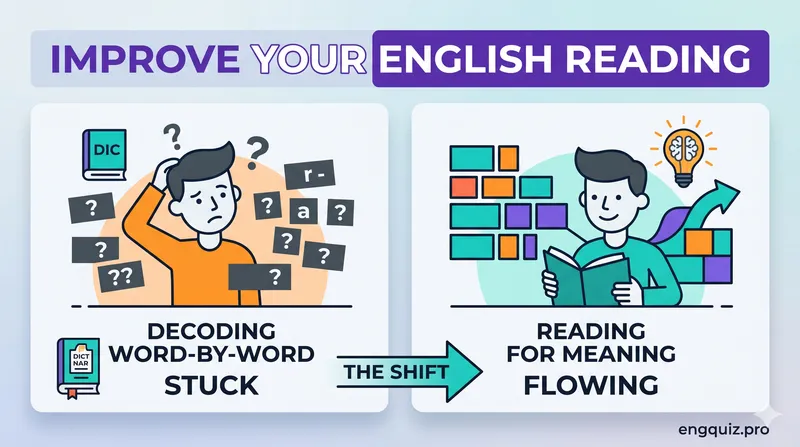
How to Improve English Reading and Actually Understand It
Why the level of the text you choose matters more than the hours you put in, and five exercises that build reading comprehension.
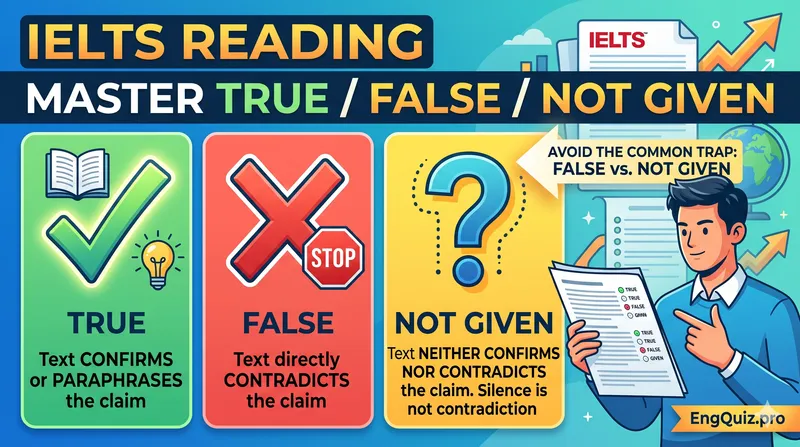
IELTS Reading: How to Master True/False/Not Given
True/False/Not Given is the most-failed IELTS Reading task. Learn the one rule that fixes it, and practise free on real B2/C1 passages with instant feedback.
Related Articles
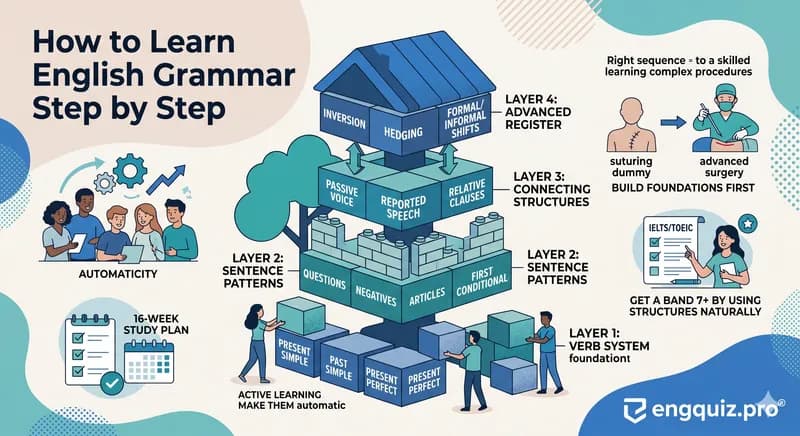
How to Learn English Grammar Step by Step: A 4-Layer Framework
Most learners study English grammar in the wrong order. Here is a four-layer step-by-step framework, with exam-angle advice and exercises to start today.
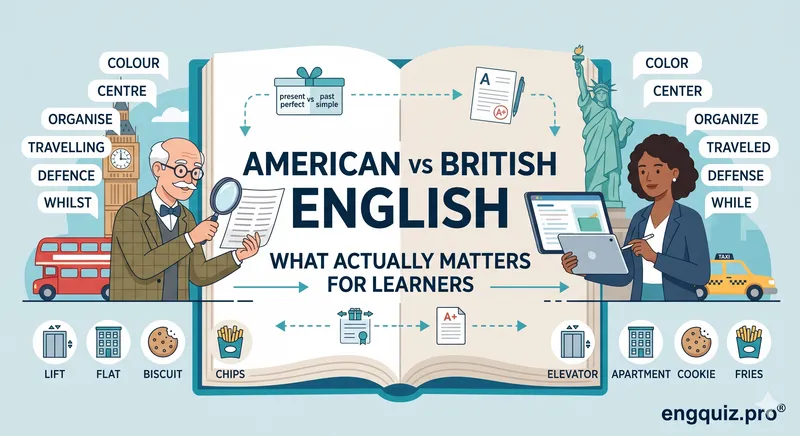
American vs British English: What Actually Matters for Learners
Spelling, vocabulary, or grammar: which differences between American and British English actually affect your exam score, and what can you safely ignore?