How to Improve English Reading and Actually Understand It
Why the level of the text you choose matters more than the hours you put in, and five exercises that build reading comprehension.
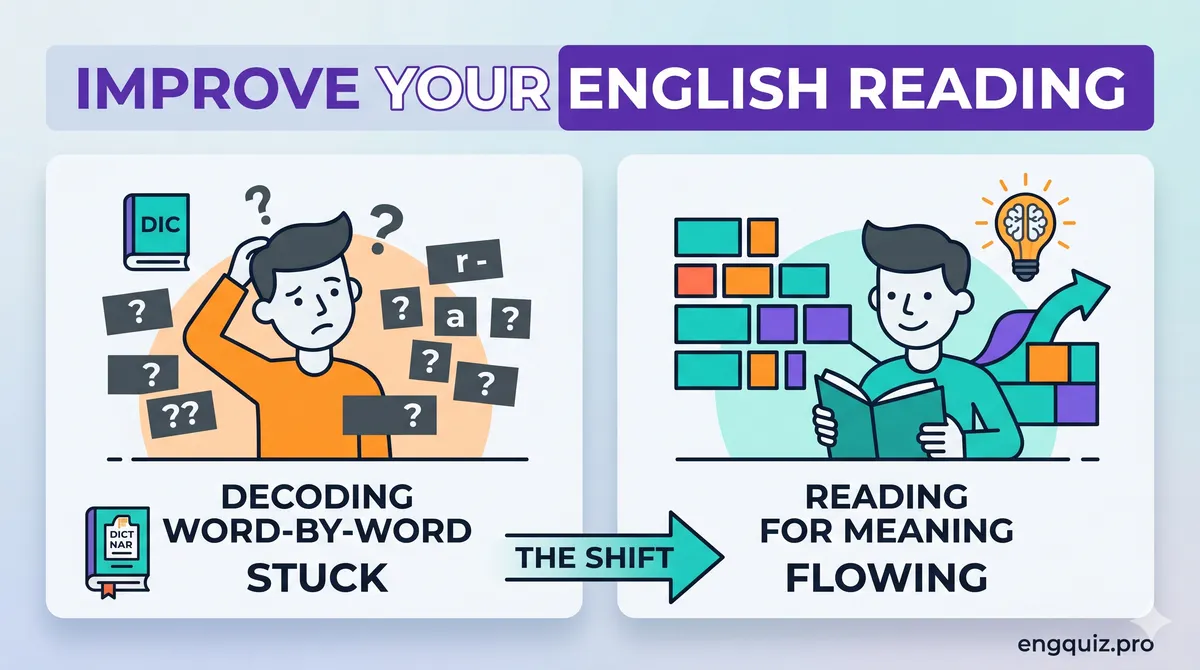
The most common advice for improving English reading is to read more. Read every day. Read articles, novels, news. That is true - but it misses the mechanism. Plenty of learners read for years and stay stuck, while others improve noticeably within months.
Learners who improve are using a different method.
The habit that keeps your reading stuck
Here is a pattern that almost every plateau learner shares: they read, but they stop constantly. Every unknown word triggers a dictionary search. Every unfamiliar phrase breaks the flow. By the time the sentence ends, the beginning of the paragraph is gone. Every stop interrupts the comprehension circuit before it can close.
Expert readers tolerate uncertainty. They do not decode texts word by word. They build meaning from clusters (the phrase, the clause, the whole sentence) and deliberately push past what does not matter yet. The unknown word in the middle of a sentence often resolves itself by the end of the paragraph. Skilled readers let it.
The skill is knowing when to move forward and when to stop.
Reading like a city navigator
Think about navigating somewhere unfamiliar. You do not stop dead at every unrecognised street name. You use the surrounding streets, your sense of direction, and the rough map you have already built. When something is unfamiliar, you orient around it.
Reading a second language works the same way. Even when individual words are unclear, you have three sources of orientation:
- Context: what the surrounding sentences establish
- Structure: the grammar, which tells you what role the unknown word is playing
- Topic knowledge: what you already know about the subject, which lets you predict
The learner who halts at every unknown word is the tourist who opens the guidebook at every corner. They eventually arrive, but they have lost the flow of the city. The learner who reads past uncertainty arrives faster and remembers more.
The goal of reading practice is to make that habit automatic.
Three layers that build English reading comprehension
Layer 1: The 95% rule for choosing texts
Vocabulary research puts a threshold on this. Hu and Nation (2000) found that learners need to know around 98% of the words in a text to understand it comfortably without help. Roughly 95%, or about one unknown word in twenty, is the practical floor: below that, interruptions come too often for meaning to build.
This has a direct practical consequence: the text you choose matters as much as how long you spend reading.
A B1 learner reading a densely argued editorial written at C1 level stops too often for meaning to accumulate. The same learner reading a news summary pitched at their level is in the zone where vocabulary quietly expands and comprehension builds.
Find texts where you can move. The small number of unfamiliar words will stick precisely because you encountered them in flowing, comprehensible context, not in a dictionary entry stripped of meaning.
Common mistake at this layer: choosing texts that feel impressive rather than texts that are productive. Difficulty without enough surrounding context teaches nothing. Match the text to your current level.
Layer 2: Reading for architecture
Every well-written text has a structure you can sense before you understand every word. In most non-fiction:
- The first sentence of a paragraph states the main point.
- The body provides support, evidence, or examples.
- The final sentence often signals transition or reinforces the key idea.
Train yourself to locate this structure as you read. Before you read a paragraph closely, read its first and last sentence. Ask: what is this writer claiming? What are they using to support it?
IELTS and TOEIC both reward this kind of structural reading.
Common mistake at this layer: giving every sentence equal attention. A supporting example is not as important as the main claim. Let your reading speed vary with the weight of the content.
Layer 3: The three-encounter rule for building vocabulary
You do not need to look up every new word. Stopping mid-read to search a dictionary is one of the most reliable ways to break comprehension flow and still forget the word by the next day.
A better approach: note words that appear more than once across different texts. When a word shows up a second time in a new context, it is earning a place in your active vocabulary. When it appears a third time, look it up properly: with example sentences, collocations, and a note of where you first saw it.
The result is a vocabulary weighted by frequency (the words that keep appearing are the words you most need), reading flow that stays intact, and a richer memory trace for each word you do learn.
Common mistake at this layer: looking up every word immediately, in isolation, then losing it within 48 hours because it never had a context to anchor to.
What this looks like in IELTS and TOEIC
IELTS Academic Reading
The test gives you three passages and 40 questions in 60 minutes. That is 90 seconds per question, including the time to locate the relevant part of the text.
Candidates who read each passage from beginning to end before answering questions routinely run out of time on the third passage. High-scoring candidates work differently: they read the questions first, identify keywords, skim the passage to locate the relevant section, then read only that section closely.
The task is to locate and verify. The passage is your only source. In True/False/Not Given questions in particular, you are confirming, contradicting, or acknowledging the absence of specific information, and nothing in your own knowledge counts.
Applying Layer 2 here means scanning paragraph-first-sentences before committing to a close read. The topic sentence of each paragraph is your map. Find it, decide whether that paragraph contains your answer, then move.
TOEIC Reading Part 7
Part 7 includes emails, memos, advertisements, online reviews, and schedules, all shorter and more formulaic than IELTS passages. The skill that pays off fastest is document-type recognition in the first two lines.
An email has a subject line and a clear sender. A memo has a date, a TO, and a FROM. An advertisement leads with a product benefit or offer. Knowing what type of document you are reading tells you where its key information lives: in an email, the reason for writing is usually the second sentence and the requested action is near the end; in a memo, the key decision is usually the first paragraph.
At TOEIC 700-750, the bottleneck is rarely vocabulary. It is reading speed. Apply the three-encounter rule (stop looking up everything mid-text) and the architecture approach (read structure first), and the time pressure becomes manageable.
Four habits that cost you marks
Trap 1: Reading only what is comfortable. A diet of easy texts builds fluency but not range. Comprehension does expand, but you meet no new vocabulary or structures, so nothing new is acquired. Fix: For every three texts you read comfortably, choose one that stretches you, where roughly one word in fifteen is unfamiliar. That sits below the 95% floor, so treat it as training rather than ordinary reading practice: slow down, and pay attention to the context clues you use to work it out.
Trap 2: The mid-sentence dictionary reflex. Stopping to look up a word mid-sentence means you will likely have lost the first half of the sentence by the time you return to it. Fix: Underline or highlight unknown words. Keep reading. Look them up at the end of the paragraph, not the middle of the sentence.
Trap 3: Reading without checking comprehension. You reach the bottom of the page and realise you have processed none of it. The words went in; the meaning did not follow. Fix: After each paragraph, ask yourself one question: what was the main point? If you cannot answer, re-read from the first and last sentence only, then reconstruct the whole.
Trap 4: Translating into your first language. Translating works for individual words. It breaks down at the clause level, where sentence structure in English may work differently from your own language. You end up constructing a hybrid sentence that fits neither. Fix: When you notice yourself translating, stop. Re-read the sentence and ask: what situation is the writer describing? Picture it first, then return to the English.
Five exercises to improve your English reading
Exercise 1: The preview test Before reading a new article, spend 60 seconds looking only at the headings, the first sentence of each section, and the final paragraph. Write down three things you predict the text will say. Then read. How close were you? Text structure is predictable enough that a short preview usually catches the main ideas, which is why the technique is worth training.
Exercise 2: One-sentence summary Read one paragraph. Close the text. Write one sentence in English (not in your first language) saying what that paragraph was about. Squeeze the meaning into a single clause.
Exercise 3: Context guessing Find a word you do not know. Before looking it up: decide what word class it is (noun, verb, adjective, adverb). Decide what the sentence means with your best guess in place. Then check. Were you close? Word class alone narrows your guess considerably. A word used as a subject or object is probably a noun. A word between a determiner and a noun is probably an adjective. A word following an auxiliary verb is probably a main verb.
Exercise 4: Speed re-read Take a paragraph you have already read and understood. Read it again, but 30% faster. Notice that your comprehension stays almost fully intact. This trains your brain to trust forward momentum over word-by-word decoding.
Exercise 5: Document-type identification Take any English text: an email, a news story, an advertisement. From the first two sentences only, identify what type of document it is and what its main purpose is. Write it down before reading further.
Frequently asked questions
How long does it take to improve English reading?
Most learners notice measurable improvement in reading speed and comprehension within four to eight weeks of deliberate practice, provided they are reading at the right level (the 95% rule above). Vocabulary range builds more slowly; expect six to twelve months before unfamiliar academic or professional texts become comfortable.
What reading level should I start with?
Start at your own level rather than above it. If you are B1, choose B1-tagged content rather than B2. Aim for flow. Once you can move through a text with fewer than one unknown word per paragraph, step up.
Should I read in English every day?
Frequency matters more than session length. Twenty minutes of focused reading every day outperforms two hours on a Saturday. Daily exposure keeps vocabulary fresh, trains automatic word recognition, and builds the reading habit that transfers to exam conditions.
Key takeaway
The next time you hit an unfamiliar word, try moving forward instead of stopping; the sentence after it usually tells you what you need.
New Articles
How to Embed a Free English Grammar Quiz on Your Website (WordPress, Google Sites, Moodle)
Step-by-step instructions for adding a free, interactive English grammar quiz to WordPress, Google Sites, Moodle, or any page that accepts HTML. No plugin, no sign-up, no ads.
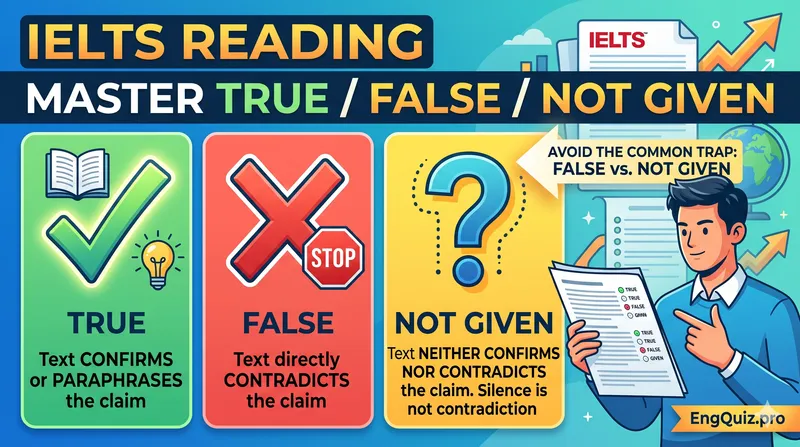
IELTS Reading: How to Master True/False/Not Given
True/False/Not Given is the most-failed IELTS Reading task. Learn the one rule that fixes it, and practise free on real B2/C1 passages with instant feedback.
What Is A1 English Level? Skills, Grammar & First Words
A1 is absolute beginner English at the start of the CEFR scale. Learn what A1 means, the first grammar and words, and how long it takes to reach A2.