IELTS Reading: How to Master True/False/Not Given
True/False/Not Given is the most-failed IELTS Reading task. Learn the one rule that fixes it, and practise free on real B2/C1 passages with instant feedback.
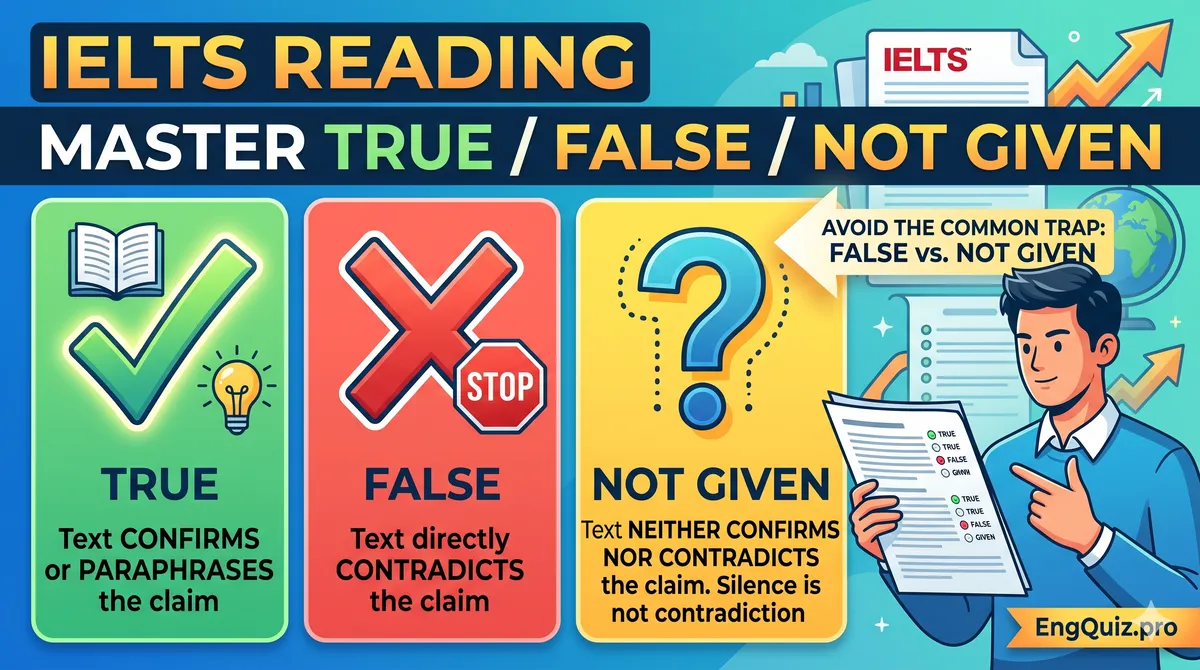
True/False/Not Given costs more IELTS Reading marks than any other question type, not because the English is difficult, but because the decision between False and Not Given is genuinely counterintuitive. Most candidates understand True. The gap between False and Not Given is where marks disappear.
In IELTS Academic Reading, this question type typically covers 5 to 7 of the 40 questions per paper. At Band 7.0, you can afford to drop no more than six or seven questions total. These questions alone can decide your score.
The verdict that trips up strong readers
The most common error is not confusing True with False. It is marking False when the answer should be Not Given.
This happens because learners apply everyday logic: if a statement is not supported, it must be wrong. In conversation, that is reasonable. In IELTS Reading, it is a trap.
There are exactly three outcomes. One criterion for each:
| Your answer | Use it when |
|---|---|
| True | The passage confirms or clearly implies the statement. |
| False | The passage directly contradicts the statement. |
| Not Given | The passage neither confirms nor contradicts it; the topic simply is not addressed. |
Never use your own knowledge of the world; answer only from what the text says.
Read like a fact-checker, not a reader
Imagine you are a professional fact-checker assigned to verify a set of claims, but you are only allowed to use one source: a single article you have been given. A colleague hands you a list of statements and asks: "Can you verify each one from this article?"
Your three verdicts:
- Verified: the article confirms the same thing (True)
- Disputed: the article says the opposite (False)
- Unverifiable: the article does not mention it, so you cannot check (Not Given)
A careful fact-checker never writes "Disputed" just because the source is silent on something. Silence is not contradiction. If your source does not address the claim at all, the correct verdict is "Unverifiable," regardless of what you personally know or believe.
That is exactly what IELTS is testing. The passage is your only source. Everything outside it (your general knowledge, your intuition, what "probably" follows) does not exist for this question.
How True/False/Not Given works in IELTS Reading
Layer 1: Confirming True
A statement is True when the passage confirms the same idea, often in different words. IELTS passages almost never repeat the statement verbatim; they paraphrase.
Passage: "The firm reduced its annual travel budget by 40% after switching to video conferencing." Statement: The company spent significantly less on travel after adopting online meetings. → True. Different vocabulary, same meaning. "Reduced budget" = "spent less"; "video conferencing" = "online meetings."
Passage: "Over 60% of survey respondents said they preferred the new scheduling system." Statement: The majority of respondents favoured the updated scheduling tool. → True. "Over 60%" = "majority"; "preferred" = "favoured"; "new scheduling system" = "updated scheduling tool."
Layer 2: Confirming False
A statement is False when the passage makes a claim that directly opposes the statement. Look for a genuine logical contradiction: not a gap in detail, but a head-on clash.
From our free B2 exercise, The Rise of Remote Work:
"The technology that made this possible had existed for over a decade."
Statement: The technology that made remote work possible was invented in 2020.
The text says the technology already existed for ten years; that directly contradicts "invented in 2020." → False.
Passage: "The study enrolled participants from five countries." Statement: The study was limited to participants from a single country. → False. "Five countries" directly contradicts "a single country."
Layer 3: Recognising Not Given
This is the hard layer. Not Given does not mean "probably false" or "the text does not prove it." It means the passage simply does not address that part of the statement.
From the same exercise:
"Employers discovered that they could reduce spending on expensive city-centre offices."
Statement: City-centre office rents fell as a direct result of remote work.
Does the text confirm it? No, it says employers reduced their own spending, not that market rents fell. Does the text contradict it? No. The passage neither confirms nor contradicts a fall in rents. → Not Given.
The decision rule: If you cannot point to a specific sentence in the passage that directly contradicts the statement, the answer is Not Given, not False.
What IELTS examiners are actually testing
T/F/NG appears in every IELTS Academic Reading paper and most IELTS General Training papers. The question type tests whether a candidate can separate what a text says from what can merely be inferred.
Band 5–6 candidates typically mark Not Given as False when the statement makes a plausible inference. They add meaning to the text: "the passage implies this is wrong, so it must be False." They are answering a question the passage never asked.
Band 7+ candidates know the rule precisely: False requires a direct contradiction, not an implication. They test every limiting word in the statement (all, only, never, first, more than) against the passage, because a single limiting word can turn a True into a False.
The specific move that pushes band scores: When uncertain, locate the key claim in the statement and ask: where exactly does the passage address this claim? If you cannot point to that sentence, choose Not Given. One habit eliminates most False/Not Given errors.
In IELTS Academic Reading, examiners deliberately choose statements that match the topic of the passage but address adjacent information the passage does not cover. The Not Given answer is not an accident or an omission; it is designed to test whether you read only from the source.
Five traps that look like knowledge
Trap: Outside knowledge A statement matches what you know about the world, so it feels obviously True, but the passage never says it. Fix: Your background knowledge is invisible to the examiner. If the passage does not say it, choose Not Given.
Trap: "Some" vs "all" Passage: "Some companies reported cost savings from the shift to remote work." Statement: "All companies reported cost savings from the shift to remote work." Fix: False. "Some" directly contradicts "all"; that is a contradiction, not a gap.
Trap: Plausible inference Passage: "Workers reported spending significantly less time commuting each day." Statement: "Workers used their saved commuting time for exercise." Fix: Not Given. The text confirms time was saved; it says nothing about how that time was used. An inference is not a contradiction.
Trap: Partial confirmation A statement contains two claims. The passage confirms one and is silent on the other. Passage: "The programme proved popular with participants." Statement: "The programme was both popular and cost-effective." Fix: Not Given. Both claims need support for True. One confirmed, one missing = Not Given, not True.
Trap: Negatives and qualifying words Words such as not all, few, rarely, unlikely, and limited create partial negatives that are easy to misread under time pressure. Passage: "Few businesses reported any difficulties with the transition." Statement: "Businesses widely reported difficulties with the transition." Fix: False. "Few" directly contradicts "widely reported." Read every negative and qualifying word before deciding.
A reliable four-step method
Use this process on every True/False/Not Given question in IELTS Reading:
-
Read the statement first. Before looking at the passage, underline the key claim and any limiting words (all, only, always, first, more than, never). These are the words most likely to determine whether the answer is True, False, or Not Given.
-
Locate the matching part of the passage. The statements in T/F/NG questions usually follow the order of the passage, so you do not need to scan the whole text for each one. Look for the same idea, not the same words. IELTS paraphrases almost every statement.
-
Compare meaning, not vocabulary. Once you have found the relevant sentence, ask: does the text confirm the same idea, say the opposite, or say nothing about it?
-
Decide in order: confirmed → True; contradicted → False; neither → Not Given. If you are hesitating between False and Not Given, choose Not Given. The hesitation itself is a signal that the passage is not clearly contradicting the statement.
Four practice questions
Passage extract:
"The city council approved the construction project in April, three months ahead of the original schedule. The new terminal is expected to handle up to 12 million passengers annually, though critics have questioned whether local transport links are adequate."
Statement 1: The construction project received approval earlier than originally planned.
Statement 2: The terminal is expected to handle more than 15 million passengers per year.
Statement 3: The city council consulted local residents before approving the project.
Statement 4: Critics argued that the new terminal would damage the local environment.
(Try all four before scrolling. That is the whole point.)
Remember this
The moment you think "the passage does not say this, so it must be False," stop. That thought is the trap.
Answers:
- True: "three months ahead of the original schedule" confirms "earlier than originally planned."
- False: "up to 12 million" directly contradicts "more than 15 million."
- Not Given: the passage says nothing about resident consultation.
- Not Given: critics questioned transport links, not environmental impact. Different claims; the passage is silent on environment.
Practise on a full passage
Reading about this technique is not the same as doing it under exam conditions. The worked examples above come from a complete B2 reading exercise: a full passage, fourteen statements, and instant feedback on every answer.
The Rise of Remote Work (B2): True/False/Not Given →
FAQ
Is "Not Given" the same as "False"? No. False means the passage contradicts the statement. Not Given means the passage does not mention it at all. When in doubt between the two, choose Not Given.
Can I use my own knowledge to answer? No. Answer only from the passage. A statement can be factually true in the real world and still be Not Given if the text does not state it.
Do the answers come in passage order? Usually yes. T/F/NG questions tend to follow the order of information in the text, so once you have located one answer, the next is normally further along.
What is the difference from Yes/No/Not Given? The logic is identical. True/False/Not Given tests factual information; Yes/No/Not Given tests the writer's claims or opinions. The decision process is the same.
How much time should I spend on each T/F/NG question? Target 60 to 90 seconds per question. Since answers follow passage order, work through the text once and match statements as you go. If you are stuck between False and Not Given after 90 seconds, choose Not Given and move on.
New Articles

How to Embed a Free English Grammar Quiz on Your Website (WordPress, Google Sites, Moodle)
Step-by-step instructions for adding a free, interactive English grammar quiz to WordPress, Google Sites, Moodle, or any page that accepts HTML. No plugin, no sign-up, no ads.
How to Improve English Reading and Actually Understand It
Why the level of the text you choose matters more than the hours you put in, and five exercises that build reading comprehension.
What Is A1 English Level? Skills, Grammar & First Words
A1 is absolute beginner English at the start of the CEFR scale. Learn what A1 means, the first grammar and words, and how long it takes to reach A2.