What Is B1 English Level? Grammar, Vocabulary & Exams
B1 is intermediate English: the level where you stop surviving and start communicating. Learn B1 grammar, vocabulary, exam scores, and how to reach it.
Introduction
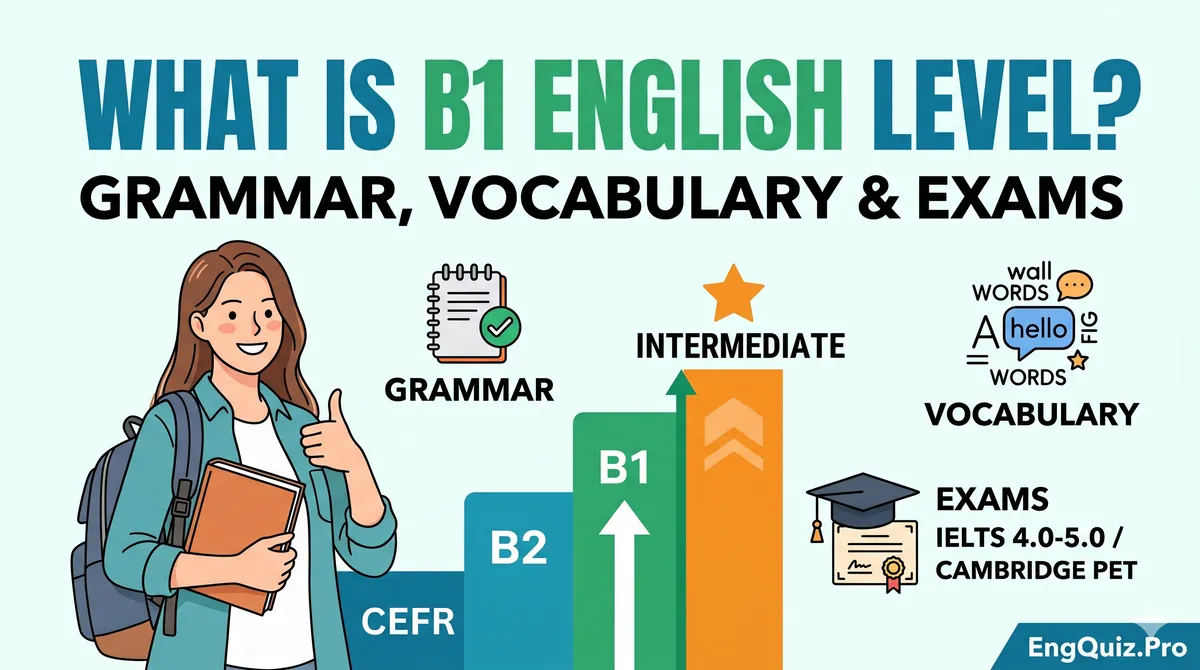
B1 is the level where English stops being "survival" and starts being communication. At B1 you can hold a conversation on familiar topics, write a personal email, follow the main points of clear standard speech, and handle most situations a tourist or a casual user of English meets day to day.
This guide covers what B1 means in real conversations, the grammar and vocabulary you need to reach it, the exams that certify B1, how long the move from A2 usually takes, and the cleanest path from B1 toward B2.
Quick answer: B1 English is "threshold" or "intermediate" on the CEFR scale. At B1 you can deal with most situations while travelling in an English-speaking country, describe experiences and ambitions, give reasons and short explanations, and produce simple connected text on familiar topics. You typically know around 2 500–3 000 active words. Reaching B1 from A2 usually takes 180–250 hours of focused study; from zero, plan on around 380–500 hours overall.
What B1 Means in Practice
The Council of Europe defines B1 (also called Threshold or Intermediate) through real-world can-do statements. At B1 you can:
| Skill | What you can do at B1 |
|---|---|
| Speaking | Hold a conversation on familiar topics, describe experiences and plans, give opinions, manage most travel situations, deal with simple problems (lost item, complaint) |
| Listening | Follow the main points of clear standard speech on familiar topics, including short news items if they are spoken slowly |
| Reading | Understand the main ideas of straightforward articles, short stories, and everyday letters; pick out details when the topic is familiar |
| Writing | Write a coherent personal email, a short blog comment, a simple report, or a 150-word description of an event or experience |
What you cannot yet do at B1:
- Follow a fast, idiomatic conversation between two native speakers
- Read a serious newspaper article on an unfamiliar topic without effort
- Write a structured 250-word essay with confident grammar
- Discuss abstract or technical subjects in depth
- Understand films at native speed without subtitles
B1 is the first level where you can use English as a working tool, but the range is still narrow. Push past familiar topics or natural speed and you will still feel out of your depth.
B1 Grammar: What You Must Know
B1 is where grammar starts getting structurally rich. Master these and you have the grammatical core of the level:
| Grammar point | Why it matters at B1 | Example |
|---|---|---|
| Present perfect (simple) | Linking past events to the present | I have lived here for three years. I have just finished. |
| Past continuous | Background and interrupted past actions | I was reading when he called. |
| Past perfect (basic) | Putting two past events in order | When I arrived, the train had already left. |
| First and second conditional | Real and unreal future hypotheticals | If it rains, I will stay home. If I had more time, I would travel more. |
| Basic passive voice | Most-common tenses | The bridge was built in 1880. English is spoken here. |
| Modals of deduction and advice | should, must, might, may | You should rest. It might rain. He must be tired. |
| Reported speech (basic) | Reporting what someone said with backshift | She said she was tired. He told me he had finished. |
| Defining relative clauses | Joining ideas with who / which / that | The man who lives next door is a chef. |
| Gerunds and infinitives (common patterns) | enjoy doing, want to do, stop to do vs stop doing | I enjoy reading. I want to learn Spanish. |
| Linking words for short texts | because, although, however, so, while | I went home because I was tired. |
Notice what is not yet on the list: mixed conditionals (B2), modal perfects (B2: should have done), non-defining relative clauses (B2), advanced passive forms (B2+), reduced relative clauses (B2+). B1 is the layer below all of those.
For a focused walkthrough of one of the trickiest B1 contrasts, see our Present Perfect vs Past Simple guide.
B1 Vocabulary: What You Need
B1 vocabulary is typically 2 500–3 000 active words, the next big jump up from the A2 baseline. The areas you need to cover at B1:
| Topic | Examples |
|---|---|
| Work and study | colleague, deadline, meeting, application, course, degree |
| Health and wellbeing | symptom, prescription, appointment, fitness, mental health |
| Travel beyond the basics | itinerary, boarding pass, customs, accommodation, sightseeing |
| Opinions and feelings | agree, disagree, doubt, worried, disappointed, relieved |
| News and current events | election, protest, economy, climate, technology, crime |
| Relationships and life events | married, divorced, retired, promoted, graduate, move house |
| Hobbies and culture | hobby, exhibition, festival, novel, recipe, instrument |
| Functional connectors | on the other hand, in addition, for example, in conclusion, however |
Two practical tips for B1 vocabulary:
- Move from passive to active vocabulary. At B1, the gap between what you understand and what you can produce starts to bite. For every new word, write one or two sentences using it the same week.
- Learn collocations, not isolated words. Make a decision, reach an agreement, take a chance, pay attention. Native speakers store these as units; learning the unit gets you a fluent-sounding phrase, not just a word.
B1 Exams: What Certificates Prove B1?
If you need official proof of B1, three exams certify it:
| Exam | Length | Format | Cost (typical) |
|---|---|---|---|
| Cambridge B1 Preliminary (PET) | ~2.5 hours | Reading, Writing, Listening, Speaking | £100–140 |
| IELTS | ~2.75 hours | Listening, Reading, Writing, Speaking | $200–250 |
| TOEIC | 2 hours (L&R) | Listening + Reading | $90–150 |
| Exam | B1 score equivalent |
|---|---|
| Cambridge B1 Preliminary | Pass (140–159) |
| IELTS | 4.0–5.0 |
| TOEIC (Listening + Reading total) | 550–780 |
IELTS and TOEIC are not taken to certify B1: these are score equivalents only. Cambridge B1 Preliminary is the dedicated B1 certificate. For visa, university, or professional registration purposes, always check which specific test the awarding body accepts.
For a deeper comparison of which exam fits your goal, see IELTS vs TOEIC vs Cambridge.
How Long Does It Take to Reach B1?
The Council of Europe's reference figure is 180–250 guided learning hours to go from A2 to B1, and a cumulative 350–500 hours from no English at all. In practice:
| Study intensity | Time from A2 to B1 | Time from zero to B1 |
|---|---|---|
| 1 hour/week (casual) | 4–5 years | 7–9 years |
| 2 hours/week (school pace) | 2–2.5 years | 4–5 years |
| 4 hours/week (motivated) | 12–15 months | 24–30 months |
| Daily 30–45 min + immersion | 6–8 months | 12–16 months |
| Intensive (10 hours/week + practice) | 3–4 months | 8–10 months |
The fastest path at B1 is regular output with feedback: write something short every day, get it corrected, and rewrite it. Passive input alone (Netflix, YouTube, scrolling English social media) almost never gets a learner across the A2 → B1 boundary on its own.
For a complete study plan template that scales up to B2 and beyond, see How to learn English grammar step by step.
Common Mistakes That Keep Learners Stuck at B1
These are the patterns we see most often in our B1 learner data. Fix them and the door to B2 opens much faster.
Mistake 1: Using past simple where present perfect is required
I work here for three years.→ I have worked here for three years.Did you ever go to London?→ Have you ever been to London?
Present perfect is the most heavily tested B1 structure. If you are not using have/has + past participle for ongoing or recent-relevance situations, examiners and native speakers will notice immediately.
Mistake 2: Mixing up first and second conditional
If I will have time, I would call you.→ If I have time, I will call you. (1st: real future)If I have more money, I will travel more.→ If I had more money, I would travel more. (2nd: unreal/hypothetical)
The split is about reality, not time. First conditional = a real possibility. Second conditional = an imagined or hypothetical situation. Mixing the verb forms is the most common B1 conditional error.
Mistake 3: Translating tenses literally from the first language
A learner whose first language has only one past tense often forces every English past situation into past simple. B1 needs at least three: past simple, past continuous, and past perfect. Each one tells the reader something different about when and how an event sits in the past.
Mistake 4: Avoiding the passive voice entirely
Many B1 learners can recognise the passive but never produce it. The result is unnatural-sounding sentences like People built this bridge in 1880 instead of This bridge was built in 1880. Pick one passive structure per week and force yourself to use it in writing until it becomes automatic.
Mistake 5: Treating reading as the main path to B2
Reading is necessary but not sufficient at B1. Learners who only read tend to stall: they understand more and more, but produce no more than before. Every B1 learner who reliably reaches B2 has the same pattern in their routine: daily short writing, regular correction, and weekly rewriting of the corrected output. Without that loop, the level rarely moves.
How to Move from B1 to B2
The jump from B1 to B2 is the biggest single step in the CEFR scale, and it deserves its own plan rather than a quick checklist. The headline targets:
- Master present perfect (simple and continuous), past perfect, and modal perfects. These tenses are the structural backbone of B2.
- Move vocabulary from 3 000 to 4 000–5 000 word families. Push beyond everyday topics into academic, professional, and semi-formal registers.
- Build a daily writing-and-correction routine. Output volume with honest feedback is what makes the biggest difference at this stage.
For a full month-by-month plan, including a 12-month roadmap and an example learner path, see our B1 to B2 roadmap. The roadmap is where the action sits; this page is the level definition.
Quick Reference
| Question | B1 answer |
|---|---|
| What does B1 mean? | Threshold / Intermediate: communicate, not just survive |
| Vocabulary size | 2 500–3 000 active words |
| Time from A2 | 180–250 study hours (~6–8 months at daily pace) |
| Key grammar | Present perfect, past continuous, conditionals 1 & 2, basic passive, reported speech |
| Certifies B1 | Cambridge B1 Preliminary, IELTS 4.0–5.0, TOEIC 550–780 |
| What's not in B1 yet | Mixed conditionals, modal perfects, non-defining relatives, advanced passive |
B1 Practice Exercises
The fastest way to confirm B1 is to take B1-level exercises and see what you score. Start with the B1 Present Perfect Gap Fill; the rest of our B1 set is linked at the end of this article.
If you score 60%+ on B1 exercises, you are solidly at B1. Score 80%+ and you are ready to start working on B2 material from the roadmap.
Last updated: 23 May 2026 · See our editorial standards.
Frequently Asked Questions
Yes. B1 is the lower of the two intermediate levels on the CEFR scale (B1 = Threshold / lower intermediate; B2 = Vantage / upper intermediate). At B1 you can hold a conversation on familiar topics and use English as a working tool, but with a noticeably narrower range than a B2 speaker.
A2 lets you survive in routine situations. B1 lets you communicate. Vocabulary roughly doubles (1 500–2 500 → 2 500–3 000), present perfect appears, conditionals (1st and 2nd) appear, and you can now produce short connected text rather than only isolated sentences. For a full A2 breakdown, see What Is A2 English Level?.
For some jobs, yes. B1 is accepted for hospitality, customer-facing retail, in-person service roles, and entry-level positions in international teams where the working language is partly your first language. Office work in a fully English-speaking environment, technical writing, and most professional-services roles still require B2 minimum.
Sometimes. Several skilled-work visas (UK Skilled Worker, certain EU work permits) accept B1 as the language threshold. Most undergraduate and postgraduate university programmes in English require B2 or higher. Always check the exact CEFR level (or accepted test score) listed by the immigration authority or institution you are applying to.
Take a free CEFR self-check first: see our free CEFR level test. Then try a B1 grammar exercise: if you score 60%+ on the present perfect set, you are at B1. If you struggle with present perfect or first/second conditional, you are probably in the A2–B1 transition.
B2 - Upper-Intermediate. At B2 you can hold conversations on unfamiliar topics, write structured essays, and follow native-speed speech in clear conditions. The B1 → B2 step is the biggest single jump in the CEFR scale; our B1 to B2 roadmap is a 12-month plan for making it.
New Articles
How to Embed a Free English Grammar Quiz on Your Website (WordPress, Google Sites, Moodle)
Step-by-step instructions for adding a free, interactive English grammar quiz to WordPress, Google Sites, Moodle, or any page that accepts HTML. No plugin, no sign-up, no ads.
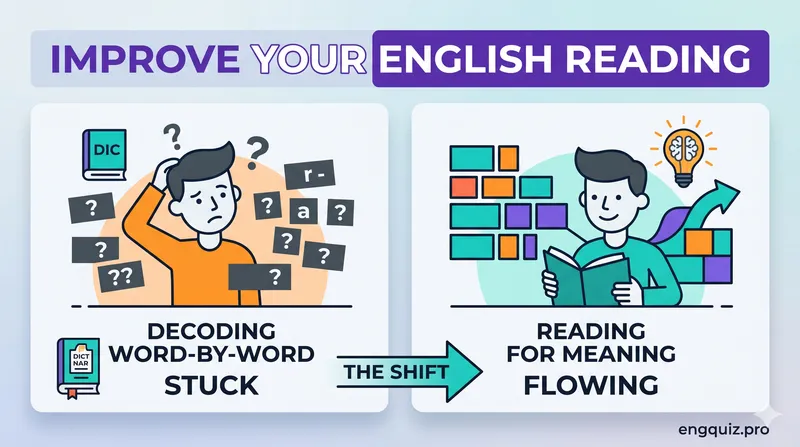
How to Improve English Reading and Actually Understand It
Why the level of the text you choose matters more than the hours you put in, and five exercises that build reading comprehension.
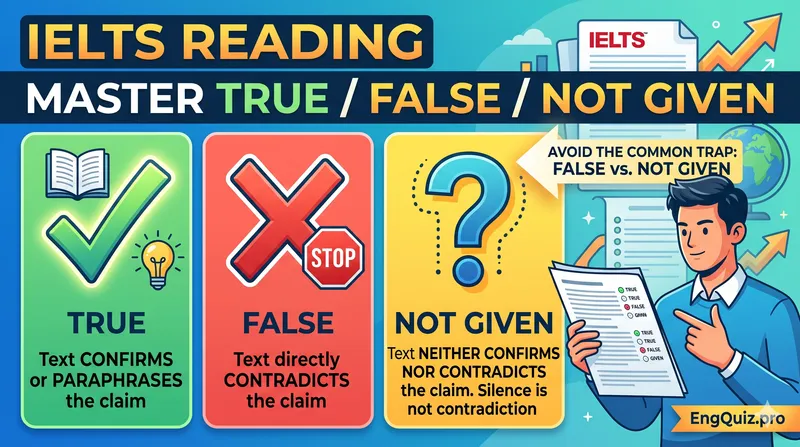
IELTS Reading: How to Master True/False/Not Given
True/False/Not Given is the most-failed IELTS Reading task. Learn the one rule that fixes it, and practise free on real B2/C1 passages with instant feedback.
Related Articles
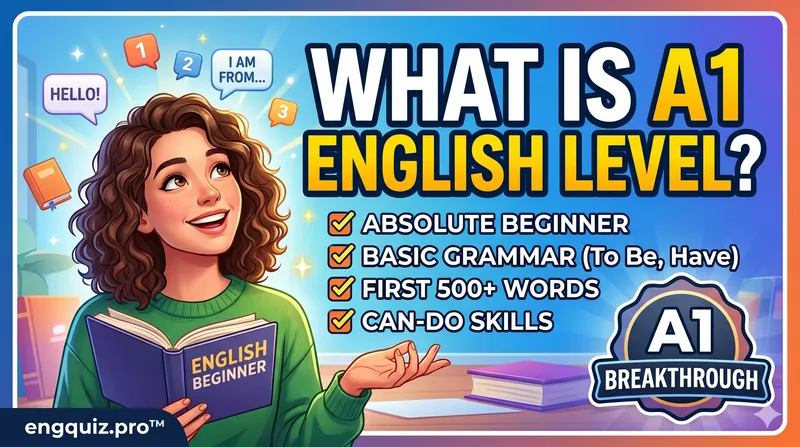
What Is A1 English Level? Skills, Grammar & First Words
A1 is absolute beginner English at the start of the CEFR scale. Learn what A1 means, the first grammar and words, and how long it takes to reach A2.
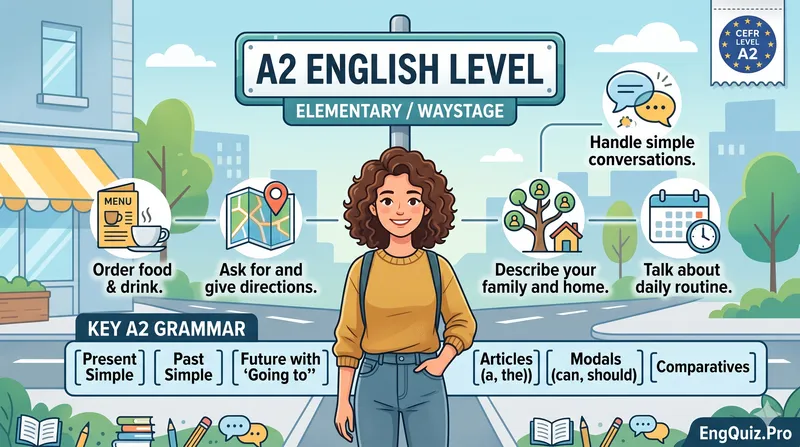
What Is A2 English Level? Grammar, Vocabulary & Exams
A2 is the elementary CEFR level: survival English for everyday situations. Learn A2 grammar, vocabulary, exam scores, and how long it takes to reach it.
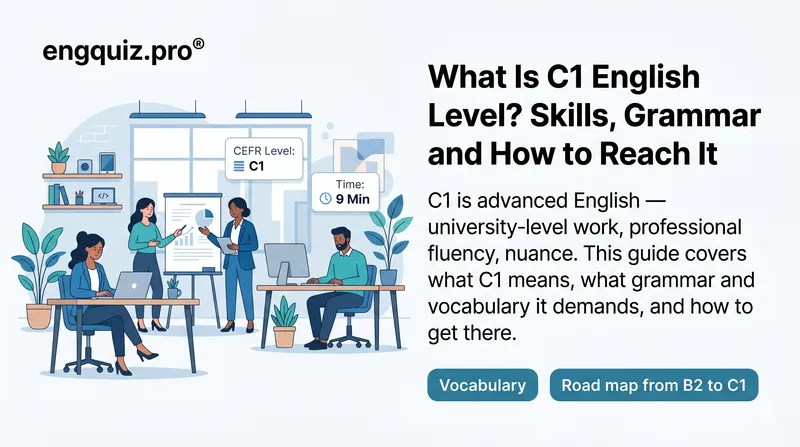
What Is C1 English Level? Skills, Grammar and How to Reach It
C1 is advanced English: university-level work, professional fluency, nuance. This guide covers what C1 means, what grammar and vocabulary it demands, and how to get there.