What Is A1 English Level? Skills, Grammar & First Words
A1 is absolute beginner English at the start of the CEFR scale. Learn what A1 means, the first grammar and words, and how long it takes to reach A2.
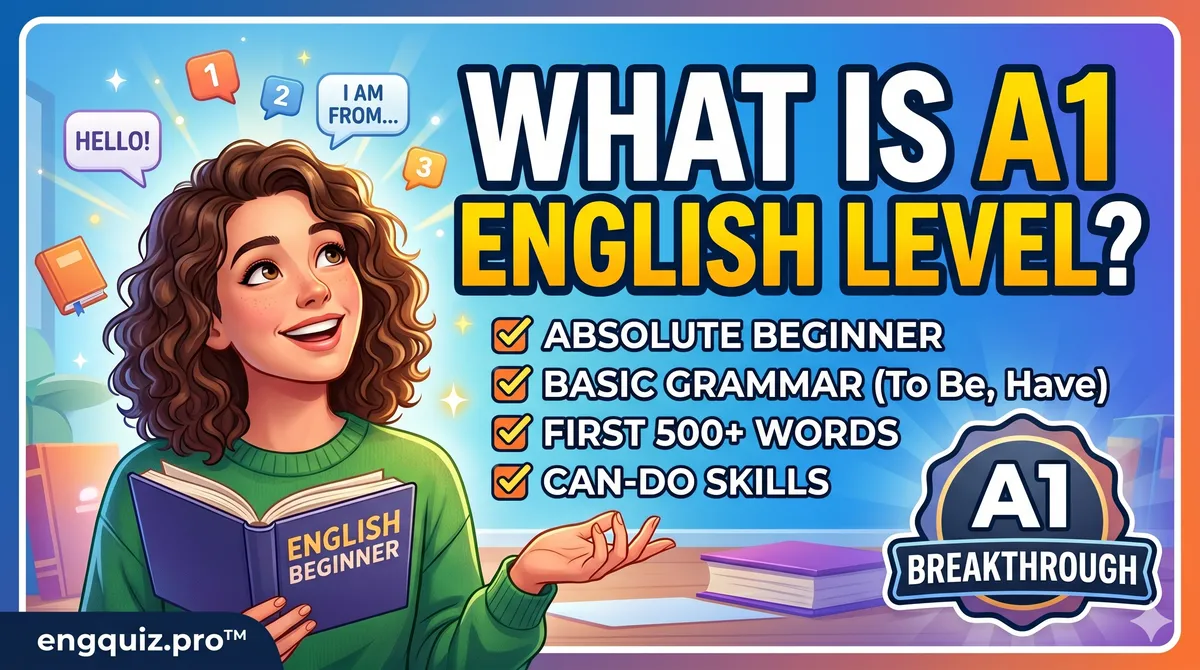
Introduction
A1 is the official starting line of the CEFR scale. At A1 you are an absolute beginner: you can introduce yourself, say where you are from, ask simple questions, and understand short, slow speech about familiar things, as long as the other person speaks clearly and is willing to help.
This guide covers what A1 means in real life, the first grammar and vocabulary to study, the exams that certify A1, how long the level usually takes, and how to make the move from A1 to A2 cleanly.
Quick answer: A1 English is "breakthrough" or "beginner" on the CEFR scale. At A1, you can introduce yourself, ask and answer simple questions about personal details, and understand basic, slow speech on very familiar topics. You typically know around 500–1 000 words and rely heavily on present simple, to be, and the most common everyday vocabulary. Reaching A1 from no English at all usually takes 80–100 hours of focused study.
What A1 Means in Practice
The Council of Europe defines A1 (also called Breakthrough) through real-world can-do statements. At A1 you can:
| Skill | What you can do at A1 |
|---|---|
| Speaking | Introduce yourself, give your name and nationality, ask basic questions (Where is the toilet? How much?), say simple numbers, dates, prices |
| Listening | Understand familiar names, simple instructions, and very basic questions if the speaker talks slowly and clearly |
| Reading | Recognise common words and very simple phrases on signs, menus, and notices |
| Writing | Fill in a short form with personal details, write a postcard with very simple sentences |
What you cannot yet do at A1:
- Hold a conversation that goes beyond a few exchanges
- Understand someone speaking at natural speed
- Read a short news article, even a simple one
- Write more than a few sentences without help
- Talk about anything you have not specifically prepared
A1 is the very start. Think of it as the level where you can survive a few key interactions - only with help from a patient, slow speaker.
A1 Grammar: The First Structures to Learn
A1 grammar is small. Focus on these structures and you will have the core of the level:
| Grammar point | Why it matters at A1 | Example |
|---|---|---|
| Verb to be (am / is / are) | The single most-used verb in introductions and descriptions | I am from Brazil. She is a teacher. |
| Subject pronouns (I, you, he, she, it, we, they) | Saying who is doing what | They are my parents. We are at the hotel. |
| Possessive adjectives (my, your, his, her) | Basic ownership | This is my passport. Her name is Anna. |
| Present simple, affirmative (regular verbs) | Describing routines and facts | I live in Berlin. He works in a shop. |
| Articles (a / an / the) | Basic noun grammar | I have a brother. The car is red. |
| Plural nouns (regular -s) | Talking about more than one of something | Two coffees, please. Three children. |
| Question words (who, what, where, when, how) | Asking the most common questions | Where do you live? How old are you? |
| Numbers, dates, prices | The everyday data of A1 conversations | I am twenty-five. It costs ten euros. |
| Basic prepositions of place (in, on, at) | Saying where things are | The book is on the table. I live in Paris. |
| Yes/no questions with to be | The first kind of full question you can ask | Are you a student? Is she here? |
Notice what is not on the list: past tenses (A2), future forms (A2), modals beyond can (A2+), present continuous (A2 in earnest), comparatives (A2). A1 is the layer below all of those.
For a step-by-step on how present simple works once you have the basics, see the present simple theory page.
A1 Vocabulary: Your First 500–1 000 Words
A1 vocabulary is typically 500–1 000 active words, which is roughly the top frequency band in any English dictionary. The areas you need to cover at A1:
| Topic | Examples |
|---|---|
| Personal information | name, age, nationality, country, family, job |
| Basic objects | book, pen, phone, table, car, house, key |
| People | mother, father, brother, sister, friend, child |
| Numbers, days, months | one to one hundred, Monday, January, today |
| Food and drink (very common) | water, coffee, bread, meat, fruit, sandwich |
| Places (very common) | shop, restaurant, station, hotel, school, hospital |
| Simple adjectives | big, small, good, bad, hot, cold, happy, sad |
| Most common verbs | be, have, do, go, come, eat, drink, work, like |
| Greetings and politeness | hello, goodbye, please, thank you, sorry, excuse me |
Two practical tips for A1 vocabulary:
- Learn whole phrases, not just words. Nice to meet you, How are you?, Can I have…? are units, not five separate words. Treat them as single building blocks.
- Start with the top-500 word frequency list. The most common 500 English words cover a huge share of everyday speech. Master them before you reach for any topic-specific lists.
A1 Exams: What Certificates Prove A1?
A1 is rarely tested in adult learner exams; most adult certifications start at A2 (Cambridge A2 Key) or B1 (Cambridge B1 Preliminary). The main A1 certifications are:
| Exam | Audience | Format | Cost (typical) |
|---|---|---|---|
| Cambridge A1 Movers | Young learners (8–11) | Reading & Writing, Listening, Speaking | £40–60 |
| Cambridge A1 Starters | Young learners (7–9, very introductory) | Listening, Reading & Writing, Speaking | £35–55 |
| TOEIC Bridge | Adults (entry level) | Listening + Reading | $75–120 |
| IELTS | Adults | Listening, Reading, Writing, Speaking | $200–250 |
| Exam | A1 score equivalent |
|---|---|
| Cambridge A1 Movers / Starters | Pass at A1 |
| TOEIC Bridge | 100–149 (Listening + Reading) |
| IELTS | 2.0–2.5 |
Cambridge A1 Movers and Starters are the dedicated A1 certificates, but they are designed for children. IELTS and TOEIC Bridge are listed here only as score equivalents; adult learners normally start exam preparation at A2 or later.
For a full comparison of which exam fits your goal, see IELTS vs TOEIC vs Cambridge.
How Long Does It Take to Reach A1?
The Council of Europe's reference figure is 80–100 guided learning hours to reach A1 from no English at all. In practice:
| Study intensity | Time to A1 from zero |
|---|---|
| 1 hour/week (casual) | 18–24 months |
| 2 hours/week (school pace) | 9–12 months |
| 4 hours/week (motivated) | 5–6 months |
| Daily 30 min + listening practice | 3 months |
| Intensive (10 hours/week + practice) | 6–8 weeks |
The fastest path at A1 is high-frequency, low-pressure exposure: short daily sessions, lots of listening to slow speakers, and repeated practice of the same 20 or so essential phrases until they come out automatically.
For a complete study plan template that scales up from A1, see How to learn English grammar step by step.
Common Mistakes That Keep Learners Stuck at A1
These patterns are the most common reasons A1 learners stall before reaching A2. Catch them early and the move to A2 becomes much shorter.
Mistake 1: Trying to translate every word from your first language
Word-by-word translation produces sentences that are grammatically valid in your language but nonsense in English. I have 25 years (from Spanish tengo 25 años or French j'ai 25 ans) becomes I am 25 years old. Learn English phrases as wholes, not as a translation puzzle.
Mistake 2: Dropping to be in descriptions
I happy.→ I am happy.She from Italy.→ She is from Italy.
In most languages, you can leave out the verb "to be" in present tense. English never does. To be is required in every simple description sentence.
Mistake 3: Confusing do and be in questions
Are you live here?→ Do you live here?Do you a student?→ Are you a student?
Use to be for states and identity. Use do/does for action verbs. Getting this split right is the first real grammatical skill of A1.
Mistake 4: Forgetting the article a / an / the
I am student.→ I am a student.I work in office.→ I work in an office.
Most A1 learners leave out articles because their first language does not use them. English uses them constantly. Practise inserting a, an, or the in every short sentence you write at A1.
Mistake 5: Using only present tense for everything
A1 learners often try to talk about the past or the future using only present simple, because that is what they know. That is fine for the first weeks, but it becomes the main reason people stall right at the A1–A2 boundary. The first move beyond A1 is to add past simple of to be (was, were) and the most common past forms (went, had, did).
How to Move from A1 to A2
The A1 → A2 jump is the gentlest move in the whole CEFR scale, but it still needs deliberate work on three fronts:
- Past simple. Start with the past of to be (was / were) and the 20 most common irregular verbs (went, had, did, said, made, came…). Past simple is the single biggest step from A1 to A2.
- Present continuous. I am working, she is reading, and any be + verb-ing form for what is happening right now. Pair it with present simple so you can distinguish I work in a bank (routine) from I am working from home today (right now).
- Vocabulary: 500 → 1 500 words. Push beyond pure survival vocabulary into food, travel, daily routines, and basic feelings. The Oxford 2000 list is the cleanest target.
For the full picture of what comes next, see What Is A2 English Level?; it covers the grammar table, exam scores, and time-to-reach figures for the next step up.
Quick Reference
| Question | A1 answer |
|---|---|
| What does A1 mean? | Breakthrough: survive a few key interactions with help |
| Vocabulary size | 500–1 000 active words |
| Time from no English | 80–100 study hours (~3 months at daily pace) |
| Key grammar | To be, present simple affirmative, articles, basic questions |
| Certifies A1 | Cambridge A1 Movers/Starters (young learners), TOEIC Bridge 100–149, IELTS 2.0–2.5 |
| What's not in A1 yet | Past tenses, future forms, modals beyond can, present continuous |
A1 Practice Exercises
There are no dedicated A1 exercises on EngQuiz Pro yet; our exercise bank starts at A2. The good news: if you can sit comfortably with the A2 Present Simple Gap Fill and score around 40–50%, you are right at the A1–A2 transition. Score 60%+ and you have already crossed into A2.
If you want a quick self-check, take our free CEFR level test. The easier half of the questions probe A1-range grammar and vocabulary directly.
Last updated: 23 May 2026 · See our editorial standards.
Frequently Asked Questions
Yes. A1 is the lowest level on the CEFR scale. The level below A1 is "no useful English": you cannot say anything meaningful or understand anything spoken at any speed. As soon as you can introduce yourself, ask a basic question, and understand a slow, clear reply, you are at A1.
The Council of Europe's reference figure is 80–100 guided learning hours. At one hour a day, that is about three months. At 30 minutes a day, around six months. At one hour a week, it can stretch to two years.
Just about. A1 covers introductions, asking for prices, ordering food in a slow restaurant, and asking simple questions about directions. You will still need patience from the people you talk to. Natural-speed speech is not yet inside your range.
No. Almost no job and no university programme accepts A1 English. Most skilled work and academic study require B1 or B2 at a minimum. A1 is best thought of as a stepping stone, not a working level.
If you can complete this sentence accurately: "Hi, my name is ____. I'm from ____. I work as a ____." and you can answer "Where do you live?" with a full sentence, you are at A1. If those sentences feel impossible without writing them down first, you are still below A1 and need a few more weeks of foundational study.
A2 - Elementary. At A2 you can handle predictable everyday situations on your own, use past simple to tell short stories, and understand short emails. The A1 → A2 jump is the most achievable in the whole CEFR scale and usually takes 80–100 additional hours of focused study.
New Articles
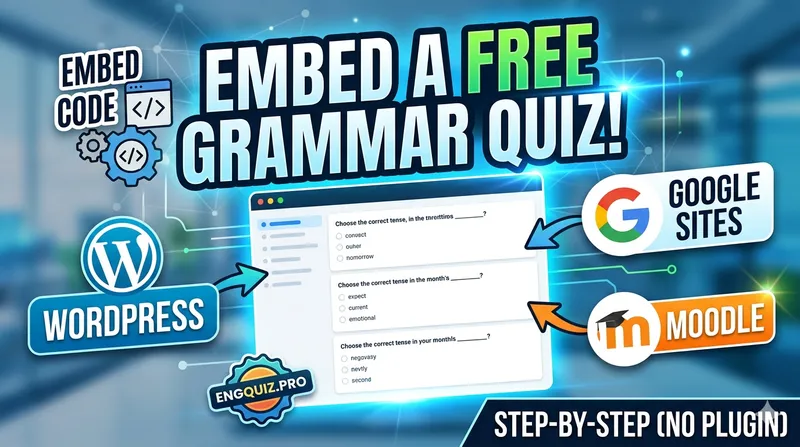
How to Embed a Free English Grammar Quiz on Your Website (WordPress, Google Sites, Moodle)
Step-by-step instructions for adding a free, interactive English grammar quiz to WordPress, Google Sites, Moodle, or any page that accepts HTML. No plugin, no sign-up, no ads.
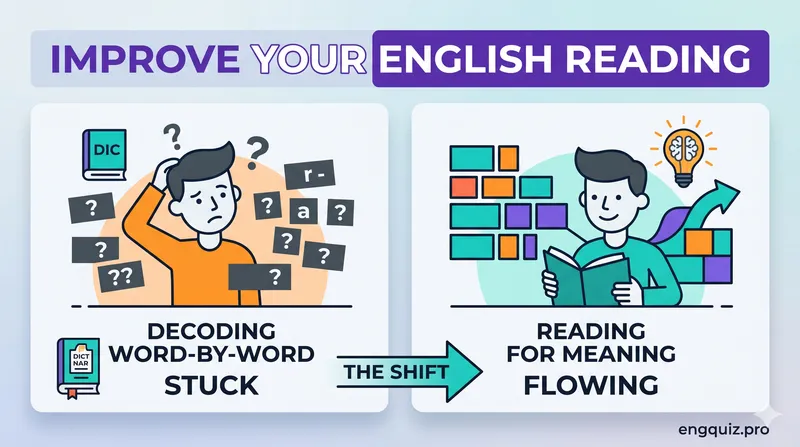
How to Improve English Reading and Actually Understand It
Why the level of the text you choose matters more than the hours you put in, and five exercises that build reading comprehension.
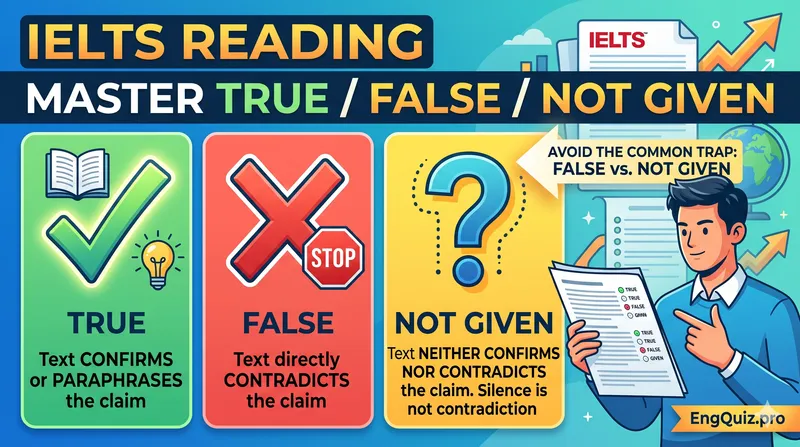
IELTS Reading: How to Master True/False/Not Given
True/False/Not Given is the most-failed IELTS Reading task. Learn the one rule that fixes it, and practise free on real B2/C1 passages with instant feedback.
Related Articles
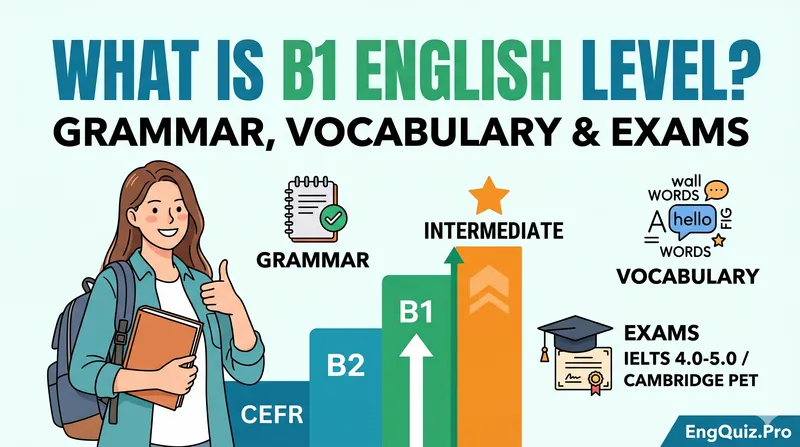
What Is B1 English Level? Grammar, Vocabulary & Exams
B1 is intermediate English: the level where you stop surviving and start communicating. Learn B1 grammar, vocabulary, exam scores, and how to reach it.
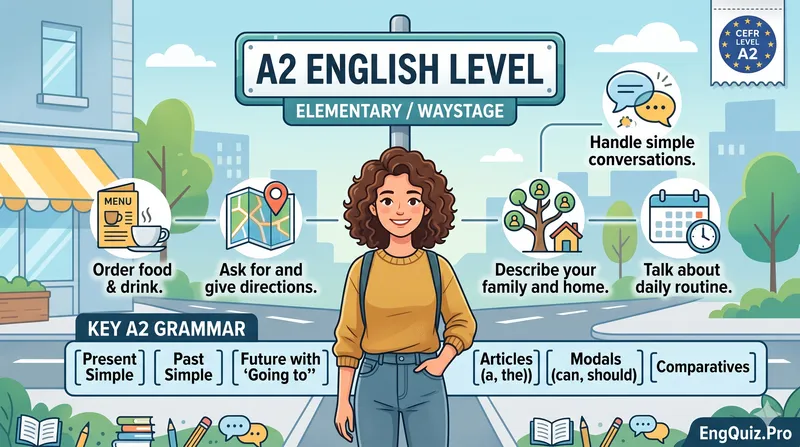
What Is A2 English Level? Grammar, Vocabulary & Exams
A2 is the elementary CEFR level: survival English for everyday situations. Learn A2 grammar, vocabulary, exam scores, and how long it takes to reach it.
What Is C1 English Level? Skills, Grammar and How to Reach It
C1 is advanced English: university-level work, professional fluency, nuance. This guide covers what C1 means, what grammar and vocabulary it demands, and how to get there.