Types of Conditionals in English: Zero, First, Second, Third and Mixed
The 5 types of conditional sentences explained with formulas, examples and common mistakes: zero, first, second, third and mixed conditionals.
Introduction
If you can speak about real and imagined situations in English (what is true, what might happen, what could have been), you are using conditional sentences. There are five main types, and once you see them as a single system rather than five separate rules, the whole structure clicks into place.
This guide explains all five conditional types: the formula, when to use it, real-world examples, and the common mistakes that trip up B1 and B2 learners. By the end you'll be able to tell the difference between If I have time, I help and If I had time, I would help in less than a second, and know exactly when each one is correct.
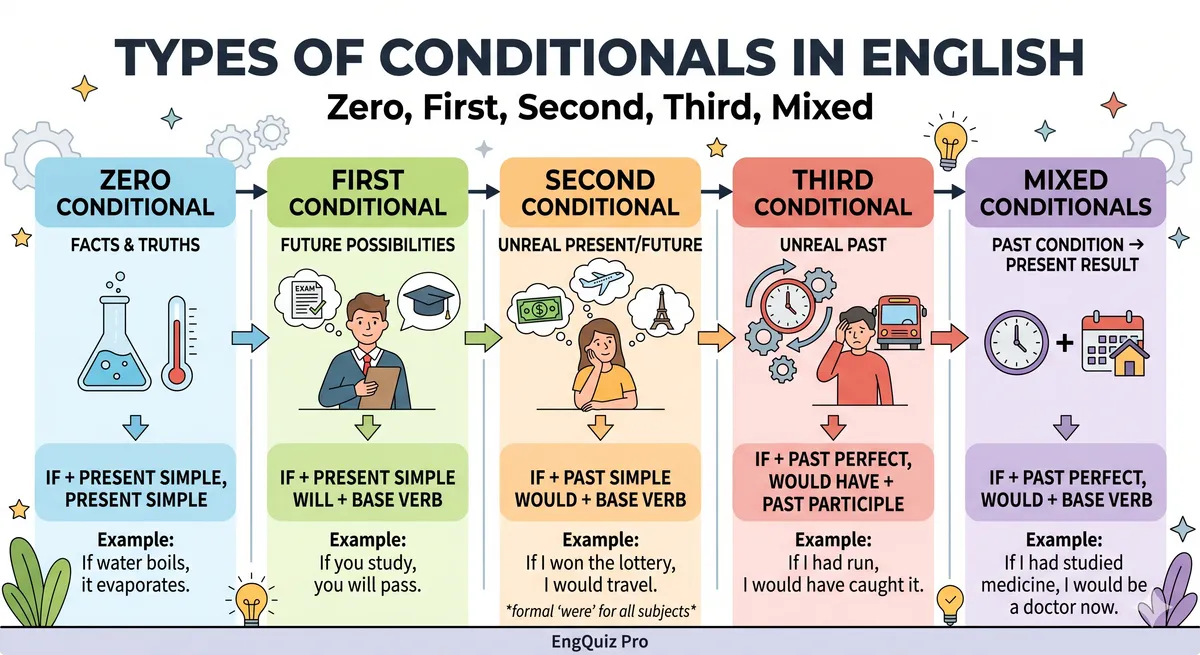
Quick answer: English has five conditional types. Zero = always-true facts (If water boils, it evaporates). First = real future possibilities (If it rains, I'll stay home). Second = unreal present/future (If I had a car, I'd drive). Third = unreal past (If I had studied, I would have passed). Mixed = unreal past condition + unreal present result (If I had studied, I would be a doctor).
The Five Conditional Types at a Glance
| Type | If-clause | Main clause | Use | Example |
|---|---|---|---|---|
| Zero | present simple | present simple | facts, scientific truths, instructions | If you heat ice, it melts. |
| First | present simple | will + base verb | real future possibilities | If you study, you will pass. |
| Second | past simple | would + base verb | unreal / hypothetical present or future | If I had a million dollars, I would travel. |
| Third | past perfect | would have + past participle | unreal past (regret, criticism, what-if) | If I had studied, I would have passed. |
| Mixed | past perfect | would + base verb | unreal past condition + present result | If I had studied, I would be a doctor today. |
The pattern is consistent: as the condition becomes less real, the tense shifts further back in time.
Zero Conditional: Facts and Truths
The zero conditional describes things that are always true: scientific facts, general truths, and unchanging cause-and-effect.
Formula: If + present simple, present simple.
When to use the zero conditional
- Scientific facts: If you mix red and yellow, you get orange.
- General truths: If people don't sleep, they get tired.
- Instructions: If the light flashes red, press the reset button.
- Habits / routines: If she has time, she goes to the gym.
Tip: if and when are interchangeable here
Because the situation is always true, when and if can be swapped: If/When water reaches 100°C, it boils. This is the only conditional type where this works.
Read the full breakdown on the zero conditional theory page.
First Conditional: Real Future Possibilities
The first conditional describes a real, likely future situation and its result.
Formula: If + present simple, will + base verb.
When to use the first conditional
- Plans and warnings: If you don't leave now, you'll miss the train.
- Promises: If you finish your homework, I'll take you to the cinema.
- Threats: If you don't stop, I'll call the police.
- Predictions about specific situations: If it rains tomorrow, the match will be cancelled.
Variations to know
You can swap will for other modals to change the strength:
- If you study, you can pass. (ability)
- If you study, you may pass. (possibility)
- If you study, you should pass. (likelihood)
For B2+ learners, see the formal inversion Should you have any questions, please contact us, covered in the first conditional theory page.
Second Conditional: Unreal Present or Future
The second conditional describes imaginary, unlikely or impossible situations in the present or future, and their hypothetical results.
Formula: If + past simple, would + base verb.
When to use the second conditional
- Hypothetical situations: If I won the lottery, I would buy a house.
- Advice: If I were you, I wouldn't do that.
- Polite requests: Would you mind if I opened the window?
- Dreams: If I lived in Paris, I would visit the Louvre every weekend.
The were vs was note
In formal English, were is used for all subjects in the second conditional:
- If I were rich, I would travel. ✓ (formal)
- If I was rich, I would travel. ✓ (informal, accepted in everyday speech)
In an exam answer, in business writing, or after the fixed phrase If I were you..., always use were. See the second conditional theory page for the full register breakdown.
Third Conditional: Unreal Past
The third conditional describes imaginary past situations, things that did not happen, and their hypothetical past results. This is the conditional of regret, criticism, and counterfactual thinking.
Formula: If + past perfect, would have + past participle.
When to use the third conditional
- Regret: If I had studied harder, I would have passed the exam. (I didn't study; I didn't pass.)
- Criticism: If you had told me earlier, I could have helped. (You didn't tell me.)
- Counterfactual reflection: If she hadn't missed the flight, she would have arrived on time.
Variations
The main clause can also use could have or might have:
- If I had been there, I could have stopped him. (past ability that didn't happen)
- If we had left earlier, we might have caught the train. (past possibility)
Read the full pattern, including formal inversion (Had I known...) at the third conditional theory page.
Mixed Conditionals: Combining Time References
A mixed conditional combines two of the types above to describe a hypothetical situation where the time of the condition and the time of the result are different.
Most common pattern: If + past perfect (unreal past condition), would + base verb (unreal present result).
- If I had studied medicine, I would be a doctor today. (Past condition that didn't happen → present situation that isn't true.)
- If she hadn't missed the train, she would be here now.
- If we had bought that house in 2010, we would be millionaires today.
Less common: present condition → past result
- If I were a better cook, I would have made dinner. (Present trait → past missed action.)
- If he didn't have a fear of flying, he would have come to the wedding.
Mixed conditionals are common in IELTS Writing Task 2 and Cambridge speaking exams. Master them and you signal a B2/C1 level immediately. See the mixed conditionals theory page for full coverage.
How to Choose the Right Conditional
A two-step decision tree:
Step 1: is the situation REAL or UNREAL?
| Situation type | Conditional |
|---|---|
| Always true (fact / law) | Zero |
| Could happen in the future | First |
| Imaginary present or future | Second |
| Imaginary past | Third |
| Imaginary past condition + present result | Mixed |
Step 2: match the tenses
The key rule: one step back in time for each level of unreality.
- Real present → present (zero, first)
- Unreal present → past (second)
- Unreal past → past perfect (third)
This single principle drives all five formulas. If you ever forget which tense to use, ask: how unreal is this? The more unreal, the further back the tense goes.
Common Mistakes
Mistake 1: Using will in the if-clause
If it will rain, I will stay home.
Why it's wrong: English doesn't put will after if (with one exception: polite requests like if you will follow me). The if-clause uses the present simple.
✓ If it rains, I will stay home.
Mistake 2: Using would in the if-clause (second conditional)
If I would have money, I would buy a car.
Why it's wrong: The second conditional uses past simple in the if-clause, not would.
✓ If I had money, I would buy a car.
Mistake 3: Using past simple instead of past perfect (third conditional)
If I knew about the meeting, I would have come.
Why it's wrong: The third conditional requires the past perfect (had + past participle) in the if-clause to mark the unreal past.
✓ If I had known about the meeting, I would have come.
Mistake 4: Mixing the formulas across types
If she would have studied, she would pass.
Why it's wrong: This mixes third-conditional if-clause material (would have studied, incorrectly) with second-conditional result (would pass). For mixed, the if-clause is past perfect and the result is would + base verb.
✓ If she had studied, she would pass. (mixed: past condition → present result) ✓ If she had studied, she would have passed. (third: past condition → past result)
Mistake 5: Forgetting were with I/he/she/it
If I was the president, I would change the law.
Why it's wrong: In formal English, were is the standard subjunctive form across all subjects in the second conditional.
✓ If I were the president, I would change the law.
Mistake 6: Confusing unless with if not
Unless = if not. You can't use both in the same clause.
Unless you don't leave now, you'll be late.✓ Unless you leave now, you'll be late. ✓ If you don't leave now, you'll be late.
Conditionals in Real Communication
Conditionals are not just exam material; they are how English speakers handle anything uncertain. A quick map of where each type lives in real conversation:
- Customer-service emails rely on the first conditional: If your order doesn't arrive by Friday, please contact us.
- Job interviews love the second conditional for hypotheticals: If you were in this situation, how would you handle it?
- Apologies and regret use the third: If I had known, I would have called you.
- Reflective writing (essays, personal statements) lean on mixed: If I hadn't moved to Berlin, I would not be writing this today.
If you can move between all five types confidently, you sound fluent. That's the single biggest reason this topic is worth mastering.
Practice Exercise
Choose the correct form to complete each conditional:
- If you (heat / heated / will heat) ice, it melts.
- If she (study / studies / will study) hard, she will pass the exam.
- If I (was / were / would be) you, I wouldn't accept that job.
- If we (had left / left / would leave) earlier, we wouldn't have missed the train.
- If he (had taken / took / would have taken) the medicine, he would be healthy now.
Answers: 1. heat (zero) | 2. studies (first) | 3. were (second, formal) | 4. had left (third) | 5. had taken (mixed)
Practise All Five Conditionals Now
Conditionals are best mastered through high-volume, mixed practice: flipping rapidly between types is what builds real fluency. EngQuiz Pro has free B1 and B2 conditional exercises that cycle through all five types with instant feedback and rule explanations.
→ Practise Conditionals (B1 Gap Fill) → → Practise Conditionals (B2 Multiple Choice) →
For the theory pages, each one expanded with formulas, signal words, register notes and common mistakes:
- Zero Conditional (full theory)
- First Conditional (full theory)
- Second Conditional (full theory)
- Third Conditional (full theory)
- Mixed Conditionals (full theory)
Conditionals on the IELTS, TOEIC and Cambridge Exams
Conditionals appear in every major English exam, usually as a fluency / range marker rather than a true/false trap.
- IELTS Writing Task 2: using all five types (especially mixed) across a 250-word essay signals band 7+. Examiners look for grammatical range and accuracy; conditionals are the easiest way to show range.
- IELTS Speaking Part 3: hypothetical questions (What would you do if..., How would things change if...) require fluent second and third conditionals. Pre-practise five hypotheticals in each tense before the exam.
- Cambridge B2 First / C1 Advanced (Use of English): key-word transformations regularly test the conversion between types: I didn't study, so I failed → If I had studied, I would have passed. Memorise the four conversions: real-future → first, hypothetical-present → second, hypothetical-past → third, hypothetical-past-with-present-result → mixed.
- TOEIC Parts 5 and 6: multiple-choice answers regularly hinge on the if + present, will + base pattern. The most common trap is offering if + will as a distractor.
The British Council reference covers all five types across two pages, zero, first and second conditionals and third and mixed conditionals, with audio examples that are useful for hearing the natural intonation of each type. For a wider view of which structures examiners reward, see our IELTS grammar structures post.
Frequently Asked Questions
Five is the standard teaching framework, and it covers ~95% of conditional sentences you'll meet. Some grammar references describe more, for example polite requests with would (If you would sign here, please) and conditional clauses with modal verbs other than will. But for IELTS, TOEIC and Cambridge purposes, the five-type system is what's tested.
Yes: when (zero conditional only), unless (= if not), as long as, provided that, on condition that, suppose / supposing, in case. Each has its own nuance: unless introduces an exception, as long as implies a condition, in case talks about precaution. See the conditional theory pages for full coverage.
Because the past form is doing the same job as in I wish I had a car: it marks the situation as unreal rather than past. This is called the subjunctive use of the past tense, and it's also why we say If I were you (not was).
The first is the third conditional: the past condition would have produced a past result. I failed the exam. The second is a mixed conditional: the past condition would produce a present result. I still don't have the qualification today. The choice depends on whether the result is anchored in the past or the present.
Yes, and the comma disappears: I would help if I had time. I would have called if I had known. Both orders are correct; starting with if is more emphatic.
New Articles

How to Embed a Free English Grammar Quiz on Your Website (WordPress, Google Sites, Moodle)
Step-by-step instructions for adding a free, interactive English grammar quiz to WordPress, Google Sites, Moodle, or any page that accepts HTML. No plugin, no sign-up, no ads.
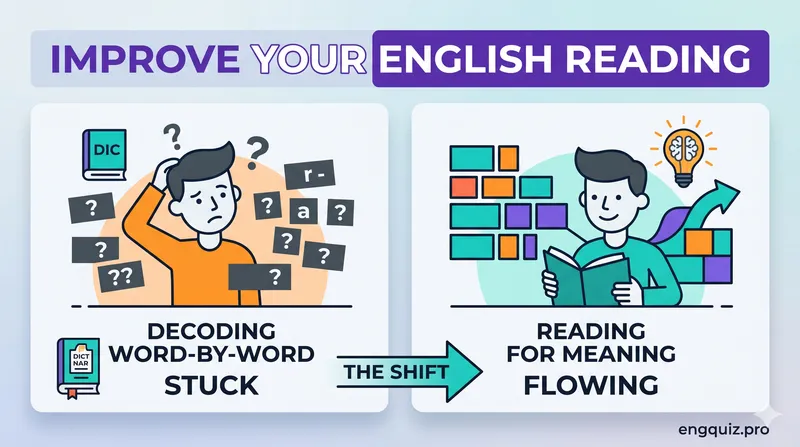
How to Improve English Reading and Actually Understand It
Why the level of the text you choose matters more than the hours you put in, and five exercises that build reading comprehension.
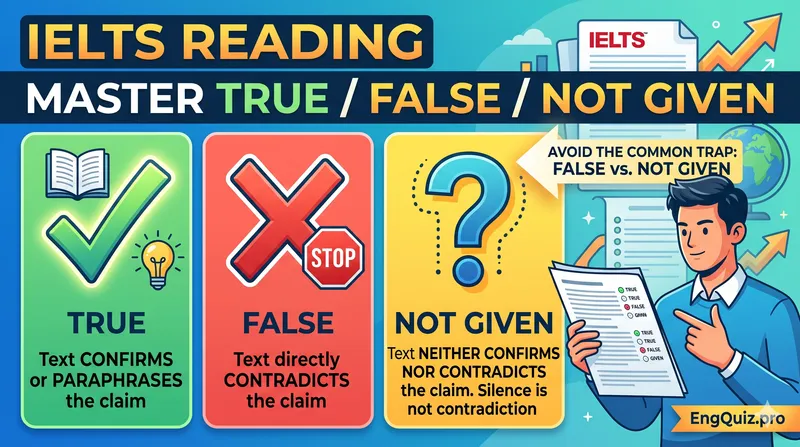
IELTS Reading: How to Master True/False/Not Given
True/False/Not Given is the most-failed IELTS Reading task. Learn the one rule that fixes it, and practise free on real B2/C1 passages with instant feedback.
Related Articles
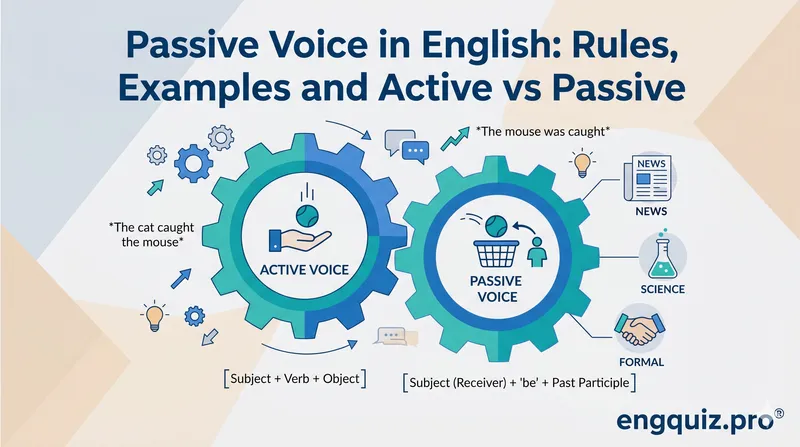
Passive Voice in English: Rules, Examples and Active vs Passive
The passive puts the receiver of an action first: "The letter was written." Learn to form it in every tense, when to use it, and 5 common mistakes.
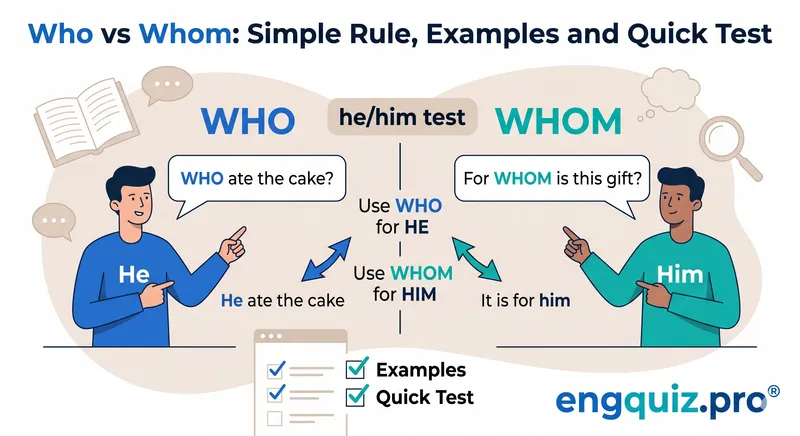
Who vs Whom: Simple Rule, Examples and Quick Test
Confused by who vs whom? Use the he/him test: if he fits, use who; if him fits, use whom. Examples, common mistakes and a 5-question quiz inside.
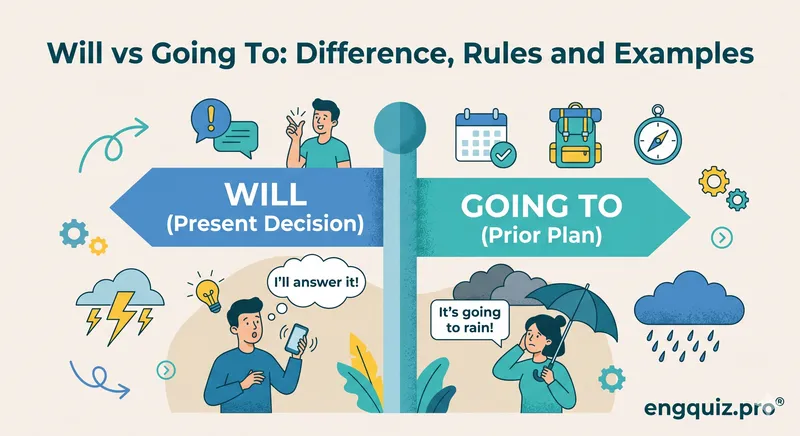
Will vs Going To: Difference, Rules and Examples
Will or going to? The simple rule: use 'going to' for plans and predictions you can see; use 'will' for decisions made at the moment of speaking.