Who vs Whom: Simple Rule, Examples and Quick Test
Confused by who vs whom? Use the he/him test: if he fits, use who; if him fits, use whom. Examples, common mistakes and a 5-question quiz inside.
Introduction
Who or whom? Even confident English speakers freeze on this one. The good news: the rule is one of the simplest in English grammar; most learners just never get a clear version of it.
This guide gives you a test you can apply in less than a second, walks through every situation you'll meet on an exam, and ends with a quick practice quiz.
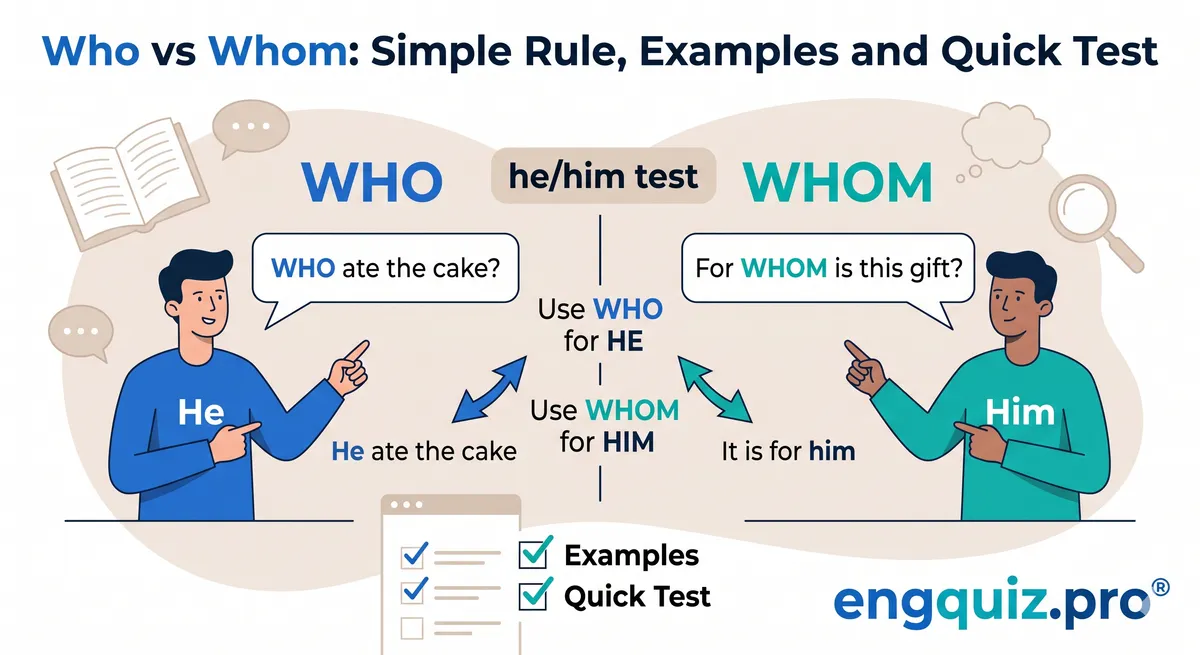
Quick answer: Use who as the subject of a verb (the person doing the action). Use whom as the object of a verb or a preposition (the person receiving the action). The fastest test: try replacing it with he (→ who) or him (→ whom).
The He/Him Test
This is the only memory trick you need. Both whom and him end in m, and that's the link.
| If you can replace it with… | Use |
|---|---|
| he (or she, they) | who |
| him (or her, them) | whom |
Watch it work:
- (Who / Whom) wrote this poem? → He wrote this poem. ✓ → Who
- (Who / Whom) did you call? → I called him. ✓ → Whom
- (Who / Whom) is at the door? → He is at the door. ✓ → Who
- (Who / Whom) are you talking to? → I am talking to him. ✓ → Whom
That's the whole rule. Everything below is just practice.
When to Use Who
Who is a subject pronoun. It performs the action of the verb.
As the subject of a question
- Who opened the door? (Someone opened the door; that person did the action.)
- Who is calling at this hour?
- Who wants pizza?
As the subject of a relative clause
- The teacher who corrected my essay was very kind. (The teacher corrected; she did the action.)
- I have a friend who speaks five languages.
- People who exercise daily live longer.
In each case, who is the doer of the verb in its own mini-sentence.
When to Use Whom
Whom is an object pronoun. It receives the action of the verb, or it follows a preposition.
As the object of a verb
- Whom did you meet? (You met someone; that someone is the object of "meet".)
- Whom should I invite?
- The candidate whom the committee chose is from Berlin.
As the object of a preposition
This is where whom sounds most natural, even to people who never use it elsewhere.
- To whom it may concern, (formal letter opening)
- With whom are you going?
- For whom is this gift?
- About whom are you talking?
When whom sits right after a preposition (to whom, with whom, for whom), it is grammatically required in formal writing.
Whom in Relative Clauses
This is the most common place where exams test who vs whom. The trick is to isolate the relative clause and check whether the missing word is subject or object.
| Sentence | Test | Correct |
|---|---|---|
| The man (who/whom) called me is my uncle. | He called me. | who |
| The man (who/whom) I called is my uncle. | I called him. | whom |
| The student (who/whom) won the prize works hard. | She won the prize. | who |
| The student (who/whom) we hired starts Monday. | We hired her. | whom |
| The friend with (who/whom) I travelled is here. | I travelled with him. | whom |
In everyday speech, who often replaces whom
This is one of the most important things to know: in casual conversation, native speakers almost always use who where formal grammar would require whom.
- Who did you meet? ✓ (conversational)
- Whom did you meet? ✓ (formal; sounds stiff in speech)
In an exam, on a CV, or in a business letter, whom is the safe choice when it's the object. In a chat with a friend, who sounds more natural.
Common Mistakes
Mistake 1: Using whom as the subject
Whom is at the door?
Why it's wrong: Apply the he/him test: He is at the door, not Him is at the door. So the answer is who.
✓ Who is at the door?
Mistake 2: Using who after a preposition (in formal writing)
To who should I send the invoice?(business email)
Why it's wrong: After a preposition (to, with, for, about), formal writing uses whom.
✓ To whom should I send the invoice? ✓ (less formal alternative) Who should I send the invoice to?
Mistake 3: Choosing whom because it "sounds smarter"
The person whom asked me…
Why it's wrong: The person asked, so they are the subject. He asked me, not him asked me.
✓ The person who asked me…
This is the most common over-correction. Whom is not a fancier form of who; it has a specific job.
Mistake 4: Forgetting that the test applies to the clause, not the whole sentence
Give the prize to whoever / whomever wins.
Why it's wrong: The whole clause "whoever wins" is the object of to, but inside that clause, the missing word is the subject of wins. Test it: he wins ✓, him wins ✗.
✓ Give the prize to whoever wins.
Whoever vs Whomever
The same rule applies to the -ever versions.
| Function | Form |
|---|---|
| Subject (he/she/they fits) | whoever |
| Object (him/her/them fits) | whomever |
- Whoever finishes first wins. (He finishes: subject)
- Invite whomever you like. (You like him: object)
- The award goes to whoever scores highest. (Whoever is the subject of scores, even though the whole clause is the object of to.)
Quick Reference
| Question | Form |
|---|---|
| Is this the subject of a verb (the doer)? | who |
| Is this the object of a verb (the receiver)? | whom |
| Does it follow a preposition (to, with, for, about)? | whom (formal) / who (informal) |
| Can you replace it with he/she/they? | who |
| Can you replace it with him/her/them? | whom |
| Are you writing casually? | who is almost always fine |
| Are you writing formally? | use the strict rule |
Practice Exercise
Choose who or whom:
- ____ ate the last slice of cake?
- To ____ should I address this letter?
- The candidate ____ we interviewed was excellent.
- The candidate ____ interviewed me was friendly.
- ____ did you give the keys to?
Answers: 1. Who (he ate the cake) | 2. whom (to him) | 3. whom (we interviewed him) | 4. who (he interviewed me) | 5. Whom in formal English (to him); Who is accepted in everyday speech.
Practise Who vs Whom Now
This contrast lives inside relative clauses, the structure that decides whether the missing pronoun is a subject or an object. EngQuiz Pro has free B2 relative-clause exercises that drill exactly this pattern with instant feedback.
→ Practise Relative Clauses (B2) →
For the theory side, read:
- Relative pronouns (who, whom, whose, which, that) (full theory)
- Defining relative clauses (full theory)
Who vs Whom on the IELTS, TOEIC and Cambridge Exams
This is a classic register marker on writing tasks: examiners are not testing whether you know the rule, but whether you can use it appropriately for the formality of the task.
- Cambridge B2 First / C1 Advanced (Use of English): open-cloze and key-word transformations test whom after prepositions: the colleague to ___ I spoke → whom. Memorise the four high-frequency openers: to whom, with whom, for whom, about whom.
- IELTS Writing Task 1 (formal letter, semi-formal letter): addressing someone you do not know by name often calls for To whom it may concern. In Task 2 essays, whom in a relative clause signals a higher register, useful for band 7+.
- TOEIC Part 5 (incomplete sentences): the structure the ___ whom / who [subject pronoun] [verb] repeatedly tests object-position whom. Spot the subject pronoun (I, we, they) immediately after the blank; that's your clue the missing word is an object.
For more grammar structures that examiners reward, see our IELTS grammar structures post. For the broader picture of common errors learners make under exam pressure, the Cambridge Dictionary entry on who and whom is the cleanest reference.
Frequently Asked Questions
In casual speech, almost: most native speakers say who even where formal grammar wants whom. But in formal writing (business letters, academic papers, exams), whom is alive and well, and using it correctly signals careful writing.
Rarely on its own, but after prepositions, even spoken English keeps it: To whom am I speaking? is normal on a phone call. Who am I speaking to? is also fine and more conversational.
Different question. Who's = who is or who has. Whose = the possessive form (whose book is this?). Neither relates to the who/whom subject/object choice. See our common English grammar mistakes post for that distinction.
Because he and who are both subject pronouns; him and whom are both object pronouns. They follow the same grammatical pattern, so if one fits, the other fits. It's the most reliable test in English grammar.
Absolutely, and it often does in formal writing: The lawyer who drafted the contract, and whom the client later hired, retired in 2020. The first refers to the subject of drafted; the second to the object of hired.
New Articles

How to Embed a Free English Grammar Quiz on Your Website (WordPress, Google Sites, Moodle)
Step-by-step instructions for adding a free, interactive English grammar quiz to WordPress, Google Sites, Moodle, or any page that accepts HTML. No plugin, no sign-up, no ads.
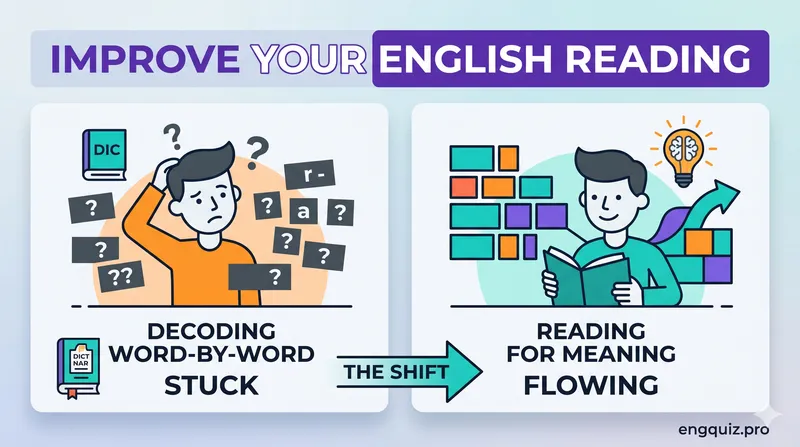
How to Improve English Reading and Actually Understand It
Why the level of the text you choose matters more than the hours you put in, and five exercises that build reading comprehension.
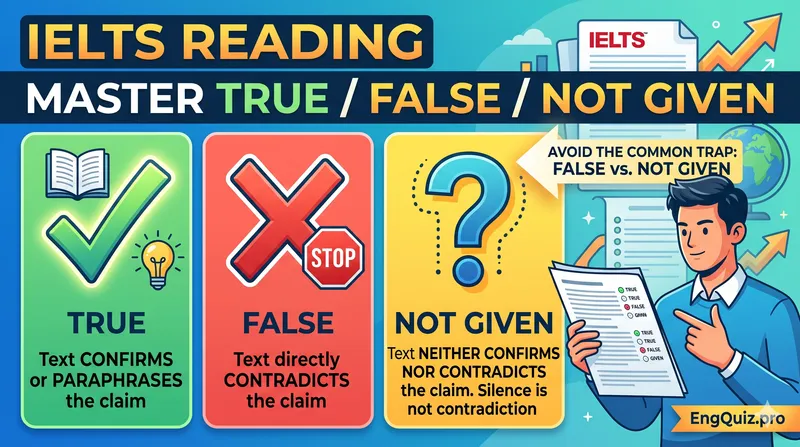
IELTS Reading: How to Master True/False/Not Given
True/False/Not Given is the most-failed IELTS Reading task. Learn the one rule that fixes it, and practise free on real B2/C1 passages with instant feedback.
Related Articles
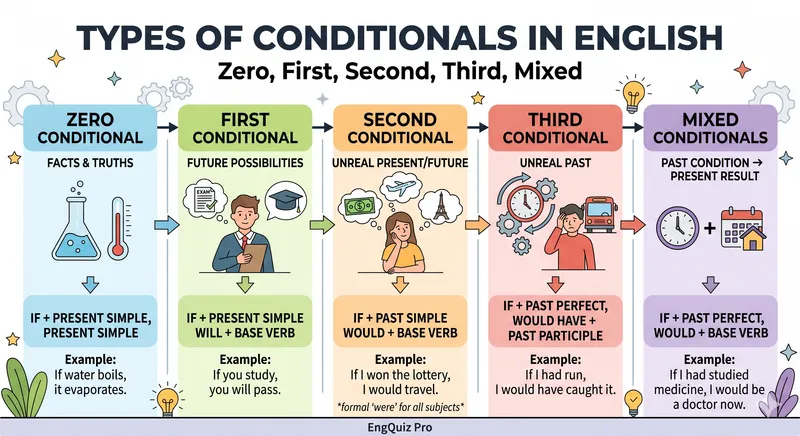
Types of Conditionals in English: Zero, First, Second, Third and Mixed
The 5 types of conditional sentences explained with formulas, examples and common mistakes: zero, first, second, third and mixed conditionals.
Passive Voice in English: Rules, Examples and Active vs Passive
The passive puts the receiver of an action first: "The letter was written." Learn to form it in every tense, when to use it, and 5 common mistakes.
Will vs Going To: Difference, Rules and Examples
Will or going to? The simple rule: use 'going to' for plans and predictions you can see; use 'will' for decisions made at the moment of speaking.