Passive Voice in English: Rules, Examples and Active vs Passive
The passive puts the receiver of an action first: "The letter was written." Learn to form it in every tense, when to use it, and 5 common mistakes.
Introduction
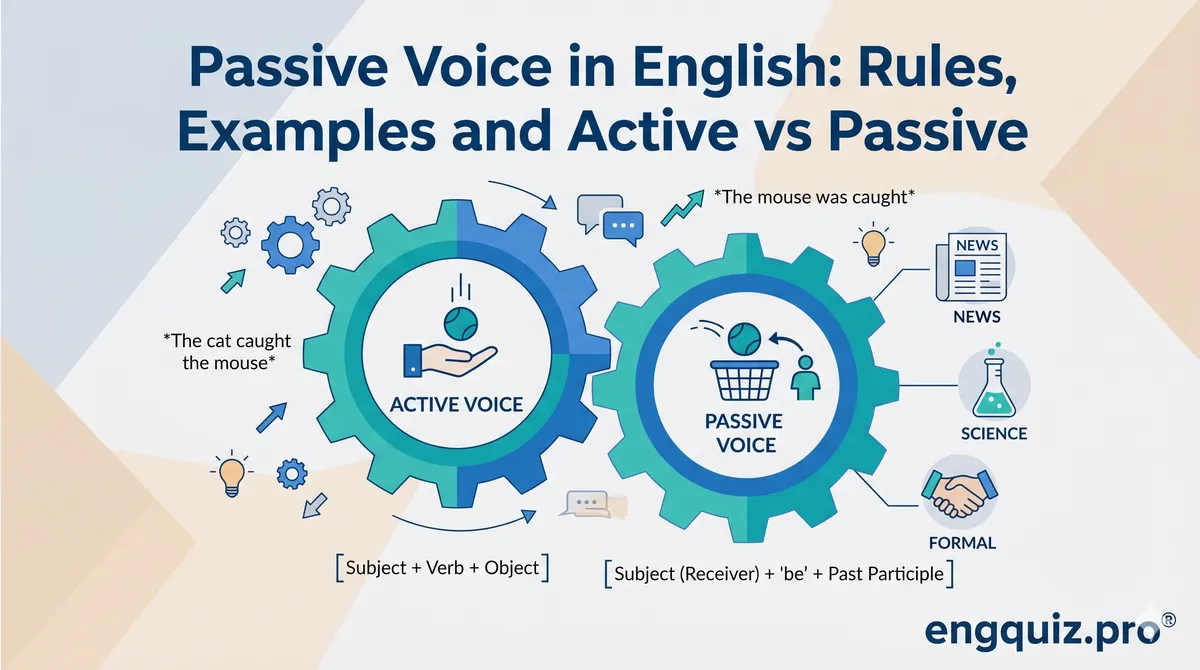
The cat caught the mouse. Active. The mouse was caught by the cat. Passive.
Same situation, two camera angles. The passive voice lets English speakers shift the focus from the doer of an action to the receiver of that action, and it appears far more often than learners realise, especially in news, science, formal writing and academic English.
This pillar guide covers everything you need: when (and when not) to use the passive, the exact formula in every tense, the difference between get-passives and be-passives, and the five mistakes that most often cost marks on IELTS, TOEIC and Cambridge exams.
Quick answer: The passive voice is formed with be + past participle: was eaten, is delivered, has been chosen. Use it when the action or the receiver matters more than the doer. It is common in news (the building was destroyed), science (the sample was heated), and formal writing (mistakes were made). The active voice is the default; switch to passive only when there's a real reason.
What Is the Passive Voice?
Every English sentence with a transitive verb can be expressed in two voices:
| Voice | Focus | Structure | Example |
|---|---|---|---|
| Active | the doer (subject acts) | subject + verb + object | Shakespeare wrote Hamlet. |
| Passive | the receiver (object becomes subject) | object + be + past participle (+ by + doer) | Hamlet was written by Shakespeare. |
The grammatical object of the active sentence ("Hamlet") becomes the grammatical subject of the passive sentence. The original doer ("Shakespeare") moves to the end with by, or disappears entirely if it's unimportant or unknown.
When the doer disappears
In real English, the by + doer phrase is left out about 80% of the time. Look at these examples:
- English is spoken in over 60 countries. (We don't say by people; it is obvious.)
- My car was stolen last night. (We don't know who stole it.)
- The new bridge will be opened next month. (Who? Not relevant.)
- Mistakes were made. (A politician's classic; it avoids naming the responsible party.)
This is the single biggest reason to use passive voice: when the doer is unknown, irrelevant, or being hidden.
Passive Voice in All Tenses
The pattern is always be + past participle. The form of be changes with the tense.
| Tense | Active | Passive |
|---|---|---|
| Present simple | They make cars in Japan. | Cars are made in Japan. |
| Present continuous | They are building a bridge. | A bridge is being built. |
| Past simple | Shakespeare wrote Hamlet. | Hamlet was written by Shakespeare. |
| Past continuous | They were repairing the roof. | The roof was being repaired. |
| Present perfect | Someone has stolen my bag. | My bag has been stolen. |
| Past perfect | They had completed the work. | The work had been completed. |
| Future (will) | They will announce the winner. | The winner will be announced. |
| Future (going to) | They are going to fire him. | He is going to be fired. |
| Modal verbs | You should send the letter. | The letter should be sent. |
| Modal perfect | They might have lost the keys. | The keys might have been lost. |
| Infinitive | They want to invite us. | We want to be invited. |
| Gerund | They love telling stories. | Children love being told stories. |
Notice the pattern: be takes whatever tense the active verb was in; the main verb becomes the past participle (3rd form: eaten, made, written, taken).
When to Use the Passive
There are five clear situations where the passive is the right choice, not just an alternative.
1. The doer is unknown
- My wallet was stolen at the concert. (You don't know who took it.)
- The window has been broken. (Whoever broke it is gone.)
- English was first spoken over 1 500 years ago. (Who exactly? Too long ago to matter.)
2. The doer is obvious or irrelevant
- He was arrested on Friday. (By the police, obviously.)
- Sandwiches will be served at lunchtime. (By the caterers, but who cares.)
- The patient was treated in the emergency room. (By medical staff, obviously.)
3. The receiver matters more than the doer
This is the heart of passive style. Compare:
- Police arrested three suspects. (Active: police are the focus.)
- Three suspects were arrested. (Passive: the suspects are the focus.)
A newspaper writing about the suspects will choose passive. A newspaper writing about the police force will choose active.
4. Formal writing, science and reports
In academic writing, scientific reports and business reports, passive voice creates distance and objectivity:
- The samples were heated to 100°C and observed for 30 minutes. (Lab report: we would sound informal.)
- A new policy has been introduced to reduce expenses. (Business: management has introduced would sound less neutral.)
- The findings are presented in Table 3. (Academic: I present would sound too personal.)
Many style guides now recommend balancing active and passive in academic writing, but the passive remains the default for methods sections and reports.
5. Diplomatic or evasive statements
The passive lets you describe an action without naming who did it. Politicians and diplomats use this constantly:
- Mistakes were made. (No one specific is blamed.)
- The decision has been reviewed. (No one specific reviewed it.)
- A different approach will be considered. (No one specific is responsible.)
In personal writing, this can sound evasive. In diplomacy, it's deliberate.
Active vs Passive: Same Story, Different Camera
Let's see how the same situation reads in both voices:
| Active sentence | Passive sentence |
|---|---|
| The chef cooked the meal. | The meal was cooked by the chef. |
| Someone has cleaned the office. | The office has been cleaned. |
| The team is preparing the report. | The report is being prepared. |
| They will release the new model in June. | The new model will be released in June. |
| You must complete the form by Friday. | The form must be completed by Friday. |
| Picasso painted Guernica in 1937. | Guernica was painted by Picasso in 1937. |
| They had planned the wedding for months. | The wedding had been planned for months. |
The passive doesn't replace the active. It gives you a second camera angle to choose from.
Get-Passive vs Be-Passive
In casual English, get often replaces be to form a passive:
- My phone got stolen last night. (= was stolen, slightly more conversational)
- He got fired from his job. (= was fired)
- We got invited to the wedding. (= were invited)
When to use get: in conversational English; when the event was sudden, unexpected, or unwanted; when describing a change of state.
When to stick with be: in formal or academic writing; when the action is neutral; when the meaning is a permanent state rather than a sudden change.
In IELTS Writing Task 2 or a business letter, prefer be. In a chat with a friend or a personal blog, get sounds natural.
Common Mistakes
Mistake 1: Forgetting the past participle
The cake was eat by the children.
Why it's wrong: Passive voice requires the third form of the verb (past participle), not the base form.
✓ The cake was eaten by the children.
This is the single most common passive error, especially with irregular verbs (eat → eaten, write → written, speak → spoken).
Mistake 2: Using be in the wrong tense
The new building is built in 2025.(meaning: was completed in 2025)
Why it's wrong: The past event needs past be: was, not is.
✓ The new building was built in 2025.
Match be to the tense the action happened in, not to now.
Mistake 3: Trying to passivise intransitive verbs
The accident was happened yesterday.My grandfather was died last year.
Why it's wrong: Only transitive verbs (verbs that take a direct object) can be passive. Happen and die are intransitive: there is no receiver, so there can be no passive form.
✓ The accident happened yesterday. ✓ My grandfather died last year.
The rule: if you can't ask what? or whom? after the verb in the active sentence, you can't make it passive. I happened the accident? Nonsense. I died him? Nonsense.
Mistake 4: Overusing the passive
The report was completed. The figures were analysed. The conclusions were written. The document was sent to the manager. The manager was informed.
Why it's weak: Every sentence is passive, so the writing feels indirect and lifeless. Readers lose track of who is doing what.
✓ I completed the report, analysed the figures, and wrote the conclusions. I then sent the document to the manager and informed her.
Passive is a tool, not a default. In IELTS Writing Task 2 and Cambridge Writing, examiners actively penalise essays that overuse it. A 250-word essay should have a few well-placed passive sentences, not 15.
Mistake 5: Adding by unnecessarily
English is spoken by people in many countries.
Why it's weak: By people adds no information; of course English is spoken by people. The phrase clutters the sentence.
✓ English is spoken in many countries.
Rule: only keep the by + doer phrase if it carries real information (Hamlet was written by Shakespeare ✓, because the name matters).
Quick Reference
| Question | Passive choice |
|---|---|
| Do you know who did the action? | If no → passive |
| Is the doer important to the reader? | If no → passive |
| Is the receiver the topic of the sentence? | If yes → passive |
| Is this scientific / formal / academic? | Often → passive |
| Is this casual conversation? | Active is more natural |
| Are you trying to be diplomatic? | Passive softens responsibility |
| Formula reminder | Pattern |
|---|---|
| All passive sentences | subject (receiver) + form of be + past participle |
| Optional doer | + by + agent |
Practice Exercise
Rewrite each active sentence in the passive voice:
- Shakespeare wrote Romeo and Juliet.
- They are building a new hospital downtown.
- Someone has stolen my bicycle.
- They will announce the results tomorrow.
- People speak Portuguese in Brazil.
Answers:
- Romeo and Juliet was written by Shakespeare.
- A new hospital is being built downtown.
- My bicycle has been stolen.
- The results will be announced tomorrow.
- Portuguese is spoken in Brazil.
Practise the Passive Voice Now
Passive voice lives inside tense knowledge: you can't get was being written right without first being comfortable with be across all tenses. EngQuiz Pro's B2 mixed-tense exercises cycle through active and passive forms so you build both at once.
→ Practise Mixed Tenses Multiple Choice (B2) → → Practise Mixed Tenses Gap Fill (B2) →
To strengthen the underlying tense knowledge that the passive depends on, read:
Passive Voice on the IELTS, TOEIC and Cambridge Exams
Passive voice is a register marker on every major English exam. Examiners expect you to use it well, not constantly.
- IELTS Writing Task 1 (academic): describing graphs, processes and maps almost forces passive: The sample was placed in the centrifuge, A new road was built in 2015. Candidates who only use active sound less academic.
- IELTS Writing Task 2: overusing passive flattens the essay. The band 7+ pattern is roughly 80% active, 20% passive, with passives placed where they shift focus to issues rather than people (The problem can be solved by > People can solve the problem by).
- Cambridge B2 First / C1 Advanced (Use of English): key-word transformations regularly test active-to-passive conversion: Someone has cleaned the office → The office has been cleaned. Memorise the formula in every tense (above) and these conversions take seconds.
- TOEIC Parts 5 and 6: listening and reading comprehension lean heavily on passive: the package will be delivered, the meeting has been rescheduled, applicants must be reviewed. Recognition speed matters more than production.
The British Council reference on passive voice is the cleanest single source for the formulas. For a broader look at exam-favoured structures, see our IELTS grammar structures post.
Frequently Asked Questions
No, it's a tool. Style guides like Strunk & White and Orwell warn against overusing the passive, not using it at all. In academic writing, news reporting and formal letters, passive voice is essential. The rule of thumb: use active by default, switch to passive when there's a real reason (unknown doer, receiver matters more, formal context).
No, only transitive verbs (verbs that take a direct object). Eat, write, send, destroy can be passive. Happen, exist, die, sleep, arrive cannot, because they have no receiver to become the new subject.
Be-passive is neutral and standard. Get-passive is conversational and often suggests something sudden, unwanted or significant: He got fired (sudden, unwanted) feels stronger than He was fired. In formal writing, stick with be.
Technically yes, but native speakers almost never use them. The road will be being repaired tomorrow is grammatically correct but extremely awkward. Use will be repaired or rephrase in the active. The same applies to has been being built, which is rare in real English.
Move the be form to the start and add the past participle: Did they send the letter? → Was the letter sent? / Have they finished the report? → Has the report been finished? The grammar is the same as a statement, just with question-style word order.
New Articles

How to Embed a Free English Grammar Quiz on Your Website (WordPress, Google Sites, Moodle)
Step-by-step instructions for adding a free, interactive English grammar quiz to WordPress, Google Sites, Moodle, or any page that accepts HTML. No plugin, no sign-up, no ads.
How to Improve English Reading and Actually Understand It
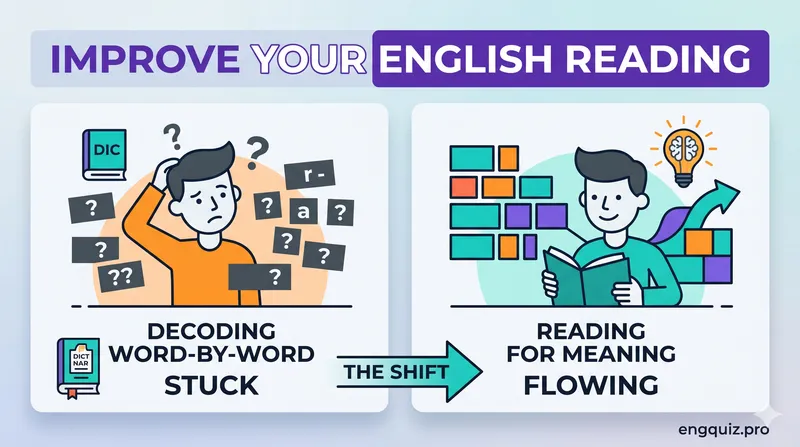
Why the level of the text you choose matters more than the hours you put in, and five exercises that build reading comprehension.
IELTS Reading: How to Master True/False/Not Given
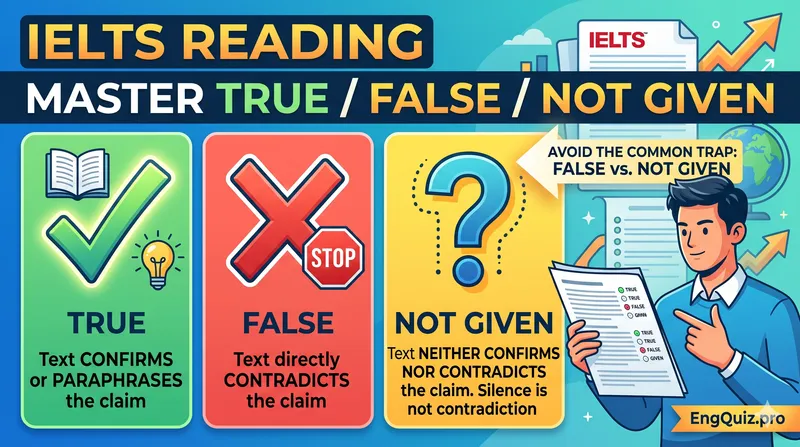
True/False/Not Given is the most-failed IELTS Reading task. Learn the one rule that fixes it, and practise free on real B2/C1 passages with instant feedback.
Related Articles
Types of Conditionals in English: Zero, First, Second, Third and Mixed
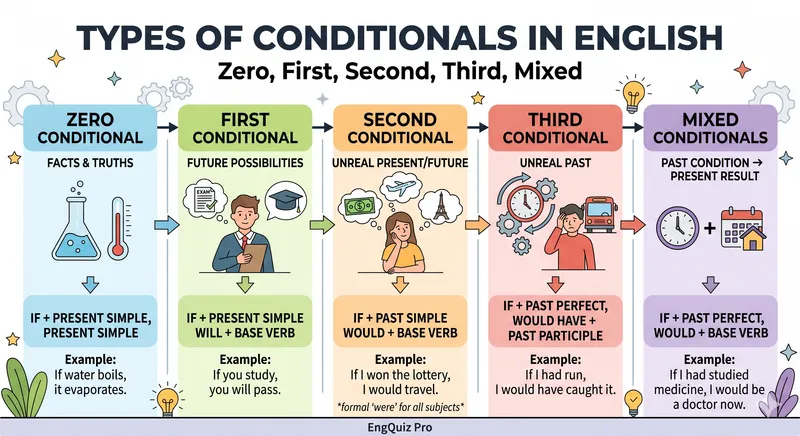
The 5 types of conditional sentences explained with formulas, examples and common mistakes: zero, first, second, third and mixed conditionals.
Who vs Whom: Simple Rule, Examples and Quick Test
Confused by who vs whom? Use the he/him test: if he fits, use who; if him fits, use whom. Examples, common mistakes and a 5-question quiz inside.
Will vs Going To: Difference, Rules and Examples
Will or going to? The simple rule: use 'going to' for plans and predictions you can see; use 'will' for decisions made at the moment of speaking.