What Is C1 English Level? Skills, Grammar and How to Reach It
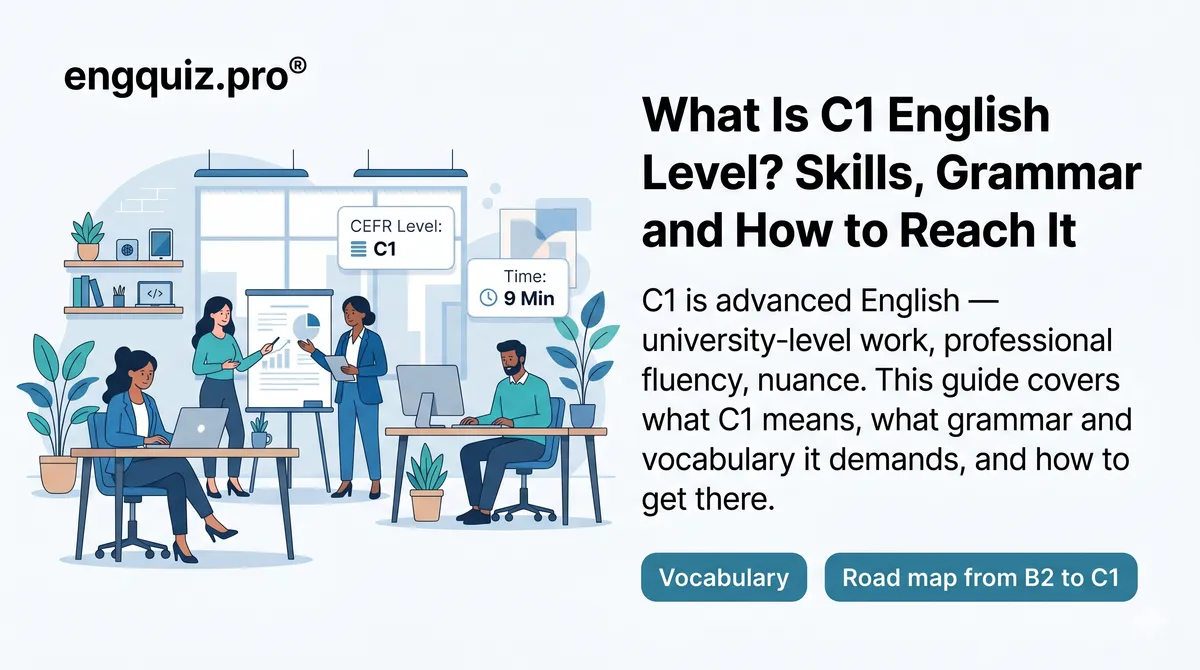
C1 is advanced English: university-level work, professional fluency, nuance. This guide covers what C1 means, what grammar and vocabulary it demands, and how to get there.
Introduction
C1 is where English stops being a foreign language and starts being a working tool. At C1, you can read a novel for pleasure, write a 2 000-word academic essay, debate a complex topic, follow university lectures, and work in an English-speaking professional environment without translation overhead.
This guide explains exactly what C1 means in practice, what grammar and vocabulary separate it from B2, what exams certify it, and how to make the jump from B2 to C1, typically the hardest progression on the CEFR scale.
Quick answer: C1 English is "advanced" or "effective operational proficiency" on the CEFR scale. At C1, you can use English for complex academic and professional purposes: understanding long, demanding texts, expressing yourself fluently and spontaneously, writing well-structured detailed essays on complex subjects. You know around 8 000–10 000 words, control most grammar accurately, and handle idioms, register and irony naturally. Reaching C1 from B2 typically takes 200–250 additional hours of focused study, usually 12–24 months for most learners.
What C1 Means in Practice
The Council of Europe defines C1 (also called Advanced or Effective Operational Proficiency) through these real-world can-do statements:
| Skill | What you can do at C1 |
|---|---|
| Speaking | Express yourself fluently and spontaneously without searching for words; use language flexibly for social, academic and professional purposes; argue a complex position |
| Listening | Understand extended speech even when not clearly structured; follow lectures, films, news without subtitles; pick up implicit meaning and irony |
| Reading | Understand long, complex factual and literary texts; appreciate stylistic differences; read specialised articles in fields outside your own |
| Writing | Express yourself in clear, well-structured text; write detailed essays, reports and letters on complex subjects; underline relevant issues and develop arguments |
C1 is also where the invisible skills start to matter:
- Register: knowing when to be formal vs casual without thinking about it
- Hedging: softening claims with tend to, appear to, somewhat, by and large
- Discourse markers: using however, nevertheless, in light of, having said that fluently
- Collocations: saying make a decision and take a risk without translating
- Idiomatic phrases: understanding on the back burner, bite the bullet, the lion's share
What C1 is not yet:
- Native-level intuition: that's C2 (Mastery)
- Effortless literary depth: reading Shakespeare or Joyce comfortably is C2 territory
- Bilingual fluency: C1 is fluent, but you still translate occasionally in your head under pressure
C1 Grammar: What You Must Control
By C1, you've met every major grammar structure. The question is no longer do you know it but can you produce it accurately under time pressure.
| Grammar area | What C1 requires | Example |
|---|---|---|
| All tenses, including continuous forms of the perfect | Used correctly and naturally | She'll have been working there for ten years by Friday. |
| Mixed conditionals | Produced accurately, both directions | If I had taken that job, I would be in Singapore now. |
| Inversion for emphasis | Used for written effect | Never had I seen such a sight. Not only did she win, she broke the record. |
| Cleft sentences | For focus and emphasis | What we need is more time. It was Sarah who suggested it. |
| Subjunctive | After suggest, insist, recommend, important that | I insist that he be present. |
| Passive variations | Including have something done and reporting verbs in passive | I had my car repaired. It is widely believed that… |
| Nominalisation | Turning verbs into nouns for formality | Failure to comply will result in cancellation. (vs If you don't comply, we will cancel.) |
| Hedging and modality | Soft claims, distance, politeness | This would appear to suggest… |
| Discourse markers and cohesion | Linking long texts naturally | Having said that, nevertheless, in light of, with regard to |
| Relative clauses, including reduced forms | All types, including non-defining and reduced | The proposal, having been rejected twice, was finally approved. |
For deeper coverage of the structures most rewarded at C1, see our IELTS grammar structures post; many of the band-7+ patterns there are precisely what C1 demands.
C1 Vocabulary: What You Need
C1 vocabulary is typically 8 000–10 000 active words, roughly five times an A2 vocabulary. The areas you must cover at C1:
| Type | Examples |
|---|---|
| Academic vocabulary | hypothesis, methodology, paradigm, empirical, prevalent, mitigate, scrutinise (Coxhead Academic Word List) |
| Abstract nouns | implication, significance, complexity, viability, sustainability, scrutiny |
| Nominalisation pairs | decide → decision; assume → assumption; refer → reference; reduce → reduction |
| Word families | Knowing analyse / analysis / analytical / analytically as one unit |
| Collocations | come to a conclusion, raise a concern, draw a parallel, set a precedent, gain insight into |
| Prefixes / suffixes | Decoding anti-, pre-, post-, sub-, super-, -ity, -tion, -ness, -ism on the fly |
| Idioms | on thin ice, by and large, the jury is out, a knee-jerk reaction |
| Phrasal verbs (advanced) | boil down to, hinge on, pertain to, attest to, account for |
| Hedging language | appears, tends to, broadly speaking, to some extent, with some caveats |
At C1, the gap is usually range rather than basic knowledge. Most C1 learners know plenty of words; they just default to the same handful. Active practice with the Coxhead Academic Word List, word families, and high-register synonyms is what gets you to band 7.5+ in IELTS Writing.
If word families, nominalisation pairs and prefixes still feel like memorisation rather than a system, our word formation guide maps the underlying mechanics (affixation, compounding, conversion and internal change) onto each CEFR level, with C1-specific nominalisation patterns at the top.
Our guide to academic vocabulary for IELTS writing walks through the four shifts (word families, collocations, nominalisation and hedging) that move a Writing answer from Band 6 to Band 7.
C1 Exams: What Certificates Prove C1?
| Exam | Length | C1 score equivalent | Cost (typical) |
|---|---|---|---|
| Cambridge C1 Advanced (CAE) | ~4 hours | Pass (180–199) | £180–230 |
| IELTS | ~2.75 hours | 7.0–8.0 | $230–280 |
| TOEIC (Listening + Reading) | 2 hours | 945+ | $90–150 |
| TOEFL iBT | ~2 hours | 95–120 | $200–280 |
| Use case | Best exam |
|---|---|
| University admissions (UK, Australia, Canada) | IELTS Academic |
| Permanent residency / professional licensing | IELTS General Training |
| University admissions (US) | TOEFL iBT |
| Lifetime certificate / Cambridge ecosystem | C1 Advanced (CAE) |
| Asian corporate use | TOEIC |
For a deeper comparison, see IELTS vs TOEIC vs Cambridge.
How Long Does It Take to Reach C1?
The Council of Europe's reference figure is 200–250 guided learning hours to go from B2 to C1, on top of the ~700 hours needed to reach B2 from zero. In practice:
| Study intensity | Time from B2 to C1 |
|---|---|
| 1 hour/week (casual) | 4–5 years |
| 2 hours/week (school pace) | 2–3 years |
| 4 hours/week (motivated) | 12–18 months |
| Daily 45–60 min + immersion | 8–12 months |
| Intensive (10 hours/week + practice) | 4–6 months |
The B2 → C1 jump is the hardest CEFR progression. Why?
- Returns flatten. From A2 to B1, every new word and structure visibly expands what you can do. From B2 to C1, the gains are subtler: better precision, better register, less obvious mistakes.
- Input must change. B2-level input (graded readers, language-learning podcasts) is no longer enough. C1 demands native-level input: academic articles, literary fiction, BBC documentaries, business journals.
- Output must specialise. B2 output is general. C1 output is domain-specific: academic essays, business reports, expert opinions on a field. This usually means combining language study with subject-matter study.
Common Patterns That Keep Learners Stuck at B2
These are the patterns we see most often in B2 → C1 transitions. Fix them and you move toward C1.
Pattern 1: Vocabulary range, not size
You probably know important, but do you reach for significant, pivotal, consequential, of considerable weight, telling, far-reaching? C1 = synonym range. Force yourself to use a different word every time.
Pattern 2: Defaulting to short sentences
B2 writers often produce 12–15 word sentences. C1 writers move between short punchy sentences and 25–40 word complex sentences, and combine them deliberately for rhythm. See our IELTS grammar structures for the patterns examiners reward.
Pattern 3: Active voice everywhere
Native-level academic and journalistic writing uses passive voice ~25–30% of the time. B2 writers often use it 5%. Switching deliberately to passive in the right places (when the receiver matters more than the doer) is a C1 marker. See our passive voice pillar.
Pattern 4: Avoiding the subjunctive and inversion
If I were you, Had I known, Never have I…, Should you require… These structures sound formal but are standard in academic writing and formal letters. B2 writers avoid them; C1 writers use them naturally.
Pattern 5: No hedging
C1 writers soften claims with tends to, appears to, broadly speaking, on the whole, with some caveats. B2 writers state things bluntly. Hedging is a register marker that examiners notice immediately.
Pattern 6: Generic linking words
Firstly, secondly, finally, in conclusion: B2 essays are full of these. C1 essays use with regard to, in light of, having said that, that said, nevertheless, more to the point. Range matters in cohesion too.
How to Make the B2 → C1 Jump
A practical 6-month plan:
| Month | Focus | What to do |
|---|---|---|
| 1 | Diagnose the gap | Take a full C1 mock (Cambridge CAE or IELTS). Identify your 2 weakest sub-skills. |
| 2 | Vocabulary range | Learn the top 200 of the Academic Word List (AWL). Force one new synonym per sentence in daily writing. |
| 3 | Native-level input | Read 1 academic article + 30 minutes of native podcast daily. No subtitles on TV. |
| 4 | Complex grammar production | Drill inversion, cleft sentences, mixed conditionals, subjunctive. 20 minutes daily for 4 weeks. |
| 5 | Writing volume | Produce 4 250-word essays per week. Get them corrected by a C1+ speaker or AI with C1 calibration. |
| 6 | Mock exams + targeted polish | 3 full mocks. Review every band-band-7 sentence and rewrite at band 8. |
Combine with daily speaking practice (15 minutes recording yourself, transcribing, rewriting) and the jump is achievable.
Quick Reference
| Question | C1 answer |
|---|---|
| What does C1 mean? | Advanced (effective operational proficiency) |
| Vocabulary size | 8 000–10 000 active words |
| Time from B2 | 200–250 study hours (~12–18 months at 4 hrs/week) |
| Key grammar | Mixed conditionals, inversion, cleft, subjunctive, nominalisation, passive variations |
| Certifies C1 | Cambridge C1 Advanced, IELTS 7.0–8.0, TOEFL 95–120, TOEIC 945+ |
| What's not C1 yet | Native intuition, literary depth (those are C2) |
C1 Practice Exercises
The fastest way to confirm C1 is to test yourself on the structures C1 demands. EngQuiz Pro has free C1 exercises across academic vocabulary, word families, nominalisation and abstract nouns:
→ C1 Academic Word Families Gap Fill → → C1 Nominalisation Gap Fill → → C1 Abstract Nouns Gap Fill →
If you score 70%+ across all three, you are solidly at C1. If you struggle on nominalisation in particular, that's the most useful C1 skill to drill. It is what separates a B2 essay from a C1 essay more than any other single feature.
Frequently Asked Questions
B2 = independent user; you can communicate well on familiar topics. C1 = proficient user; you can communicate well on unfamiliar topics, handle nuance, and use English for academic and professional purposes. B2 vocabulary is ~5 000 words; C1 is ~8 000–10 000. B2 makes occasional errors that don't affect communication; C1 errors are rare and minor.
Yes, by most practical definitions. C1 speakers handle most conversations and most professional situations without translation. They might still hesitate occasionally on rare topics, miss specific cultural references, or feel less precise when very tired, but for working purposes, C1 is fluent. C2 is near-native; the gap between C1 and C2 is mostly intuition and cultural depth.
Yes, in almost any professional setting, including academia, medicine, law (with the relevant specialised vocabulary), engineering, business, and creative industries. The only roles where C1 might not be enough are those that require very high written precision in English (e.g. translation into English, technical writing in the writer's non-native English); those typically require C2.
For most undergraduate programmes, yes (IELTS 6.5–7.0 / TOEFL 90–100 is typically required). For postgraduate at top-tier universities, you may need C1 high (IELTS 7.5+). Always check the specific programme requirement.
Take a full C1 mock test under exam conditions (Cambridge CAE practice tests are free on the Cambridge website; IELTS official practice materials too). If you score consistently in the C1 band, you're there. If you score B2 with one or two C1 sub-skills, you're in the upper-B2 / lower-C1 transition. Our free CEFR level test is a quick starting point.
New Articles
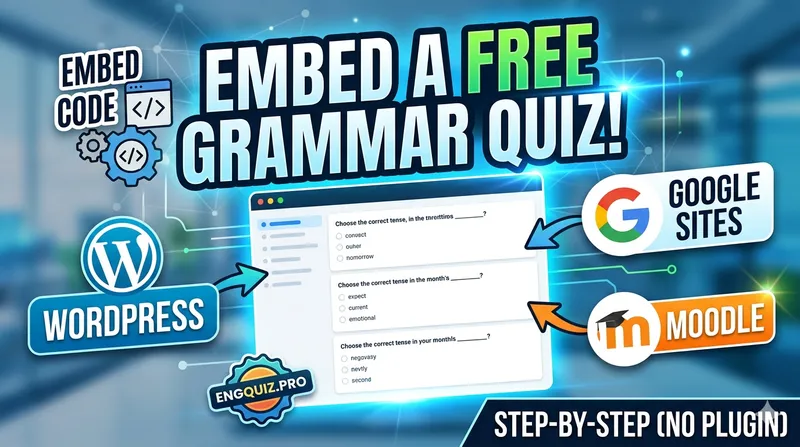
How to Embed a Free English Grammar Quiz on Your Website (WordPress, Google Sites, Moodle)
Step-by-step instructions for adding a free, interactive English grammar quiz to WordPress, Google Sites, Moodle, or any page that accepts HTML. No plugin, no sign-up, no ads.
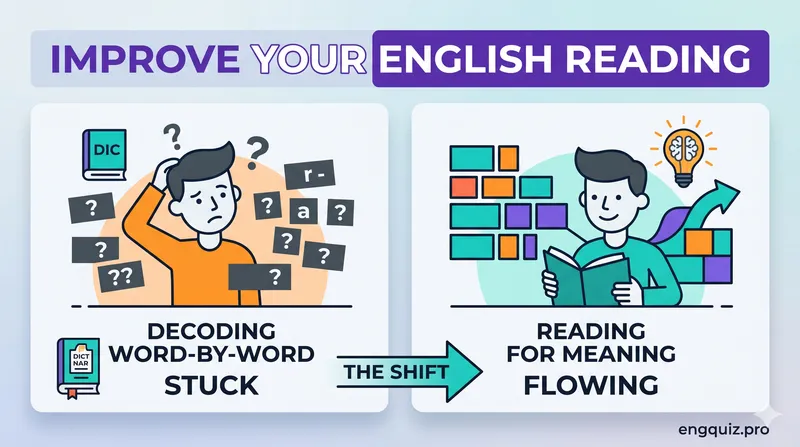
How to Improve English Reading and Actually Understand It
Why the level of the text you choose matters more than the hours you put in, and five exercises that build reading comprehension.
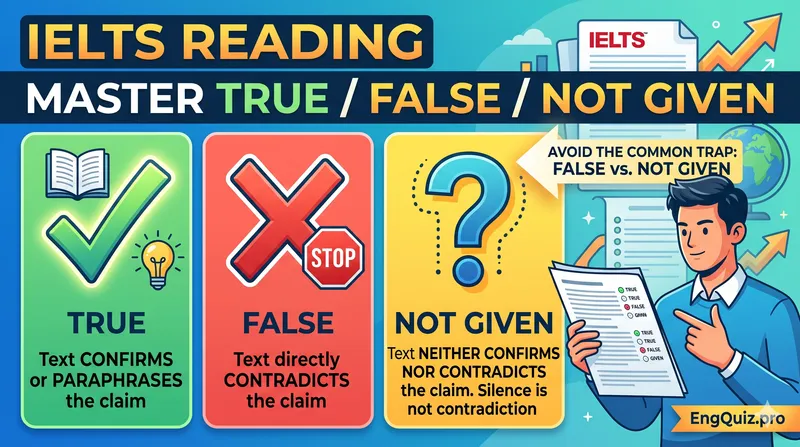
IELTS Reading: How to Master True/False/Not Given
True/False/Not Given is the most-failed IELTS Reading task. Learn the one rule that fixes it, and practise free on real B2/C1 passages with instant feedback.
Related Articles
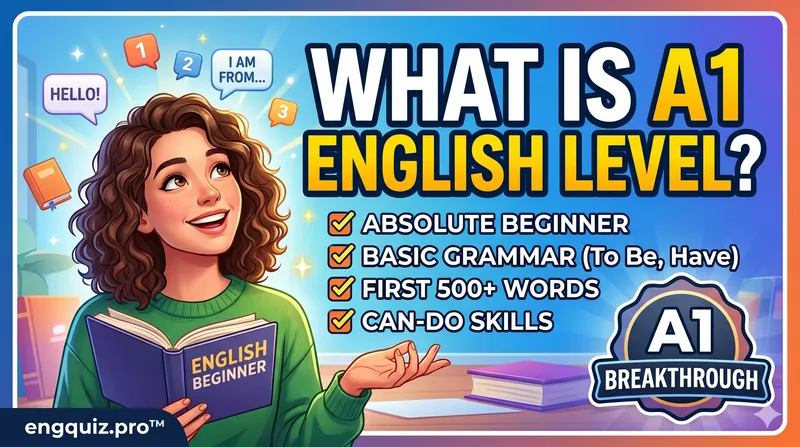
What Is A1 English Level? Skills, Grammar & First Words
A1 is absolute beginner English at the start of the CEFR scale. Learn what A1 means, the first grammar and words, and how long it takes to reach A2.
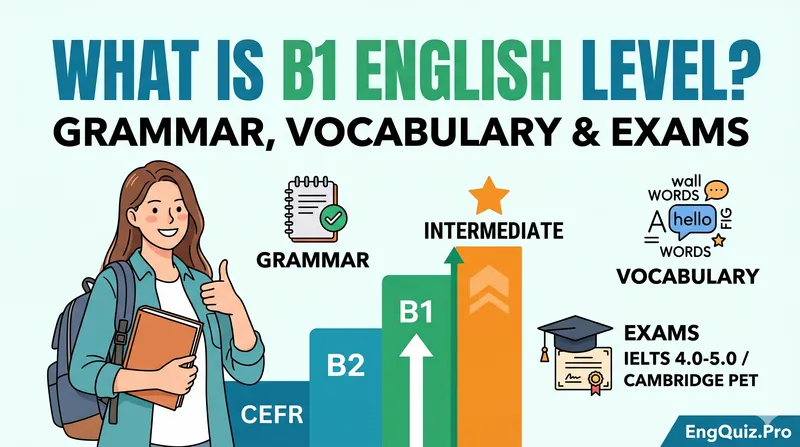
What Is B1 English Level? Grammar, Vocabulary & Exams
B1 is intermediate English: the level where you stop surviving and start communicating. Learn B1 grammar, vocabulary, exam scores, and how to reach it.
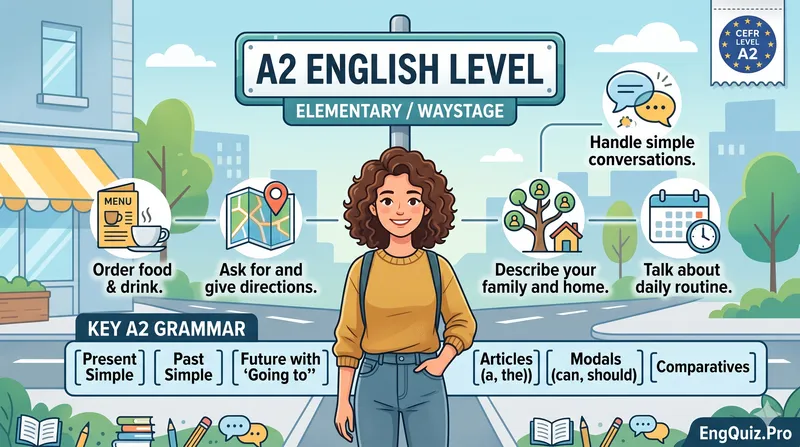
What Is A2 English Level? Grammar, Vocabulary & Exams
A2 is the elementary CEFR level: survival English for everyday situations. Learn A2 grammar, vocabulary, exam scores, and how long it takes to reach it.