What Is A2 English Level? Grammar, Vocabulary & Exams
A2 is the elementary CEFR level: survival English for everyday situations. Learn A2 grammar, vocabulary, exam scores, and how long it takes to reach it.
Introduction
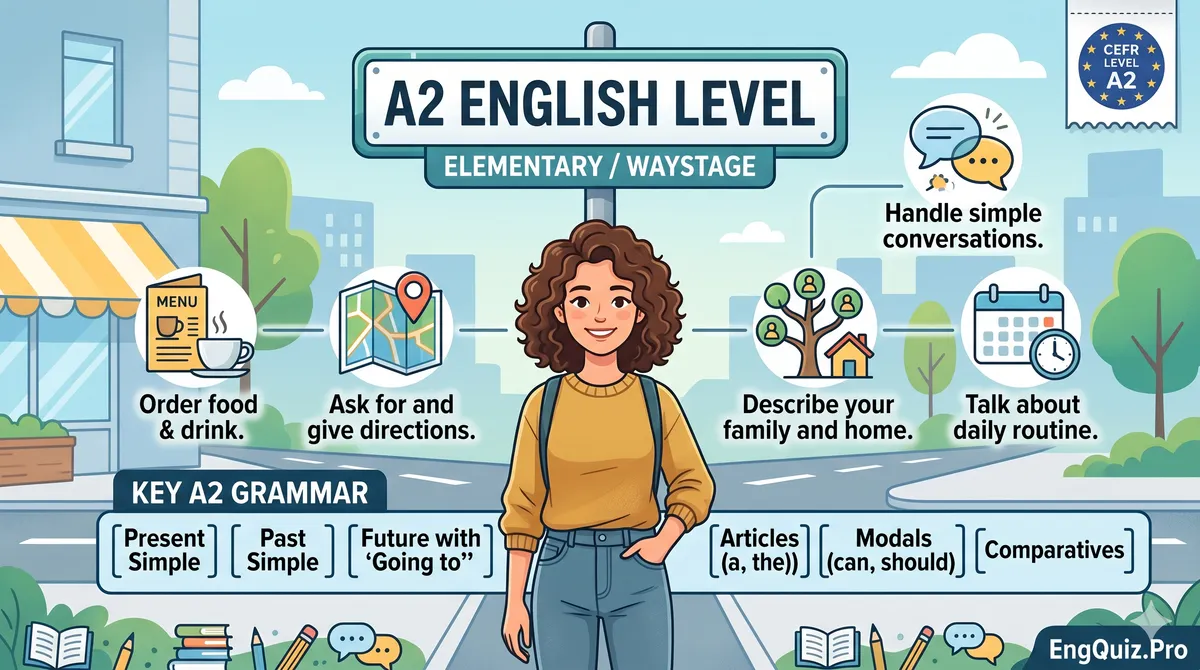
A2 is the level where English stops being a textbook and starts being a tool you can rely on day to day. At A2 you can introduce yourself, order food, ask for directions, talk about your family and your daily routine, and handle most predictable everyday situations.
This guide covers what A2 means in real conversations, the grammar and vocabulary you need to reach it, the exams that certify A2, and how long the move from absolute beginner (A1) to confident A2 usually takes.
Quick answer: A2 English is "elementary" or "waystage" on the CEFR scale. At A2, you can handle predictable everyday situations: shopping, eating out, simple conversations, basic emails, short messages. You know around 1 500–2 500 words, can use present and past simple, talk about likes/dislikes and plans, and ask and answer simple questions. Reaching A2 from A1 typically takes 180–200 hours of focused study. Starting from no English at all adds some extra time before this A1→A2 clock begins.
What A2 Means in Practice
The Council of Europe defines A2 (also called Elementary or Waystage) through real-world can-do statements. At A2, you can:
| Skill | What you can do at A2 |
|---|---|
| Speaking | Order food, ask for prices, give simple directions, describe your family, talk about your job, make small talk |
| Listening | Understand slow, clear speech on familiar topics; pick out key facts in short announcements |
| Reading | Read short personal messages, simple menus, signs, basic notices, short news headlines |
| Writing | Write short emails (booking, thanks, simple invitation), fill in forms, write a postcard |
What you cannot yet do at A2:
- Hold a long conversation on an unfamiliar topic
- Watch a TV series at native speed without subtitles
- Read a novel comfortably
- Write an essay or a formal letter
- Discuss abstract ideas (opinions on politics, ethics, art)
A2 is a strong foundation, not fluency. Think of it as the level where you can survive in an English-speaking environment, not yet thrive.
A2 Grammar: What You Must Know
A2 grammar is finite and learnable. Master these structures and you have the grammatical core of the level:
| Grammar point | Why it matters at A2 | Example |
|---|---|---|
| Present simple | Daily routines, habits, facts | I work in a bank. She lives in Paris. |
| Present continuous | Things happening now | I'm reading a book. The kids are sleeping. |
| Past simple (regular + common irregular) | Past events, stories, holidays | I went to Spain last summer. |
| Future with going to and will | Plans and predictions | I'm going to visit my family. It will rain tomorrow. |
| Articles (a / an / the / zero) | Basic noun grammar | I bought a coffee. The coffee was hot. |
| Quantifiers (much / many / some / any / a lot of) | Talking about quantity | How much milk do we have? |
| Comparatives and superlatives | Comparing things | Italy is bigger than Switzerland. |
| Adverbs of frequency | Routines | I always have breakfast. She never drinks coffee. |
| Modal verbs (can, could, must, should) | Ability, advice, obligation | I can swim. You should rest. |
| Possessives (my/your/his/her, mine/yours) | Ownership | That's my book. It's hers. |
| Object pronouns (me, him, her, them) | Pronoun replacement | I saw him. They called us. |
Notice what's not on the list: present perfect (B1), conditionals beyond the basics (B1+), passive voice (B1+), relative clauses (B1+), reported speech (B1+). A2 is the layer below all of those.
For an in-depth walkthrough of how these grammar layers stack up, see our common English grammar mistakes post and the present simple theory page.
A2 Vocabulary: What You Need
A2 vocabulary is typically 1 500–2 500 active words, roughly the top three frequency bands in any English dictionary. The areas you need to cover:
| Topic | Examples |
|---|---|
| Personal information | name, age, nationality, hometown, family, job |
| Daily life | morning, breakfast, work, lunch, evening, weekend |
| Food and drink | menu, order, bill, breakfast/lunch/dinner words |
| Travel | airport, train, ticket, hotel, suitcase, passport |
| Shopping | price, size, cheap/expensive, receipt, change |
| Health | doctor, headache, medicine, hospital, sick |
| Weather and time | sunny, rainy, cold, yesterday, last week, next month |
| Feelings | happy, tired, hungry, bored, worried |
| Numbers, dates, time | half past, quarter to, twenty-fifth of March |
Two practical tips for A2 vocabulary:
- Learn chunks, not single words. Make a reservation > make + reservation. Have breakfast > have + breakfast. Native speakers learn collocations as units, and so should you.
- Use the top-2000 word frequency list. The Oxford 2000 list covers ~80% of everyday English. Master it and you have the vocabulary backbone of A2 and B1.
A2 Exams: What Certificates Prove A2?
If you need official proof of A2, three exams certify it:
| Exam | Length | Format | Cost (typical) |
|---|---|---|---|
| Cambridge A2 Key (KET) | ~2.5 hours | Reading & Writing, Listening, Speaking | £80–110 |
| IELTS | ~2.75 hours | Listening, Reading, Writing, Speaking | $200–250 |
| TOEIC | 2 hours (L&R) | Listening + Reading | $90–150 |
| Exam | A2 score equivalent |
|---|---|
| Cambridge A2 Key | Pass (140–159) |
| IELTS | 3.0–4.0 |
| TOEIC (Listening + Reading total) | 225–545 |
IELTS and TOEIC are not taken to certify A2; these are score equivalents only. Cambridge A2 Key is the dedicated A2 certificate.
For a deeper comparison of which exam fits your goal, see IELTS vs TOEIC vs Cambridge.
How Long Does It Take to Reach A2?
The Council of Europe's reference figure is 180–200 guided learning hours to go from absolute beginner (A1) to A2. In practice:
| Study intensity | Time to A2 from zero |
|---|---|
| 1 hour/week (casual) | 3–4 years |
| 2 hours/week (school pace) | 18–24 months |
| 4 hours/week (motivated) | 12 months |
| Daily 30–45 min + immersion | 6 months |
| Intensive (10 hours/week + practice) | 3–4 months |
The fastest path is short daily sessions with active output. Two hours every day beats fourteen hours on Saturday. Speak and write. Don't just read and listen.
For a complete study plan template, see How to learn English grammar step by step.
Common Mistakes That Keep Learners Stuck at A2
These are the patterns we see most often in our A2 learner data. Fix them and you'll move toward B1 quickly.
Mistake 1: Dropping the auxiliary in questions
You like coffee?→ Do you like coffee?Where you live?→ Where do you live?
A2 question grammar needs do/does/did in front. Without it, you sound like a beginner even if your vocabulary is good.
Mistake 2: Mixing up do and be
I don't agree.✓ (correct)I am not agree.✗He is play football.✗ → He plays football. OR He is playing football.
Be and do are not interchangeable. I am hungry (state: be). I work here (action: do).
Mistake 3: Forgetting the -s in third person
She work in a hospital.→ She works in a hospital.
The third-person -s is small but critical. Native speakers notice immediately when it's missing.
Mistake 4: Using present simple for things happening now
I read a book right now.→ I am reading a book right now.
Right now, at the moment, currently all signal present continuous (be + verb-ing), not present simple.
Mistake 5: Word-for-word translation from L1
The classic: a learner translates "I have 20 years" (French j'ai 20 ans, Spanish tengo 20 años) into I have 20 years. The English structure is I am 20 years old. L1-to-English transfer is the biggest source of A2 errors. Fix it by learning English chunks as wholes, not words in isolation.
How to Move from A2 to B1
B1 is a much bigger step up from A2 than A2 was from A1. For a full picture of what waits on the other side, see What Is B1 English Level?. To make the jump itself, focus on:
- Present perfect tense. The structure that most clearly separates A2 from B1. I have lived here for three years vs. I lived here for three years (with different meanings). See our Present Perfect vs Past Simple guide.
- Conditionals (zero, first, second). See our conditional sentences pillar for the full system.
- Passive voice for news and basic descriptions. See our passive voice pillar.
- Vocabulary: 2 500 → 3 500 words. Push beyond everyday topics into work, study, opinions, and short narratives.
- Output volume. Write a short paragraph every day. Speak for 5 minutes every day. Output, not input, makes the jump.
For a step-by-step plan once you reach B1, see our B1 to B2 roadmap; many of the same habits also pull you from A2 to B1.
Quick Reference
| Question | A2 answer |
|---|---|
| What does A2 mean? | Elementary: survive everyday situations |
| Vocabulary size | 1 500–2 500 active words |
| Time from zero | 180–200 study hours (~6 months at daily pace) |
| Key grammar | Present/past simple, going to, articles, modals |
| Certifies A2 | Cambridge A2 Key, IELTS 3.0–4.0, TOEIC 225–545 |
| What's not in A2 yet | Present perfect, conditionals 2nd/3rd, passive, relative clauses |
A2 Practice Exercises
The fastest way to confirm A2 is to take A2-level exercises and see what you score. EngQuiz Pro has free A2 exercises across the key grammar points. Start with the A2 Present Simple Gap Fill; the other two A2 sets are linked at the end of this article.
If you score 60%+ across all three, you are solidly at A2. Score 80%+ across all three and you are ready to start working on B1 material.
Last updated: 11 May 2026 · See our editorial standards.
Frequently Asked Questions
A2 is elementary, which is one step above absolute beginner (A1). At A2 you are no longer a beginner: you can handle predictable everyday situations independently. But you are still a long way from intermediate (B1) and a much longer way from fluent (B2+).
A1 = you can survive only with help. A2 = you can survive on your own in routine situations. A1 vocabulary is ~500–1 000 words; A2 is ~1 500–2 500. A1 uses mostly present simple; A2 adds past simple, future forms, and basic modals. For a full breakdown, see What Is A1 English Level?.
For most jobs, no. A2 is enough for tourism, hospitality, basic customer service in person, and simple delivery/driving roles where conversations are short and predictable. Office work, technical jobs, and customer service over the phone typically require B1 minimum and often B2.
Usually not. Most countries that require an English language test for residency, citizenship, or skilled-work visas set the bar at B1 or B2. A2 may satisfy some family-reunion or basic settlement routes, but you should always check the exact CEFR level (or accepted test score) listed by the immigration authority you are applying to.
Take a free CEFR test. See our free CEFR level test guide, then take three A2 exercises (above). If you score 60%+ consistently, you're A2. If you struggle, you may still be in the A1–A2 transition.
B1, intermediate. At B1 you can hold conversations on a wider range of topics, write short essays, and understand the main points of clear standard speech. The leap from A2 to B1 is the biggest conceptual jump in the CEFR scale because it introduces present perfect, conditionals beyond the basics, and the first real use of complex sentences.
New Articles
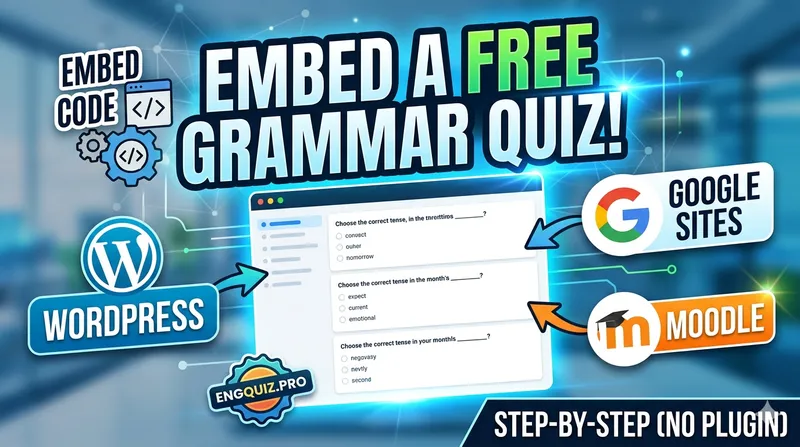
How to Embed a Free English Grammar Quiz on Your Website (WordPress, Google Sites, Moodle)
Step-by-step instructions for adding a free, interactive English grammar quiz to WordPress, Google Sites, Moodle, or any page that accepts HTML. No plugin, no sign-up, no ads.
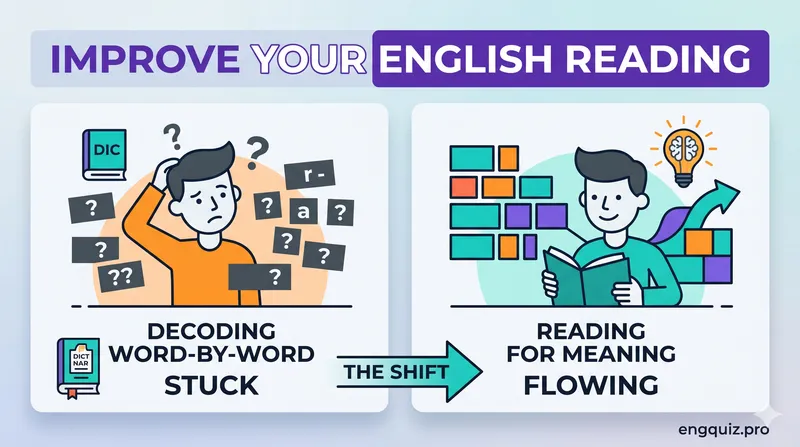
How to Improve English Reading and Actually Understand It
Why the level of the text you choose matters more than the hours you put in, and five exercises that build reading comprehension.
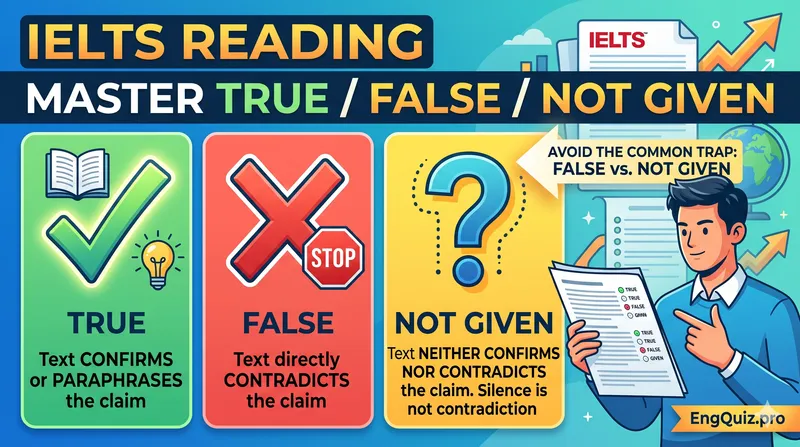
IELTS Reading: How to Master True/False/Not Given
True/False/Not Given is the most-failed IELTS Reading task. Learn the one rule that fixes it, and practise free on real B2/C1 passages with instant feedback.
Related Articles
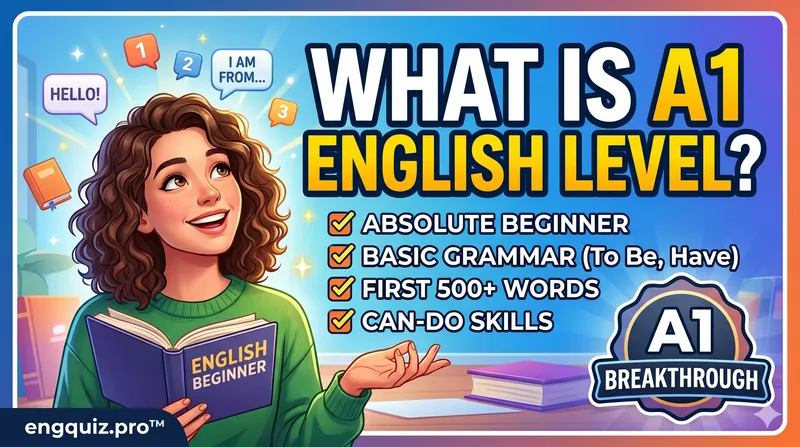
What Is A1 English Level? Skills, Grammar & First Words
A1 is absolute beginner English at the start of the CEFR scale. Learn what A1 means, the first grammar and words, and how long it takes to reach A2.
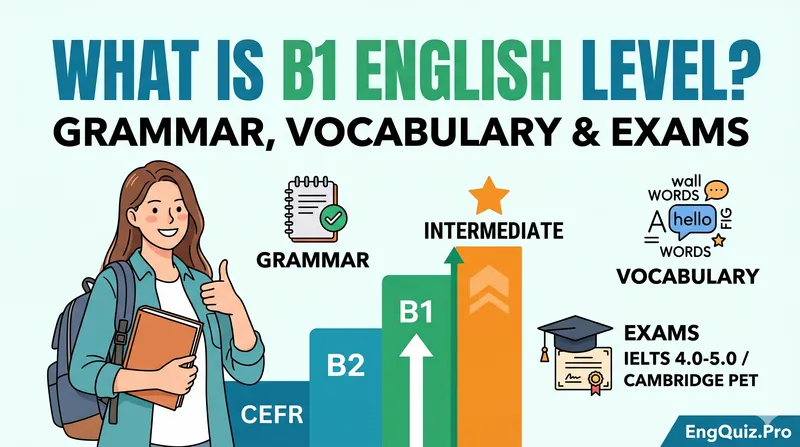
What Is B1 English Level? Grammar, Vocabulary & Exams
B1 is intermediate English: the level where you stop surviving and start communicating. Learn B1 grammar, vocabulary, exam scores, and how to reach it.
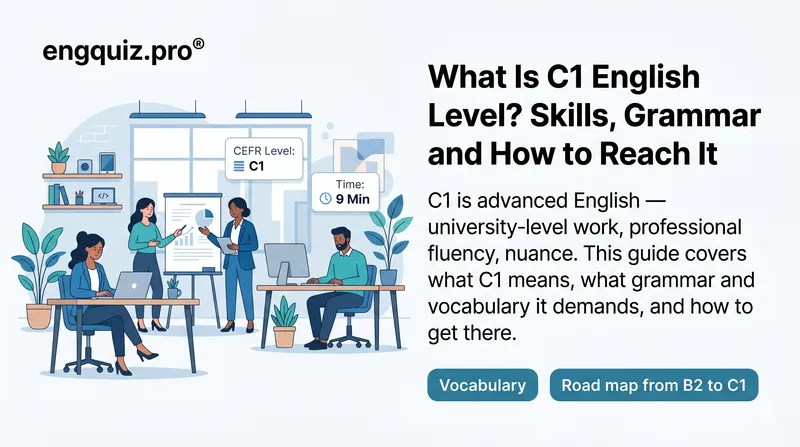
What Is C1 English Level? Skills, Grammar and How to Reach It
C1 is advanced English: university-level work, professional fluency, nuance. This guide covers what C1 means, what grammar and vocabulary it demands, and how to get there.