Will vs Going To: Difference, Rules and Examples
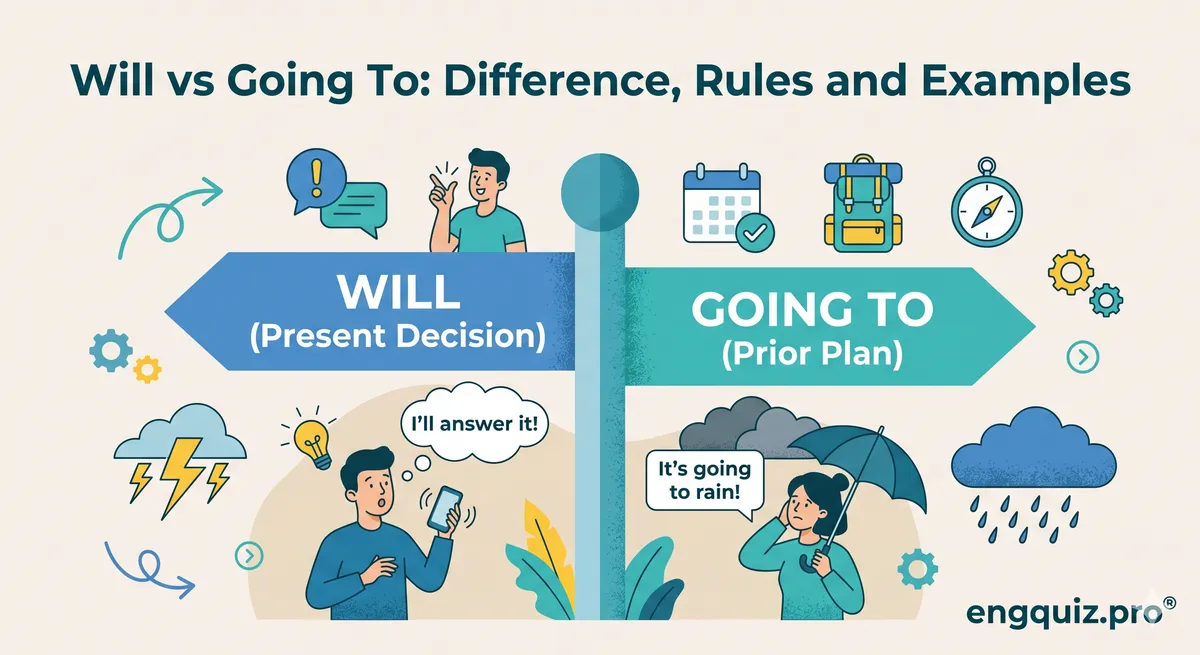
Will or going to? The simple rule: use 'going to' for plans and predictions you can see; use 'will' for decisions made at the moment of speaking.
Introduction
"I will call you later." "I'm going to call you later." Both sentences describe the future, but they do not mean the same thing.
This is one of the most asked English grammar questions: when do you use will and when do you use going to? The good news is that once you know the difference between a decision made now and a plan made earlier, you will almost never mix them up again.
Quick answer: Use going to when you already have a plan, an intention, or visible evidence for a prediction. Use will when you decide at the moment of speaking, or when you make an offer, promise, or prediction based on opinion.
The Core Difference
Both forms talk about the future. They differ in when the decision was made and what kind of evidence you have.
| Form | When you use it | Example |
|---|---|---|
| will | The decision is made right now, while you are speaking | The phone rings → "I'll get it!" |
| going to | The decision was made before you started speaking | (Bag packed last night) "I'm going to visit my parents tomorrow." |
| will (prediction) | A prediction based on your opinion, belief, or experience | "I think Italy will win the World Cup." |
| going to (prediction) | A prediction based on something you can see right now | (Dark clouds outside) "It's going to rain." |
The fastest test: ask yourself, "Did I plan this, or am I deciding it as I speak?"
- "Did you plan it?" → ✓ going to
- "Are you deciding it now?" → ✓ will
When to Use Going To
Going to describes a future that already exists in your head: a plan, an intention, or something that the present already points to.
1. Plans and intentions you decided earlier
- I'm going to start a new job next Monday. (already accepted the offer)
- We're going to travel to Vietnam in July. (already booked the flight)
- She's going to learn Spanish this summer. (already paid for the course)
If someone could ask "What's your plan?" and you would naturally use the answer, use going to.
2. Predictions with visible evidence
- (Heavy black sky) It's going to rain.
- (Empty fuel gauge) The car is going to stop.
- (Tied score, 90th minute) They*'re going to** draw.*
The clue word here is see: you can literally see the reason for your prediction.
3. Something that is about to happen
- Look out! You're going to drop that glass!
- I think I'm going to sneeze.
- Hurry up, the train is going to leave.
For events on the verge of happening, going to is almost always more natural than will.
When to Use Will
Will describes a future you have just thought of, or a future about which you are giving an opinion, an offer, or a promise.
1. Decisions made at the moment of speaking
- (Doorbell rings) I'll get it!
- (Waiter: "What would you like?") I'll have the steak, please.
- Oh, I forgot my wallet. I'll pay you back tomorrow.
The decision did not exist one second before you spoke. Will captures that on-the-spot moment.
2. Predictions based on opinion or experience
- I think it will be a tough exam.
- In ten years, electric cars will be the standard.
- She'll love this gift; she's been talking about it for weeks.
These predictions are not based on visible evidence right now; they are based on what you believe will happen.
3. Offers, promises, and requests
- Don't worry, I'll drive you to the airport. (offer)
- I promise I won't tell anyone. (promise)
- Will you open the window, please? (polite request)
- I won't do it! (refusal, with strong present meaning)
This use of will is so common in everyday conversation that learners who avoid it often sound stiff or formal.
4. Facts and certainties about the future
- The sun will rise at 5:48 tomorrow.
- I will be 30 next month.
- The new law will come into force in January.
For neutral, factual future statements, will is the default.
Will vs Going To, Side by Side
| Situation | Sentence | Why |
|---|---|---|
| Phone is ringing, you decide to answer | I'll get it. | Decision is happening right now |
| You agreed yesterday to answer phones today | I'm going to answer phones today. | Plan made earlier |
| You see dark clouds | It's going to rain. | Evidence is visible |
| Your friend asks for a weather prediction | I think it'll rain. | Personal opinion, no visible clue |
| You see a child about to fall | He's going to fall! | About to happen, evidence visible |
| You want to make a promise | I'll always be there for you. | Promise: use will |
| A train timetable says 9:00 | The train will arrive at 9:00. | Neutral fact |
| You've already booked a 9:00 train | I'm going to take the 9:00 train. | Personal plan |
Common Mistakes
Mistake 1: Using will for a plan you already made
I will visit my parents next weekend.(spoken to a friend who knows about the trip)
Why it's wrong: If the plan was made before this conversation, will sounds like you just thought of it.
✓ I'm going to visit my parents next weekend.
Mistake 2: Using going to for an on-the-spot decision
(Phone rings) I'm going to get it!
Why it's wrong: You did not plan to answer the phone; you are deciding at this exact moment.
✓ I'll get it!
Mistake 3: Mixing the two forms in one sentence
I'll going to call you tomorrow.
Why it's wrong: Going to is not used after will. Pick one.
✓ I'll call you tomorrow. (deciding now) ✓ I'm going to call you tomorrow. (already planned)
Mistake 4: Using will for a visible prediction
Look at those clouds, it will rain.
Why it's wrong: When the evidence is visible right now, native speakers strongly prefer going to. Will sounds like a guess unconnected to the clouds you can see.
✓ Look at those clouds, it's going to rain.
Special Cases and Subtleties
"Going to go": repeating the verb
Many learners drop the go after going to to avoid repetition: I'm going to the cinema (present continuous, also fine) vs I'm going to go to the cinema (going-to future). Both are acceptable in everyday English.
"I will" vs "I'm going to" in writing
In formal writing, will is far more common. Going-to feels conversational. In an academic essay, use will. In a chat with a friend, both are fine.
Predictions that mix both
You can use either form for opinion-based predictions about the long-term future:
- Cars will be self-driving by 2040. ✓
- Cars are going to be self-driving by 2040. ✓
The shift is subtle: will sounds more like a prediction, going to sounds more like a confident expectation.
Asking about plans
When asking about someone's plans, English speakers prefer the present continuous or going to, not will:
- What are you doing this weekend? ✓ (most natural)
- What are you going to do this weekend? ✓
- What will you do this weekend? ✗ (sounds like a philosophy question)
Quick Reference
| Question | Form |
|---|---|
| Was the decision made before this conversation? | going to |
| Are you deciding while you speak? | will |
| Can you see the reason for your prediction? | going to |
| Is your prediction based on opinion or belief? | will |
| Is it an offer, promise, or refusal? | will |
| Is it a neutral fact about the future? | will |
| Is it about to happen right now? | going to |
Practice Exercise
Choose will or going to:
- (Looking at a black sky) Look, it ____ rain!
- (Phone rings) I ____ answer it!
- I've decided. I ____ buy a new laptop this weekend.
- I think Real Madrid ____ win the league this year.
- Watch out! You ____ drop that vase!
- Don't worry, I ____ help you with the report.
Answers: 1. is going to | 2. 'll | 3. am going to | 4. will | 5. are going to | 6. 'll
Practise Will vs Going To Now
The fastest way to lock the difference in is deliberate practice with feedback. EngQuiz Pro has free mixed-tense exercises that test exactly this distinction inside longer sentences.
→ Practice Mixed Tenses Multiple Choice (B2) →
Want the rules in even more detail? Read the dedicated theory pages:
Will vs Going To on Cambridge, IELTS and TOEIC
Exam writers love this contrast because it tests not just grammar but also register and real-world appropriateness.
- Cambridge B1 Preliminary / B2 First: the Use of English sections regularly include items where one form is clearly more natural. The decision-vs-plan test (above) is the single most reliable filter.
- IELTS Speaking Part 2 (the long turn): when describing future plans, candidates who switch between will and going to incorrectly sound less fluent. Use going to for actual plans (I'm going to start university next September) and reserve will for promises and certainties.
- TOEIC Part 5 and Part 6: short context cues in the surrounding sentence almost always tell you which form fits. Look for evidence words (look, see, watch) for going to and decision words (OK, fine, alright) for will.
For a deeper exam-driven contrast across tenses, see our IELTS grammar structures post, which covers ten high-frequency patterns the examiners reward.
If you want the authoritative reference, the British Council page on talking about the future covers will, going to, present continuous and future continuous side by side.
Frequently Asked Questions
Yes, in some contexts. For long-term predictions ("Cars will be electric by 2040" / "Cars are going to be electric by 2040"), both work. The difference is subtle: will feels more like a personal forecast, going to feels closer to a confident expectation. For decisions made on the spot, only will sounds natural.
Because most everyday future statements are decisions made at the moment of speaking: replying to questions, making offers, promising. Hearing fluent English, you'll notice 'll (the contracted form) is far more common than the spelled-out will.
Yes, for fixed personal arrangements: I'm meeting Sarah at 7. This is even more specific than going to: you have a confirmed appointment, not just a plan. See our common English grammar mistakes post for the full breakdown.
Won't is the negative of will only. The negative of going to is not going to: I'm not going to call him. In speech, won't can express a strong refusal in the present: He won't listen to me = he refuses to listen.
Will is more formal and more common in writing. Going to is more conversational. Academic essays and formal letters strongly prefer will.
New Articles
How to Embed a Free English Grammar Quiz on Your Website (WordPress, Google Sites, Moodle)
Step-by-step instructions for adding a free, interactive English grammar quiz to WordPress, Google Sites, Moodle, or any page that accepts HTML. No plugin, no sign-up, no ads.
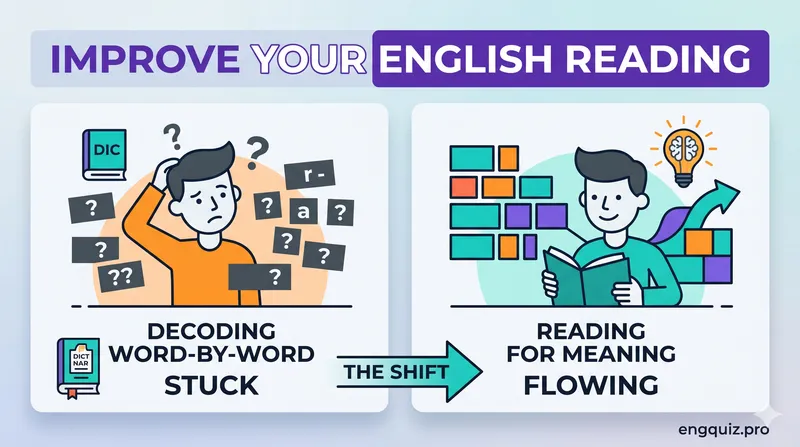
How to Improve English Reading and Actually Understand It
Why the level of the text you choose matters more than the hours you put in, and five exercises that build reading comprehension.
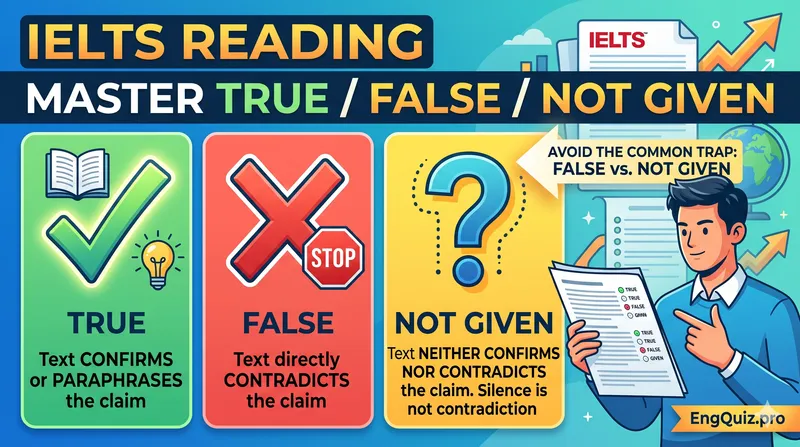
IELTS Reading: How to Master True/False/Not Given
True/False/Not Given is the most-failed IELTS Reading task. Learn the one rule that fixes it, and practise free on real B2/C1 passages with instant feedback.
Related Articles
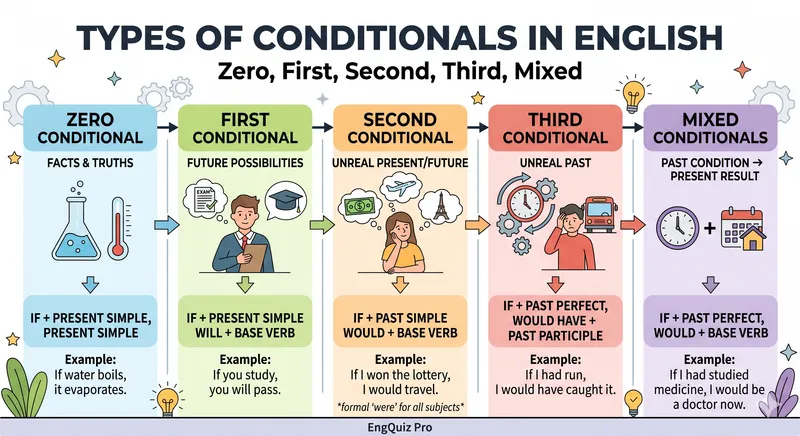
Types of Conditionals in English: Zero, First, Second, Third and Mixed
The 5 types of conditional sentences explained with formulas, examples and common mistakes: zero, first, second, third and mixed conditionals.
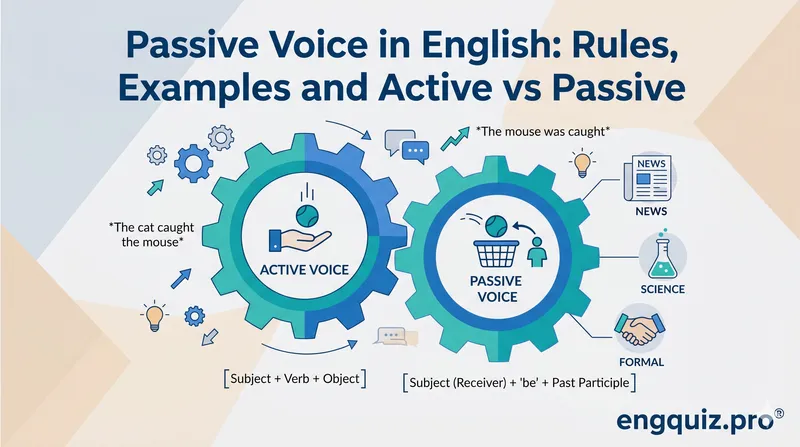
Passive Voice in English: Rules, Examples and Active vs Passive
The passive puts the receiver of an action first: "The letter was written." Learn to form it in every tense, when to use it, and 5 common mistakes.
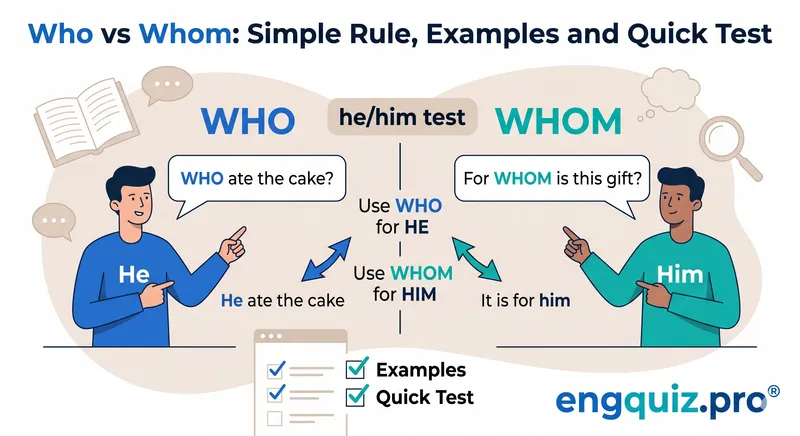
Who vs Whom: Simple Rule, Examples and Quick Test
Confused by who vs whom? Use the he/him test: if he fits, use who; if him fits, use whom. Examples, common mistakes and a 5-question quiz inside.