Academic Vocabulary for IELTS Writing: How to Move From Band 6 to Band 7
Lexical Resource is 25% of your IELTS Writing score, and most learners attack it backwards. Here is what Band 7 vocabulary actually looks like, and how to get there.
Introduction
Lexical Resource is one of four criteria in IELTS Writing, worth 25% of your Task 1 and Task 2 scores. It is also the criterion where the most preparation time is wasted: learners memorise vocabulary lists, drop "myriad" and "plethora" into every essay, and still come out at Band 6.0.
The problem is not effort. The problem is that academic vocabulary is not a category of fancy words. It is a category of words used in specific ways: with specific partners, at a specific register, in specific grammatical shapes. This guide explains what Band 7 vocabulary actually looks like, what the descriptors really demand, and the four shifts that move a Writing answer from "adequate range" to "flexibility and precision".
Quick answer: To raise IELTS Writing Lexical Resource from Band 6 to Band 7, do four things. (1) Learn word families, not isolated words (analyse / analysis / analytical / analytically as one unit). (2) Memorise collocations as fixed pairs (raise concerns, draw a parallel, pose a challenge). (3) Use nominalisation to compress verbs into noun phrases for academic density. (4) Hedge your claims with tends to, broadly speaking, in most cases instead of asserting absolutes. None of these require rare vocabulary; they require placing ordinary academic vocabulary correctly.
The Real Problem With Academic Vocabulary
Most learners think Band 7 writing means a bigger vocabulary. It does not. A Band 6 candidate and a Band 7 candidate typically know roughly the same number of words. What separates them is placement: which word goes with which partner, in which grammatical shape, at which register.
Compare two sentences expressing the same idea:
Band 6: "There are big problems with online learning." Band 7: "Online learning poses significant challenges, particularly regarding student engagement."
Both sentences use vocabulary the writer almost certainly knows. The Band 7 version differs in three measurable ways: poses + challenges is a known collocation, particularly regarding is academic discourse marking, and engagement is a nominalisation of a verb. The writer has not reached for any exotic word. They have placed ordinary academic words in the shape examiners look for.
This is what the Band 7 descriptor means by "awareness of style and collocation." Awareness, not vocabulary size.
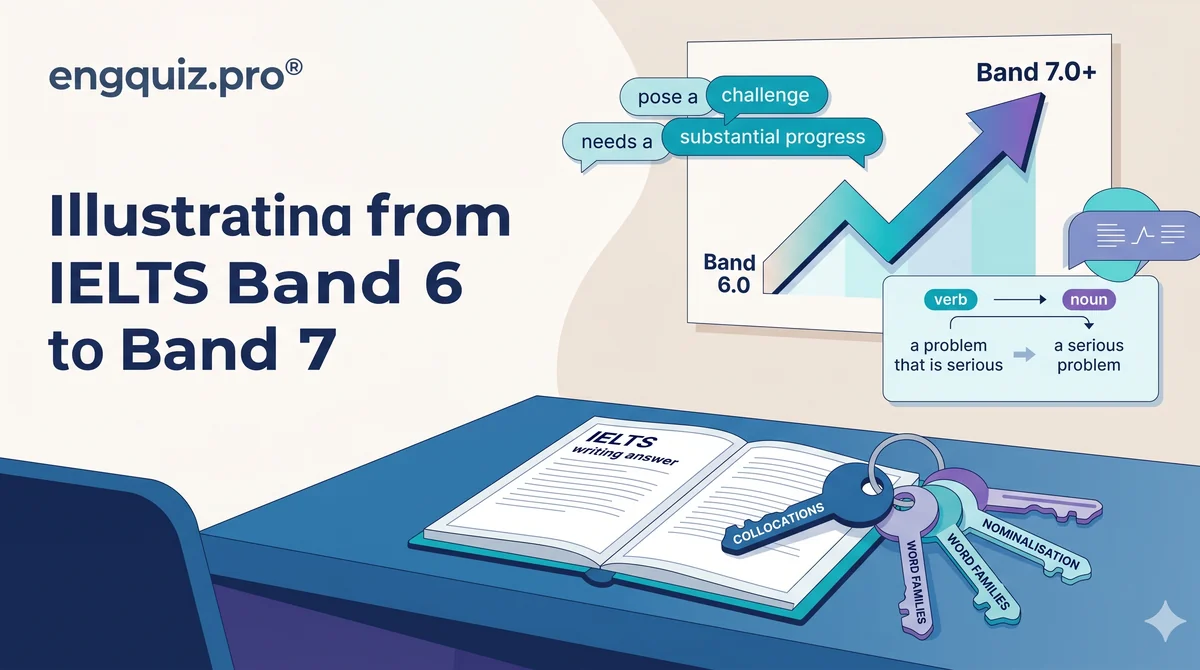
Vocabulary as a Set of Labelled Keys
A useful way to think about academic vocabulary: imagine a Band 6 writer carrying a master key (good, bad, important, big, problem) and using it to force every lock. The key works, but it grinds the mechanism every time.
A Band 7 writer carries a ring of labelled keys. Compelling opens one door, detrimental opens another, pivotal opens a third. The ring is not necessarily larger. The keys are simply labelled, and the writer reads the label before choosing.
This metaphor matters because it changes what you study. You stop hunting for rarer words and start studying which word fits which door, which is what collocation work, nominalisation work, and hedging work actually are.
The Four Layers of Band 7 Vocabulary
Layer 1: Word Families, Not Isolated Words
The Coxhead Academic Word List groups its 570 entries into word families. The family analyse includes: analyse (verb), analysis (noun), analyst (agent noun), analytical (adjective), analytically (adverb).
Learning analyse as a single verb gets you one slot in a sentence. Learning the family gets you four. A Band 7 writer can move freely between:
- "The committee analysed the proposal." (verb)
- "The committee's analysis raised three concerns." (noun)
- "The analyst's report was published yesterday." (agent noun)
- "Her approach to the problem was analytical rather than intuitive." (adjective)
Same root, four grammatical positions. This is what examiners mean by flexibility.
A common mistake at Band 6 is freezing a word in one form. The writer knows analyse but cannot reach for analysis when the sentence demands a noun, so they fall back on study or look at. The vocabulary is there; the family movement is not.
If word families still feel arbitrary, our word formation guide explains the underlying system: the suffixes that turn verbs into nouns (-tion, -ment, -ity), nouns into adjectives (-al, -ous, -ive), and adjectives into adverbs (-ly). Once the suffix rules are visible, moving across the family stops being memorisation and becomes generation.
Layer 2: Collocations Are Non-Negotiable
A collocation is a word that habitually appears with another word. Make a decision is correct; do a decision is not. Heavy rain is natural; strong rain is not. The component words are simple; the pairing is fixed.
In academic writing, collocations matter more than rare vocabulary because a single broken collocation drops the register of an entire sentence. Examiners are trained to spot them.
High-value academic collocations for IELTS Writing Task 2:
| Verb collocations | Adjective collocations |
|---|---|
| raise concerns / awareness / questions | significant impact / increase / decline |
| pose a challenge / risk / threat | compelling evidence / argument |
| draw a parallel / conclusion / distinction | widespread belief / practice / criticism |
| play a role / part | growing concern / awareness |
| reach a consensus / conclusion / agreement | considerable debate / variation |
| gain insight / momentum / acceptance | substantial progress / reduction |
A productive habit: when you learn a new academic word, do not write it down alone. Write it down inside its strongest collocation. Insight alone is half-learned. Gain insight into is ready to use.
Layer 3: Nominalisation, the Mechanic Behind Academic Density
Nominalisation is the conversion of verbs and adjectives into nouns. It is the single most distinctive grammatical feature of academic prose, and the easiest one to add to your writing once you notice it.
The pattern: verbs become noun phrases, and the action becomes the subject of its own sentence.
| Verbal sentence | Nominalised sentence |
|---|---|
| Governments tax pollution, which reduces it. | The taxation of pollution leads to a reduction in emissions. |
| Students plagiarise, so universities punish them. | Plagiarism results in formal disciplinary action. |
| Cities are growing fast, which puts pressure on housing. | Rapid urban growth places considerable pressure on housing. |
Both columns are grammatically correct. The right column reads as academic; the left as conversational. Examiners trained on band descriptors register the difference within a sentence or two.
A warning: nominalisation is a tool, not a default. A whole essay written in nominalisations becomes unreadable. The Band 7 move is to nominalise the second time you mention an action, after introducing it as a verb. This produces natural rhythm.
Layer 4: Hedging Is a Band Marker
Hedging is the language of academic caution: tends to, appears to, broadly speaking, in most cases, may, suggests, is likely to, with some caveats. It is how academic writing signals that a claim is a position, not a fact.
At Band 6, claims are absolute. At Band 7, claims are calibrated.
Band 6: "Social media causes depression in teenagers." Band 7: "Social media use appears to contribute to depressive symptoms in adolescents, particularly among heavy users."
The second sentence is not weaker. It is more credible, because it acknowledges that the relationship is not deterministic. Examiners reading thousands of IELTS essays are conditioned to read hedging as scholarly thinking and absolute claims as overconfidence.
Five hedges to absorb this week: tends to, is likely to, broadly speaking, in most cases, with some exceptions. Drop one into every paragraph of your next Task 2 essay and read the result aloud. The voice will shift.
What This Means for Your Band Descriptor
The official IELTS Writing Lexical Resource band descriptors:
| Band | What the descriptor says |
|---|---|
| 6.0 | "Uses an adequate range of vocabulary for the task. Attempts to use less common vocabulary but with some inaccuracy." |
| 7.0 | "Uses a sufficient range of vocabulary to allow some flexibility and precision. Uses less common lexical items with some awareness of style and collocation." |
| 8.0 | "Uses a wide range of vocabulary fluently and flexibly to convey precise meanings. Skilfully uses uncommon lexical items but there may be occasional inaccuracies." |
The Band 6 → Band 7 boundary lives in two phrases: flexibility and precision, and awareness of style and collocation. Re-read those phrases and notice what they do not say. They do not say rarer vocabulary. They do not say bigger words. They say flexibility (moving across word family forms), precision (the right word for the door), and awareness of style and collocation (placement).
This is why the four layers above (families, collocations, nominalisation, hedging) map directly onto the Band 7 descriptor. They are not optional polish. They are what the descriptor is asking for.
Four Traps That Keep Learners Stuck at Band 6
Trap 1: The Thesaurus Substitution
A learner looks up important in a thesaurus and finds imperative. They substitute it. The sentence "It is important to drink water" becomes "It is imperative to drink water." Both are grammatical. Only one is in register.
Imperative implies moral or strategic necessity: "It is imperative that this protocol is followed." Drinking water is recommended, not imperative.
Fix: Look up usage examples, not synonyms. A word that fits the dictionary may not fit the slot.
Trap 2: The Register Mix
A paragraph slides between academic and conversational without the writer noticing. "The government has implemented numerous policies, but loads of citizens think they are rubbish." The shift from implemented numerous policies to loads of citizens / rubbish breaks tone within a single sentence.
Fix: Pick a register before you start writing and hold it. If implemented is in your first sentence, you are committed; loads and rubbish are no longer available.
Trap 3: Latinate Over-Correction
Some learners translate every Anglo-Saxon word into a Latinate equivalent because it sounds more academic. Begin becomes commence. End becomes terminate. Use becomes utilise. Try becomes endeavour.
The result is prose that reads as forced. Band 7 examiners distinguish between Latinate where it adds precision (pose a challenge is sharper than cause a problem) and Latinate where it only adds syllables (utilise rarely beats use).
Fix: Latinise where it sharpens meaning, not where it only inflates length.
Trap 4: Collocation Drift
The right word with the wrong partner. Make a research instead of do research. Raise a meeting instead of hold a meeting. Strong rain instead of heavy rain. Each error is small. Each one signals to the examiner that the vocabulary is learned, not absorbed.
Fix: Store new academic words as collocations, not as bare entries. Conclusion is half a word. Reach a conclusion, draw a conclusion, jump to a conclusion are three usable phrases.
Five Exercises To Try Today
Work through these without checking the answers first. They map directly onto the four layers above.
1. Nominalise: Rewrite the following sentence in a more academic register by converting the verb into a noun phrase. "When students plagiarise, universities punish them severely."
2. Fix the collocation: One word in this sentence breaks a standard academic collocation. Find and replace it. "The study made important results about climate change."
3. Hedge the claim: Soften this absolute statement using academic hedging language. "Social media causes depression."
4. Move across the family: Convert the verb analyse into a noun and rewrite the sentence using the noun form as the subject. "The committee analysed the data carefully."
5. Fix the register slip: This sentence mixes registers. Rewrite it consistently in academic register. "The findings of the research are super interesting and have loads of implications."
Remember This
A Band 7 writer does not know more words than a Band 6 writer. They know which word goes where: which collocate it pairs with, which grammatical shape it takes, which register it lives in. Vocabulary is not what you know. It is what you can place.
Answers to the practice exercises:
- "Plagiarism by students results in severe disciplinary action from universities." Here the verb plagiarise → noun plagiarism; subject becomes the action itself.
- "The study produced (or yielded) important results about climate change." Make results is not a standard collocation; produce results and yield results are.
- "Social media use appears to contribute to depressive symptoms, particularly among heavy users." Hedges added: appears to, contribute to (not causes), the qualifier particularly among heavy users.
- "The committee's analysis of the data was thorough." The verb analyse → noun analysis; the action moves into subject position.
- "The findings of the research are highly significant and carry considerable implications." Super interesting → highly significant; loads of implications → considerable implications.
New Articles

How to Embed a Free English Grammar Quiz on Your Website (WordPress, Google Sites, Moodle)
Step-by-step instructions for adding a free, interactive English grammar quiz to WordPress, Google Sites, Moodle, or any page that accepts HTML. No plugin, no sign-up, no ads.
How to Improve English Reading and Actually Understand It
Why the level of the text you choose matters more than the hours you put in, and five exercises that build reading comprehension.
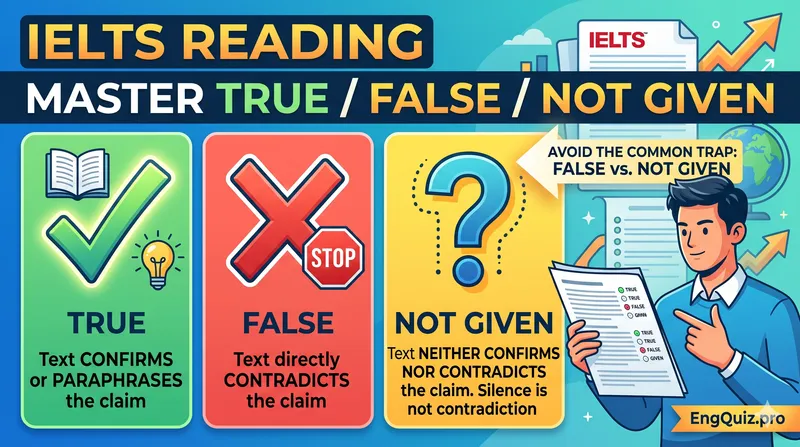
IELTS Reading: How to Master True/False/Not Given
True/False/Not Given is the most-failed IELTS Reading task. Learn the one rule that fixes it, and practise free on real B2/C1 passages with instant feedback.
Related Articles
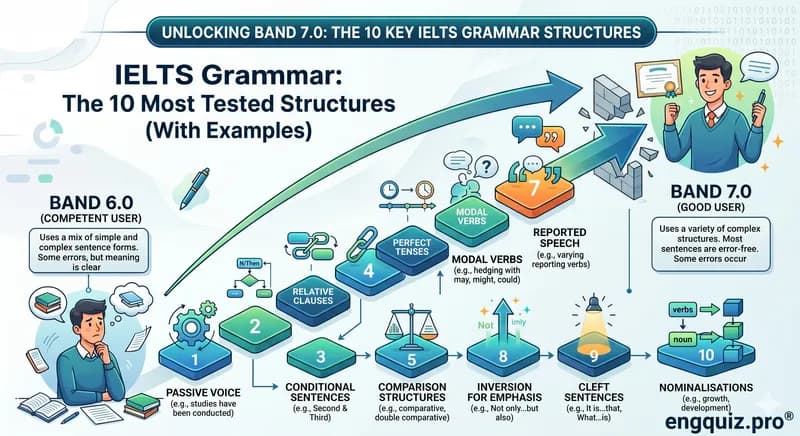
IELTS Grammar: The 10 Most Tested Structures (With Examples)
Master IELTS grammar by targeting these 10 structures, the ones that separate Band 6.0 from Band 7.0 in Writing and Speaking. Examples + exercises.
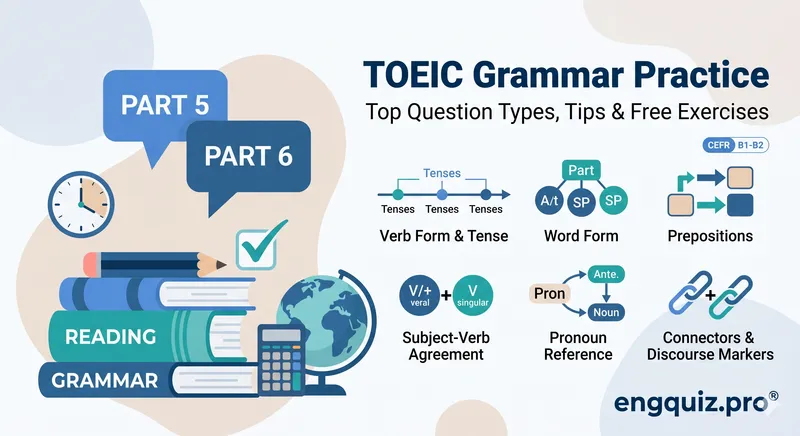
TOEIC Grammar Practice: Top Question Types, Tips & Free Exercises
Preparing for TOEIC? This guide covers the top grammar patterns tested in the TOEIC Reading section, with practice tips and free exercises at B1–B2 level.
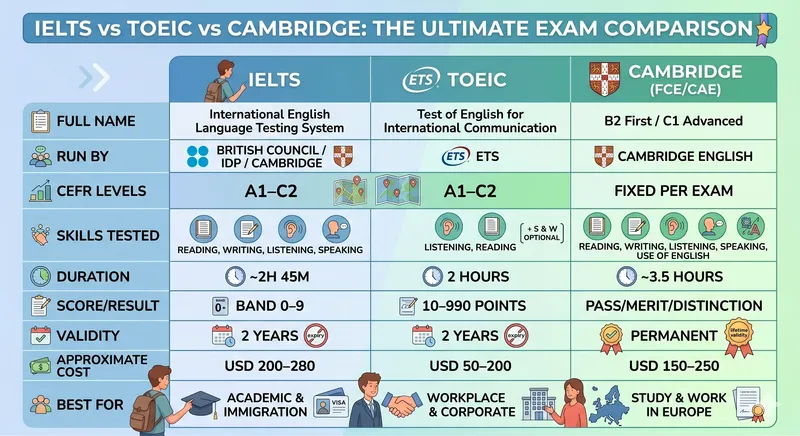
IELTS vs TOEIC vs Cambridge: Which English Exam Is Right for You?
Choosing between IELTS, TOEIC, and Cambridge exams? This guide compares all three: format, cost, recognition, and which one fits your goal.