How to Learn English Grammar Step by Step: A 4-Layer Framework
Most learners study English grammar in the wrong order. Here is a four-layer step-by-step framework, with exam-angle advice and exercises to start today.
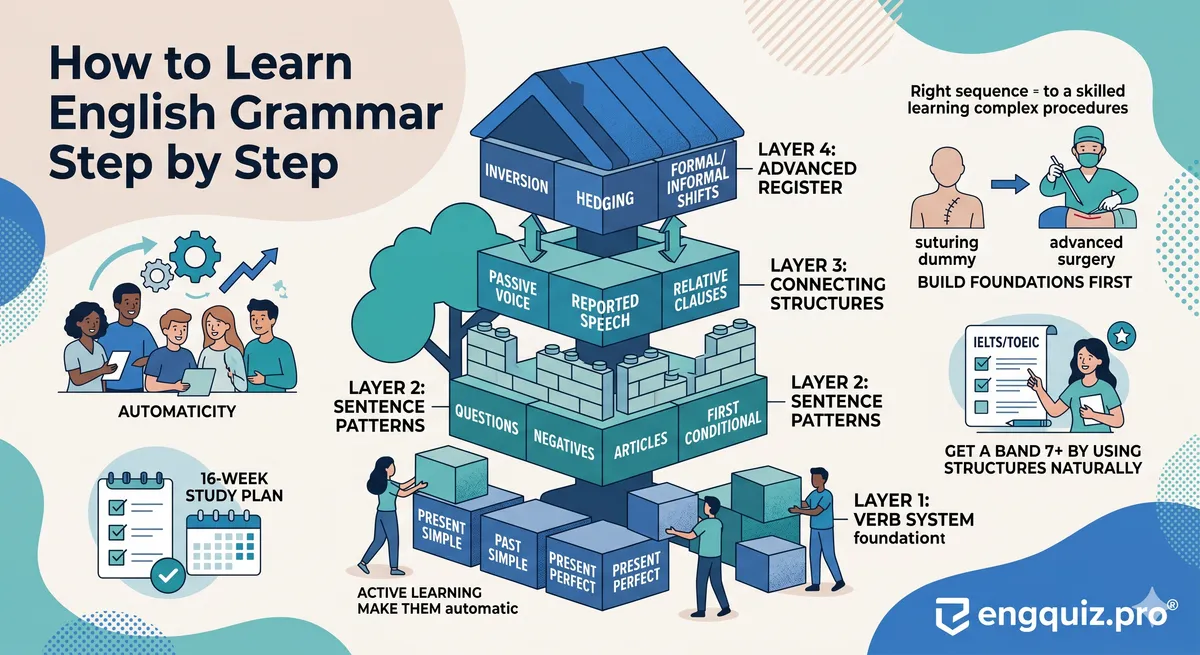
The problem with how most people study grammar
Grammar doesn't get hard because it's complex. It gets hard because most learners study it in the wrong order, trying to build the roof before the walls are up. If you are coming back to English as an adult - returning to grammar study after years away - see English Grammar Lessons for Adults for the experience-specific challenges that come with that path.
Quick answer: Learn English grammar in four layers, in order: (1) the verb system (present simple, past simple, present perfect), (2) sentence patterns (questions, negatives, articles), (3) connecting structures (conditionals, relative clauses, reported speech), and (4) advanced register (inversion, hedging, formal/informal shifts). Each layer must be automatic before the next will stick. Skip a layer and the ones above it collapse under pressure.
Why order matters more than effort
Surgeons don't learn surgery by reading anatomy textbooks and then walking into an operating theatre. They learn it in a very specific order: anatomy first, then basic suturing on a dummy, then laparoscopic skills in a simulator, then assisting on real procedures, then operating with a senior surgeon watching. Every stage requires the previous one to be automatic - not just understood, but automatic. If the suturing isn't fast and reliable, the more complex procedures become dangerous.
Grammar works exactly the same way. The intermediate learner who jumps directly to the subjunctive mood before they reliably own basic tense formation is walking into the operating theatre before they can suture. They can describe the structure on paper. They cannot use it correctly under the pressure of real speech.
The step-by-step approach isn't about going slowly. It's about knowing which step you're on and staying there until it's automatic, before moving to the next one.
The four-layer step-by-step framework
Layer 1: Own your verb system before anything else
English verbs are the skeleton of every sentence. Before you touch anything else, you need three tenses to be automatic: present simple, past simple, and present perfect. These three handle roughly 80% of everything you will say in daily life. (If terms like subject, clause, or tense are still fuzzy, skim the key grammar concepts reference first. Ten minutes there makes every layer below easier to follow.)
- She finishes work at six and takes the last bus home. (present simple: habits and routines)
- The client called twice yesterday but nobody picked up. (past simple: completed, specific past events)
- I've already sent the invoice - it should be in your inbox. (present perfect: past action, present relevance)
The learner mistake at this layer: jumping to continuous and perfect continuous forms before present perfect is automatic. Continuous forms feel more advanced, so ambitious learners rush toward them. But you cannot build reliable instinct for aspect on top of a shaky foundation. If you're still choosing between past simple and present perfect slowly, in your head, mid-sentence, that's your signal to stay in Layer 1 a while longer.
Test for readiness: Can you switch between these three tenses in speech (not in writing, in speech) without pausing to think? If yes, move on. (If you're not sure where you stand on Layer 1, the grammar and can-do checklist in what A2 English looks like in practice is a clear external anchor: Layer 1 mastery roughly equals the end of A2.)
Layer 2: High-frequency structures before elegant ones
Once your verb system is stable, prioritise the structures that appear in almost every conversation: first conditional, second conditional, passive voice, and reported speech. These are not advanced structures. They are everyday structures. Most learners treat them as advanced because they appear late in grammar books. But that's a publishing decision, not a frequency decision.
- If the connection drops, the session will end automatically. (first conditional: real and likely)
- If I had more context, I'd be able to give you a better answer. (second conditional: hypothetical)
- The report was submitted before the deadline. (passive: focus on the action, not the actor)
- She said she'd call back by Thursday. (reported speech: extremely common in professional contexts)
The learner mistake at this layer: textbooks often present all four conditional types in the same chapter because they share a grammatical family. This makes learners think first and third conditionals have equal priority. They don't. First conditional appears in virtually every workplace conversation. Third conditional appears occasionally, in reflection and speculation. A B1 learner who postpones the third conditional for six months loses nothing. A B1 learner who doesn't own the first conditional is immediately limited.
Test for readiness: Write three conditional sentences without thinking about the rule, just about what you want to say. If the grammar arrives automatically, you're ready for Layer 3.
Layer 3: Understand the system, not just the rule
After you have functional command of the high-frequency structures, go back and understand why each one works the way it does. This is the layer where you stop memorising and start understanding.
Why is present perfect incompatible with "yesterday"? Because "yesterday" pins an event to a specific point in time, and present perfect specifically refuses to be pinned. Present perfect says: this happened at some point before now, and the result is still relevant. "Yesterday" says: this happened at that specific moment. These two signals cannot coexist in the same clause. "I've finished it yesterday" breaks the rule at the level of meaning, not just grammar.
Why does second conditional use past tense to talk about the present? Because English past tense has two jobs: marking time (what happened before now) and marking distance from reality (what is hypothetical or unlikely). In second conditional, past tense does the second job. "If I knew the answer" is not past time. It's present hypothetical distance.
Understanding the logic turns rules you've memorised into patterns you feel. When you feel a pattern, you catch your own errors before they leave your mouth.
The learner mistake at this layer: trying to do this work before you have production experience. If you attempt Layer 3 before you can produce the structures in speech, the logic stays theoretical. Theory without reps is like knowing how a jump shot works without ever touching a basketball. Read the system explanation, but confirm it against sentences you've already produced, not against sentences on a page.
Layer 4: Target your personal error clusters
At every stage, you will make errors, but not random ones. Your errors will cluster around specific structures that your first language influences, your level, and your exposure gaps. Identify your clusters and target them specifically.
A Vietnamese speaker will have different persistent errors from a German speaker. Article use, tense selection, and prepositions are the classic trouble zones for learners from article-free languages. Subject-verb agreement and word order are more common trouble zones for learners whose languages have freer word order. A one-size-fits-all grammar curriculum is often too slow in your strong areas and too fast in the areas you actually need.
The practical method: take any piece of writing you produced last week and identify every grammar choice you made. Mark the ones you made automatically (good: that structure is consolidating). Mark the ones you made deliberately (this structure needs more reps). Mark the ones you got wrong (this structure needs more understanding). Your next study session targets the deliberate and wrong ones, not the whole grammar syllabus.
The learner mistake at this layer: treating all grammar errors as equally important. "He go to work" (missing third-person -s) signals much lower proficiency than an occasional article omission. Prioritise errors by the signal they send and how frequently they appear, not by the order they appear in a textbook.
How this maps to IELTS, TOEIC, and CEFR
IELTS Writing Task 2: Grammar Range and Accuracy (GRA) is assessed on two dimensions: how varied your structures are and how accurately you use them. A Band 5 writer uses simple structures accurately: short sentences, basic tenses, simple conditionals. A Band 7 writer uses complex structures naturally: passive voice to vary focus, second conditional to discuss hypothetical arguments, relative clauses to pack information into fewer sentences. The critical word is naturally. Examiners can hear when a learner is performing complexity rather than using it. Learners who follow the step-by-step sequence tend to reach Band 7 more reliably than those who jump to complex structures before they own the foundations.
Band 5 example: "If we reduce pollution, the air will be better and people will be healthier." Band 7 example: "If governments invested in public transport infrastructure, urban air quality would improve significantly and the health burden on public hospitals would fall in proportion."
Both use conditional structures. The Band 7 version uses the structure to make a specific argument, embeds a relative idea in the second clause, and uses vocabulary with precision. That's what Layer 3 and Layer 4 work produces.
TOEIC Listening and Reading: TOEIC rewards structure recognition over production, but the preparation that transfers best is the same: own the high-frequency structures before moving to less common patterns. Part 5 (incomplete sentences) regularly tests tense selection, subject-verb agreement, and connector use. These are Layer 1 and Layer 2 content. A test-taker who has automated these structures answers Part 5 in seconds. One who still reasons through them consciously runs out of time.
CEFR progression: The jump from B1 to B2 is primarily a grammar jump. At B1, you can handle familiar situations with reliable simple structures. At B2, you can sustain complex arguments with varied grammatical forms across extended turns. The four-layer framework maps directly onto this jump: Layers 1–2 get you to solid B1; Layers 3–4 carry you through to B2. Learners who try to jump straight to B2 complexity without B1 accuracy typically plateau: they produce ambitious structures with persistent basic errors, which CEFR descriptors still place at B1.
The traps that keep learners stuck
Trap: The completionist trap
Feeling that you must finish a whole grammar book before you're "allowed" to use a structure in real conversation. Example: "I'm still on Unit 14 of my grammar book, so I'm not ready to use conditionals yet." Fix: Grammar books are reference tools, not training sequences. Move through the layers by what you can produce automatically, not by what page you've reached.
Trap: The accuracy trap
Prioritising accuracy in isolation from speed: producing correct grammar only in writing exercises and never under conversational pressure. Example: A learner scores 95% on gap-fill exercises but collapses into simple past for everything the moment they have to speak in real time. Fix: Accuracy under time pressure is a different skill from accuracy on paper. Once a structure is correct in writing, drill it in spoken production (short answer drills, retelling short stories, timed written responses) until the accuracy survives the pressure.
Trap: The grammar-as-content trap
Spending study time reading about grammar instead of producing language. Example: A learner reads a full chapter on passive voice, closes the book, and writes zero passive sentences before the next session. Fix: Each grammar chapter should end with at least ten sentences you produce yourself, not a quiz on someone else's sentences. Writing your own sentences forces you to make real choices. Marking textbook answers forces you to recognise pre-made choices. These are not the same skill.
Trap: The translation test
Using conscious translation from your first language as your method for forming sentences. Example: You're forming a sentence by first constructing it in your L1, translating word-by-word, and then adjusting. Fix: If you're still translating mentally to form a structure, that structure is not yet consolidated, regardless of how accurate the output is. Real consolidation means you can produce the structure without conscious translation. Use this as your personal readiness test: translation happening = stay at this layer. No translation = ready to move.
Five exercises to start today
Exercise 1 - Layer 1 audit
Write 8 sentences about your current job, project, or daily situation. Use a mix of present simple, past simple, and present perfect. Read them back. Did you avoid any of the three? The one you avoided is your Layer 1 target this week.
Exercise 2 - Layer 1 transformation drill
Rewrite each sentence in all three tenses:
- The team submits the report on Friday.
- She explains the process to new staff.
(Present simple → past simple → present perfect for each.)
Exercise 3 - Layer 2 conditional production
Without looking at any rules, write three sentences:
- One about something likely to happen at work or home (first conditional)
- One about an imaginary change in your life (second conditional)
- One about a situation you wish had gone differently (third conditional)
If the third conditional took more than 30 seconds to form, that's your Layer 2 priority.
Exercise 4 - Error spotting
What is wrong with each sentence?
- If I would study more, I will pass the exam.
- She's living in this city since five years.
- The presentation was very successfully.
- I have seen him yesterday at the conference.
Exercise 5 - Personal error audit
Find the last email or message you wrote in English. Identify two grammar choices you made consciously (not automatically). Those two structures are your Layer 3 targets. Go back and understand why they work the way they do.
Answers - Exercise 4:
- "If I would study" → "If I studied". Second conditional requires if + past simple, not if + would. "Would" belongs only in the result clause.
- "since five years" → "for five years". Since marks a specific starting point (since 2019). For marks a duration (for five years). Five years is a duration, not a point in time.
- "very successfully" → "very successful". After the verb was, you need a predicate adjective (successful), not an adverb (successfully). Adverbs modify verbs and adjectives; they don't follow linking verbs.
- "I have seen him yesterday" → "I saw him yesterday". Yesterday fixes the event to a specific past time. Present perfect is incompatible with specific time references. Use past simple.
Remember this
You don't learn grammar step by step by following someone else's sequence. You learn it by knowing which step you're on, and refusing to leave it until it's automatic.
Your 16-week study plan (the four layers, week by week)
Use this as a printable starting point. Each layer takes ~4 weeks at 30–45 min/day. Adjust dosages, not order.
| Week | Layer | Grammar focus | Daily action (~30 min) |
|---|---|---|---|
| 1 | 1 (Foundation) | Present simple, articles, personal pronouns | One present-simple gap-fill + 5 journal sentences in present simple. |
| 2 | 1 | Past simple (regular + 50 most common irregulars) | Five past simple sentences about yesterday + an irregular-verbs drill. |
| 3 | 1 | Basic question forms (Yes/No + Wh-) | Write three Wh-questions about a news article you just read. |
| 4 | 1 - Review | Mixed Layer 1 self-check | Take a free A2 level test and confirm 80%+ score. |
| 5 | 2 (Aspect) | Present continuous vs present simple | Two short paragraphs: one about your routine, one about right now. |
| 6 | 2 | Present perfect (vs past simple) | Five sentences with since / for; compare with the past-simple version. |
| 7 | 2 | Past continuous + past perfect | Rewrite a short news article switching the tense framework. |
| 8 | 2 - Review | Self-assessment + retake A2/B1 level test | Mark which Layer-2 structures are still effortful. |
| 9 | 3 - Subordination | Conditionals (zero, first, second) | Three sentences per conditional; mix with class topics. |
| 10 | 3 | Third + mixed conditionals; modal verbs of speculation | Rewrite five past-simple sentences as third-conditional speculations. |
| 11 | 3 | Relative clauses (defining vs non-defining) | Combine ten short sentences using relative clauses; check comma placement. |
| 12 | 3 - Review | Passive voice and reported speech | Convert a short dialogue to reported speech; transform five active sentences to passive. |
| 13 | 4 - Register | Formal connectors, nominalisation | Rewrite five informal sentences in formal register. |
| 14 | 4 | IELTS-level structures | Write one 250-word IELTS Task 2 essay. |
| 15 | 4 | Inversion, cleft sentences, emphatic structures | Rewrite ten sentences with stylistic variation. |
| 16 | 4 - Final review | Take the calibrated 30-question CEFR test | Compare with your starting score; identify the gap. |
Download the printable PDF. Get the 16-week study plan as a PDF with daily checkboxes: print it, stick it on the fridge, tick off each week as you go. Copying the table into Notion or a notebook works too; the rewrite-it-by-hand step is itself part of the learning.
If you want the rationale behind the four-layer sequencing (corpora, references, and the CEFR mapping), see our methodology page.
Frequently Asked Questions
Start with Layer 1 (present simple, articles, basic question forms, and personal pronouns) until you can use all of them in a 60-second self-introduction without thinking. The CEFR descriptors call this A1–A2 range. Trying to learn the present perfect or modal verbs before this layer is solid is the single most common reason learners stall at B1 for years.
Use a behavioural test, not a calendar. You are ready to move up when (a) you can use every structure from the current layer in spontaneous writing without checking, and (b) you can identify your own errors after writing without anyone pointing them out. For most learners this is 100–200 hours per layer; for fast learners with daily practice, 80; for occasional learners, 300+. Don't move up before the behavioural test is passing.
No. Skipping is the most expensive shortcut in language learning. Every higher layer assumes the lower one is automatic. If you skip Layer 2 (perfect aspect, modal verbs) and try to study Layer 3 (passive voice, reported speech, conditionals), the higher structures collapse because they depend on tenses you haven't internalised. The boredom is a sign you are close to mastery, not a sign you should move on.
That is the most common imbalance, and the fix is to add structured production drills. For every grammar topic you study, write five sentences from your own life, then say them out loud to a recording app, then play them back. Production-from-memory closes the writing-to-speaking gap faster than any amount of new input.
No, but you need feedback. The sequence works in self-study if you use grammar exercises with instant feedback, keep a written journal that you review weekly, and use a language-exchange partner or AI tool for production checks. A teacher accelerates the process but is not a prerequisite: the prerequisite is feedback on your output, however you get it.
New Articles

How to Embed a Free English Grammar Quiz on Your Website (WordPress, Google Sites, Moodle)
Step-by-step instructions for adding a free, interactive English grammar quiz to WordPress, Google Sites, Moodle, or any page that accepts HTML. No plugin, no sign-up, no ads.
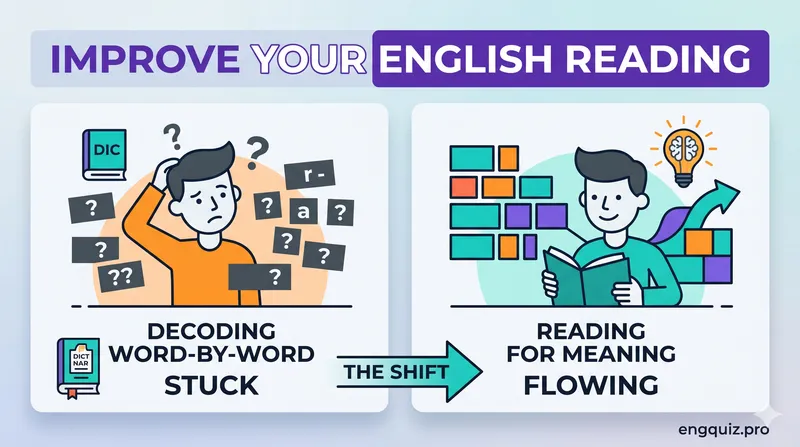
How to Improve English Reading and Actually Understand It
Why the level of the text you choose matters more than the hours you put in, and five exercises that build reading comprehension.
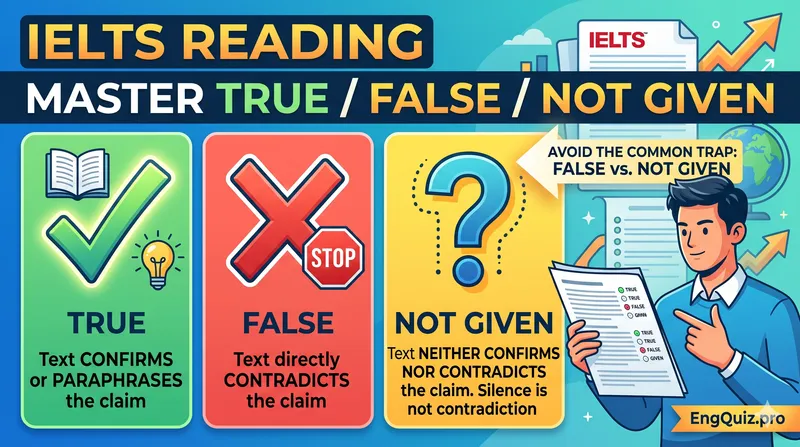
IELTS Reading: How to Master True/False/Not Given
True/False/Not Given is the most-failed IELTS Reading task. Learn the one rule that fixes it, and practise free on real B2/C1 passages with instant feedback.
Related Articles
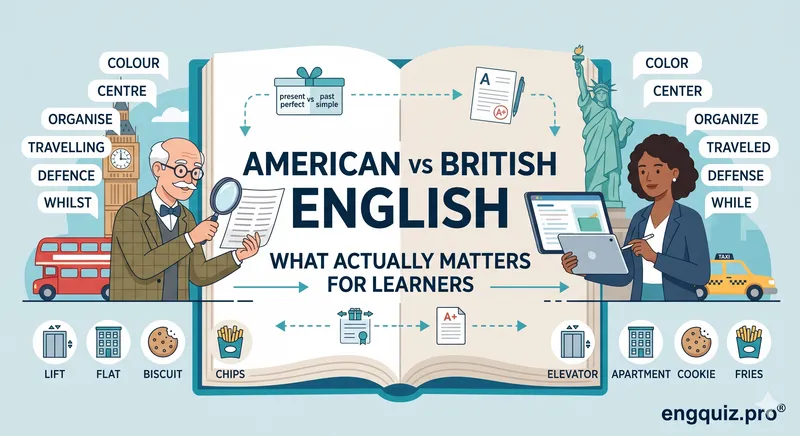
American vs British English: What Actually Matters for Learners
Spelling, vocabulary, or grammar: which differences between American and British English actually affect your exam score, and what can you safely ignore?
English Grammar Lessons for Adults: 5 Lessons That Make Patterns Stick
Five English grammar lessons for adults: how to use grammar books, the tense system, articles, prepositions, and an error-correction method that helps patterns stick.