Word Formation in English: The Complete Guide (A2-C1)
Word formation in English explained: affixation, compounding, conversion and internal change, plus how each type maps to CEFR levels A2 to C1.
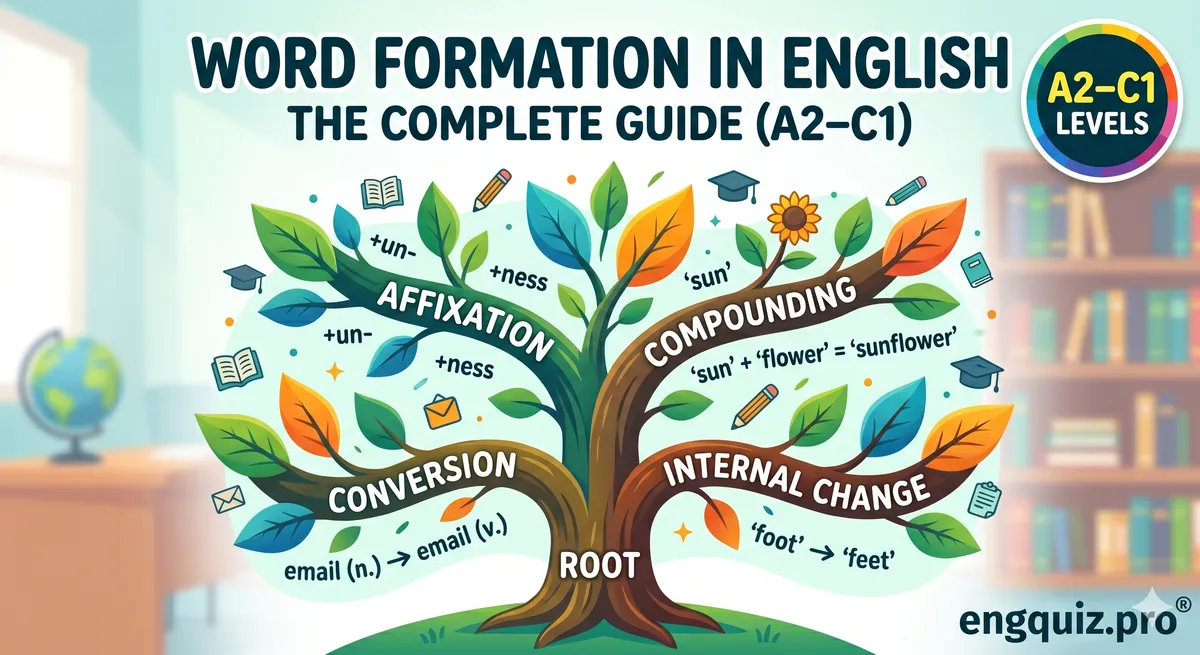
Four mechanisms, not four thousand words
English does not invent new words very often. Instead, it builds them by snapping prefixes, suffixes, other words, or whole grammatical roles onto a small core of roots. Word formation in English is the name for that assembly system, and once you can see it working, the dictionary stops being a list and starts being a kit of parts.
Quick answer: Word formation in English is how a small set of root words multiplies into thousands of related forms. Four mechanisms do almost all of the work: affixation (adding prefixes and suffixes), compounding (joining words), conversion (using one word as a different part of speech), and internal change (altering vowels or stress). Learn the system and you stop memorising words one by one.
The complete cluster
This guide is the hub of a focused series on word formation. The two highest-priority deep dives come next; the rest of the cluster will follow as the series builds out. Bookmark this page and the links will appear here as each post goes live.
- You are here: Word Formation in English - The Complete Guide (A2–C1)
- Common English Prefixes: The 25 You Must Know (A2–B1, in progress)
- English Suffixes: Form Nouns, Adjectives, Verbs and Adverbs (A2–B1, in progress)
What word formation actually means
Open a dictionary at organise. Around it sits a small constellation: organisation, organiser, organised, disorganise, disorganisation, reorganise, reorganisation. Eight words built from one root. None of them had to be invented from scratch; English assembled them from a kit of parts.
That kit, and the rules for using it, is what word formation means. It is the engine that lets a learner who knows two thousand root words actually recognise eight or ten thousand word forms in real reading and listening, and produce a good fraction of them in writing and speech.
The reason this matters is practical. Every major English exam, including Cambridge B2 First, IELTS, and TOEIC, implicitly or explicitly tests the same skill: given a root, can you produce the right form for the slot? Vocabulary lists alone don't get you there. Pattern recognition does.
The good news is that the system is small. Four mechanisms account for the overwhelming majority of new words English makes, and the rest of this guide takes each one in turn.
The four mechanisms at a glance
| Mechanism | What it does | Example |
|---|---|---|
| Affixation | Adds a prefix or suffix to a root | happy → unhappy, happiness |
| Compounding | Joins two existing words | tooth + brush → toothbrush |
| Conversion | Reuses a word as a different part of speech | email (noun) → to email (verb) |
| Internal change | Changes a vowel or stress | foot → feet; PROduce (n.) → proDUCE (v.) |
Affixation is by far the most productive of the four. It is responsible for tens of thousands of English word forms. Compounding is next. Conversion and internal change are smaller, but they cover some of the highest-frequency words in the language. We'll move through them in that order.
1. Affixation: prefixes and suffixes
Affixation has two halves. A prefix attaches to the front of a root; a suffix attaches to the back. The root keeps its core meaning, and the affix modifies it or redirects its grammatical class.
Prefixes change meaning
Prefixes almost never change the part of speech; they change the meaning. The most common functions are:
- Negation: un-, dis-, in-/im-/il-/ir-, non- → unhappy, dishonest, impossible, irregular, non-stop
- Reversal: un-, de- → unlock, defrost, decode
- Repetition: re- → rewrite, reconsider, rebuild
- Degree: over-, under-, super-, hyper- → overcook, undersleep, supermarket, hyperactive
- Time: pre-, post-, ex- → preview, postpone, ex-husband
- Position: sub-, inter-, trans- → subway, international, transatlantic
One thing that catches learners out: the negative prefixes in- / im- / il- / ir- are not interchangeable. The variant depends on the first sound of the root. In- sits in front of most consonants and vowels, but English assimilates it before /p, b, m/ (impossible, imbalance, immature), /l/ (illegal, illogical), and /r/ (irregular, irrelevant). The rule is phonetic, not a list to memorise word by word.
This is also the engine behind one of the most common Use-of-English traps: word formation negative prefix exercises. Half of B2 First Part 3 transformations require you to add both a suffix and a negative prefix in the same gap.
Suffixes change part of speech
A suffix usually does the opposite of a prefix: it leaves the meaning intact and changes the grammatical class.
| Suffix family | Common suffixes | Example |
|---|---|---|
| Noun-forming | -tion, -ment, -ness, -ity, -ance/-ence, -ship, -age | develop → development; happy → happiness |
| Adjective-forming | -ful, -less, -able/-ible, -ive, -ous, -al, -ic | care → careful; act → active; danger → dangerous |
| Adverb-forming | -ly (with -ic → -ically) | quick → quickly; basic → basically |
| Verb-forming | -ise/-ize, -en, -ify, -ate | modern → modernise; short → shorten; class → classify |
This single insight, that suffixes change the word class, is the key to every exam question that gives you a root in capitals and asks you to fit the right form into a gap. The slot in the sentence tells you what class is needed; the suffix supplies it.
A quick illustration. Look at the gap-fill:
Her _________ to the team has been remarkable. (CONTRIBUTE)
The slot is the object of a possessive, so it needs a noun. The verb contribute takes the noun suffix -tion. Answer: contribution. You did not need to know the word; you needed to know that -tion turns this verb into its noun form.
That move (read the slot, choose the class, apply the suffix) is the entire skill behind Cambridge B2 First Part 3. It's also the difference between memorising and generating English vocabulary.
Word formation rules: stacking prefixes and suffixes
The trick that catches learners (including B2 candidates on the Cambridge exam) is when a single root takes both a prefix and a suffix in the same transformation. These are the word formation rules that drive the highest-marks transformations:
- success → successful → unsuccessful
- predict → predictable → unpredictable → unpredictability
- responsible → responsibility → irresponsibility
The longest of those is six syllables, all from a single Latin root. Once you can decompose a word like irresponsibility into ir- + respons- + -ible + -ity, the dictionary stops being a list of words and becomes a list of roots: far smaller, and far easier to learn.
This stacking effect is also what people mean by double transformation word formation. On the FCE Part 3, candidates who only add a suffix when a prefix is also needed lose half the marks. Always ask: does the surrounding sentence imply a negative meaning?
2. Compounding: words made of words
A compound is two existing words bolted together to name one new thing. Toothbrush is the brush for teeth, not a brush made of teeth. Greenhouse is a glass building for plants, not a house painted green. Headquarters is the central office of an organisation, not a quarter of a head.
Compounds in English come in three written forms, and the form is largely unpredictable, which is what makes them tricky for learners:
- One word: toothbrush, weekend, software, deadline, framework
- Hyphenated: mother-in-law, well-being, e-commerce, long-term
- Two words: swimming pool, post office, ice cream, climate change
There is no fully reliable rule for which compound takes which form. The strongest pattern is age: very old compounds are usually one word (weekend, sunset, breakfast), and newer compounds often start as two words, hyphenate as they become familiar, then fuse into one once they're standard (e-mail → email; web-site → website).
What is predictable is the stress. In a compound noun, the primary stress sits on the first element:
- BLACKbird (a species of bird) vs a black BIRD (any black-coloured bird)
- GREENhouse (for growing plants) vs a green HOUSE (a house painted green)
- the WHITE House (compound, the building in Washington) vs a white HOUSE (a house that happens to be white)
This stress rule is one of the cleanest spoken-English signals you can pick up. If you hear stress on the first noun, the speaker is treating the two words as a single concept, a single named thing.
Compounding is also the productivity engine behind business and academic English. Deadline, workforce, headquarters, feedback, takeaway, breakthrough, drawback, outcome, benchmark, framework: every one of these started as two words and fused. They make up a quarter of every TOEIC business reading passage.
3. Conversion: same word, new job
Conversion (sometimes called zero-derivation) is the cheapest way to make a new word: you don't add anything. You just use the existing word as a different part of speech.
- email (noun): I sent you an email.
- email (verb): I'll email you tomorrow.
English is unusually productive with conversion compared to most other European languages. It's the reason nouns become verbs almost overnight: to google, to text, to friend, to ghost, to onboard. Each one started life as a noun (or as a non-verb) and was conscripted as a verb because English has no morphological objection.
The four most common conversion paths:
- Noun → verb: bottle → to bottle; mail → to mail; access → to access; impact → to impact
- Verb → noun: to walk → a walk; to call → a call; to try → a try; to drive → a drive
- Adjective → verb: empty → to empty; clean → to clean; calm → to calm; warm → to warm
- Adjective → noun: the rich, the poor, the unemployed, the young (always with the and always plural in meaning)
Conversion is invisible in writing, since the spelling doesn't change. But in speech, the part-of-speech change is sometimes marked by stress. That brings us to the last mechanism.
4. Internal change: vowel and stress shifts
Internal change is the least productive of the four mechanisms today, but it explains some of the highest-frequency forms in English. The two main types are vowel change and stress shift.
Vowel change (ablaut)
A small but high-frequency group of nouns and verbs change their vowel instead of taking a suffix:
- foot → feet
- man → men
- mouse → mice
- sing → sang → sung
- write → wrote → written
- speak → spoke → spoken
These are residues from older stages of the language. They look irregular today, but they aren't random; they once followed patterns that have since faded from the surface.
For learners, the takeaway is small but firm: a handful of high-frequency nouns and most strong verbs sit outside the suffix system entirely. They have to be learned as families (sing/sang/sung), not constructed.
For broader context on irregular verb patterns, see the Rules of English Grammar hub.
Stress shift
When a word does double duty as both a noun and a verb, English often marks the difference with stress alone: no spelling change, no suffix.
| Spelling | Noun (stress on 1st syllable) | Verb (stress on 2nd syllable) |
|---|---|---|
| record | a REcord | to reCORD |
| present | a PREsent | to preSENT |
| object | an OBject | to obJECT |
| produce | the PROduce | to proDUCE |
| import | the IMport | to imPORT |
| conflict | a CONflict | to conFLICT |
| permit | a PERmit | to perMIT |
Native speakers do this without thinking. Learners who only meet the written form often miss it, and then sound oddly flat when they read aloud. If you're preparing for IELTS Speaking, try recording yourself reading the noun and verb versions of each row above. The first time you hear the difference in your own voice, the pattern locks in.
Word formation by CEFR level
Different levels of the Common European Framework expect different mastery of the system. The progression looks like this.
A2: basic affixation and high-frequency compounds
At A2, learners need to recognise the most common suffixes (-er for people: teacher, worker, driver; -ly for adverbs: quickly, slowly; -ful/-less for adjectives: helpful, useless) and the everyday compound nouns of daily life (classroom, weekend, toothbrush, swimming pool).
The A2 word formation exercise set on EngQuiz Pro focuses exactly here: choosing the right common form when the root is given.
Practise: A2 Word Formation Gap Fill
B1: productive suffixes and word families
At B1, learners shift from recognising affixes to producing them. A B1 candidate is expected to take a root and generate the noun, verb, adjective, and adverb forms, at least for high-frequency families. Some classic word formation examples at this level:
- manage → management → manager → manageable → manageably
- succeed → success → successful → successfully
- create → creation → creator → creative → creatively
- decide → decision → decisive → decisively
This is the foundation of word-family work, and it's where Cambridge B2 First quietly begins testing. The trick at B1 is to stop learning one word at a time and start learning the whole family in one go.
B2: negative prefixes and the FCE Part 3 standard
B2 is where the Cambridge B2 First Use of English Part 3 task lives: eight gaps, eight transformations, eight different word forms produced from given roots. Roughly half the tested transformations involve a prefix change as well as a suffix change (success → unsuccessful; agree → disagreement). The other half rely on knowing the productive academic and workplace word families.
The same skill drives TOEIC Part 5. In TOEIC, you're given four options that share a root (e.g. active / activate / activity / actively) and you choose the form that fits the grammatical slot.
Practise: B2 Workplace Word Families Gap Fill. For broader exam strategy, see TOEIC Grammar Practice.
C1: nominalisation and academic register
At C1, word formation crosses from vocabulary into style. The signature C1 move is nominalisation: turning verbs and adjectives into noun phrases to compress information and sound more formal.
- The government decided. becomes The government's decision …
- The economy grew rapidly. becomes The rapid growth of the economy …
- It is significant that prices rose. becomes The significance of the price rise …
This is the move that separates a Band 7 IELTS Writing Task 2 essay from a Band 6 one. The underlying grammar can be identical; the nominalisation makes the writing sound academic.
Practise: C1 Nominalisation Gap Fill. For IELTS writing register more broadly, see Academic Vocabulary for IELTS Writing.
Common learner mistakes
Mistake 1: Wrong word class in the slot
Her explain was confusing.→ Her explanation was confusing.
The slot needs a noun (preceded by the possessive her). Explain is a verb. Adding -ation gives the noun form. The fix is not about meaning; it's about reading the slot.
Mistake 2: Right suffix family, wrong ending
independance→ independence
The Latin root -pend- takes -ence, not -ance. These endings are not freely chosen; they're locked to the etymology. Difference, evidence, presence, confidence all take -ence. Resistance, importance, distance, performance all take -ance. Native speakers don't reason this out, but learners need to verify when in doubt.
Mistake 3: Stacking the wrong negative prefix
disrational, unlegal, dispossible→ irrational, illegal, impossible
Negation prefixes are not interchangeable. The variant is determined by the first sound of the root (see the prefixes section above). When you have a choice, the phonetic rule wins.
Mistake 4: Missing the double transformation
successful → not successful→ successful → unsuccessful
On the FCE Part 3 and on TOEIC Part 5, candidates who add only a suffix when a prefix is also needed lose half the marks. Always check whether the sentence around the gap implies a negative meaning. Phrases like despite his hard work, however, or unfortunately are common signals.
Mistake 5: Verb in a slot that wants a nominalisation
We decided quickly, and this surprised everyone. (perfectly grammatical, Band 6 feel) Our quick decision surprised everyone. (Band 7 feel)
Both are correct. The second is shorter, denser, and sounds more formal, which is what C1 writing rewards. Nominalisation isn't always the right move (over-use makes prose unreadable), but knowing when to reach for it is part of word-formation mastery at the top of the scale.
Where to practise next
Word formation is best learned in dense, mixed practice: flipping between affix types and word classes until the right form comes out automatically. The exercises below are the best places to start at each level:
- A2: the Word Formation Gap Fill set for recognising basic suffixes and common forms.
- B2: the Workplace Word Families practice for full noun/verb/adjective/adverb production at FCE-level vocabulary.
- C1: the Nominalisation practice set for converting verbs and adjectives into formal noun phrases.
If you're preparing for a specific exam, see TOEIC Grammar Practice and Academic Vocabulary for IELTS Writing for adjacent strategy material.
For the broader grammar context, see the hub at Rules of English Grammar. If you're not sure which CEFR level you're at, take the free CEFR level test first.
Frequently Asked Questions
Word formation is the system English uses to build new words from existing ones. There are four main mechanisms: affixation (adding prefixes and suffixes), compounding (joining words), conversion (changing part of speech without changing the form), and internal change (changing a vowel or stress). Together they let a learner who knows the root create generate dozens of related forms, including creation, creator, creative, creatively, recreate, uncreative, and more.
Because vocabulary lists alone don't scale. A learner who knows 2,000 roots and the word-formation system can recognise and produce roughly 10,000 word forms. A learner who memorises words one at a time will never reach the same coverage. On exams, the difference shows up immediately: B2 First Use of English Part 3, IELTS Lexical Resource, and TOEIC Part 5 all test whether the right form comes to mind for the slot, not whether you know the dictionary entry.
Prefixes attach to the front of a root and modify the meaning: happy → unhappy (negation), do → redo (repetition). They almost never change the part of speech. Suffixes attach to the end of a root and usually do change the part of speech: happy (adjective) → happiness (noun) → happily (adverb). The same root can take both: un- + predict + -able + -ity → unpredictability.
(1) Affixation: adding a prefix or suffix; the most productive type. (2) Compounding: joining two existing words to name one thing, like toothbrush or swimming pool. (3) Conversion: using a word in a new part of speech without changing its form, like the noun email becoming the verb to email. (4) Internal change: changing a vowel (foot → feet) or shifting stress to mark a noun/verb pair (RECord vs reCORD).
B2 First Use of English Part 3 tests primarily affixation, both prefixation and suffixation, often combined in the same gap. The eight gaps usually include one or two double-transformations (suffix + negative prefix, e.g. success → unsuccessful) and several productive word-family transformations from the workplace and academic vocabulary range. Compounding and conversion appear occasionally but are not the focus.
Three habits, in order. (1) Stop learning words in isolation; learn the family. When you meet develop, learn development, developer, developed, undeveloped, redevelop at the same time. (2) Practise in production, not just recognition. Reading prefixes in a list doesn't lock them in; filling in gaps under time pressure does. (3) Pay attention to the slot, not the meaning, in exam tasks: the grammatical slot tells you what class of word you need; the root supplies the meaning.
New Articles

How to Embed a Free English Grammar Quiz on Your Website (WordPress, Google Sites, Moodle)
Step-by-step instructions for adding a free, interactive English grammar quiz to WordPress, Google Sites, Moodle, or any page that accepts HTML. No plugin, no sign-up, no ads.
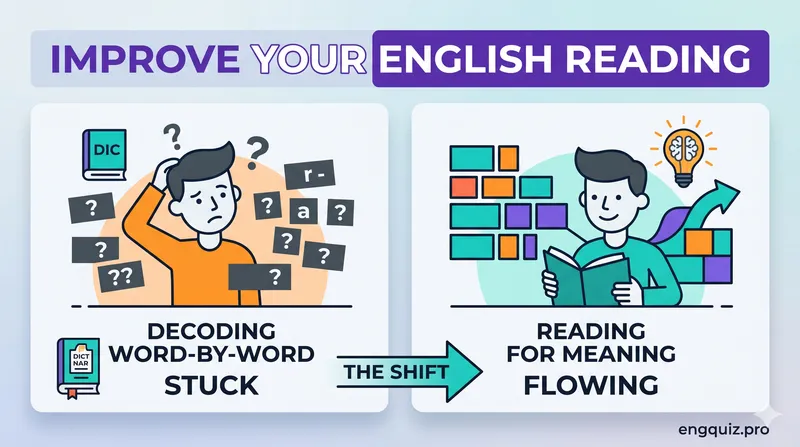
How to Improve English Reading and Actually Understand It
Why the level of the text you choose matters more than the hours you put in, and five exercises that build reading comprehension.
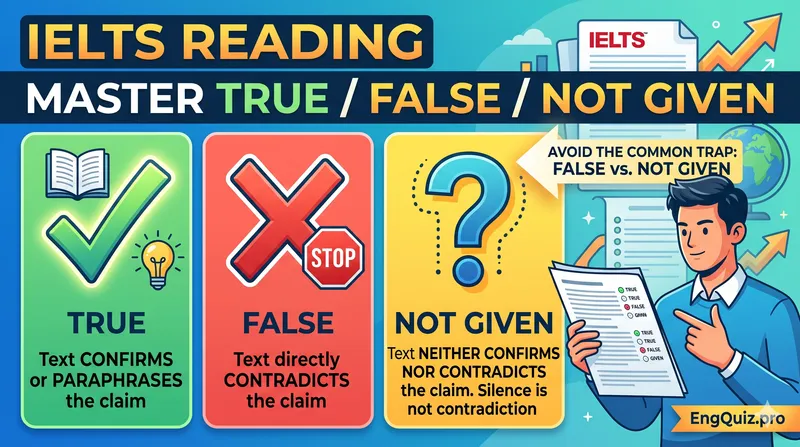
IELTS Reading: How to Master True/False/Not Given
True/False/Not Given is the most-failed IELTS Reading task. Learn the one rule that fixes it, and practise free on real B2/C1 passages with instant feedback.
Related Articles
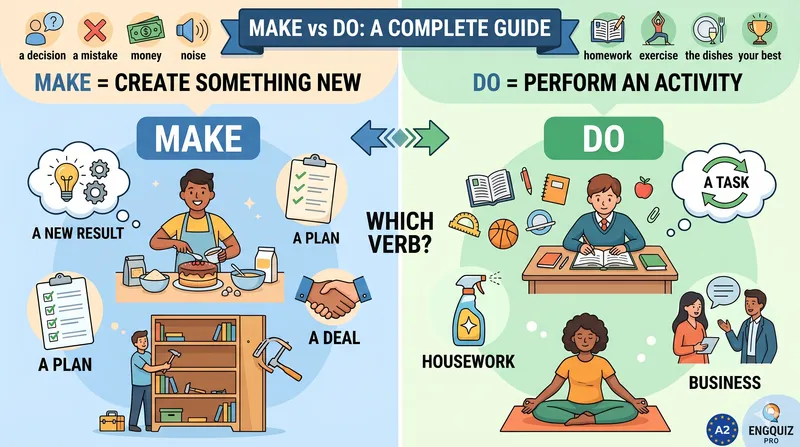
Make or Do: Complete Guide + 60 Collocations (A2-B1)
Make or do? Use make for creating something new; use do for tasks, work and activities. Includes full collocation lists, examples and a practice quiz.

20 Essential Business English Phrasal Verbs (With Examples)
Business English phrasal verbs you will hear every day in meetings, emails, and calls. Learn the 20 most important ones with real workplace examples.